
Ciudad Acuña, Mexico: Border Logistics, Maquiladoras, and Business Safety

Situated directly across the Rio Grande from Del Rio, Texas, Ciudad Acuña serves as a vital manufacturing and cross-border logistics gateway in northern Coahuila. Anchored by the maquiladora export model under Mexico's IMMEX framework, the city plays an integral role in North American automotive, aerospace, and electrical equipment supply chains. While international attention often focuses on border security, Acuña operates within Coahuila's distinct security framework, offering lower violent crime metrics than central and eastern border corridors. This analysis reviews the city's export economy, trade infrastructure, demographic labor base, and operational considerations for executives, freight operators, and those traveling to Mexico for business.
Table of Contents
- Strategic Location and Industrial Profile of Ciudad Acuña
- Cross-Border Logistics and the Del Rio Port of Entry
- Economic Indicators and Maquiladora Manufacturing Data
- Demographics, Labor Pool, and Industrial Parks
- Safety Profile, Operational Risk, and Travel Advisory Analysis
- Nearshoring Expansion and Infrastructure Projects
- Frequently Asked Questions About Ciudad Acuña
Strategic Location and Industrial Profile of Ciudad Acuña
Ciudad Acuña is the municipal seat of Acuña Municipality in the northern reaches of the Mexican state of Coahuila. Founded originally in 1877 as Garza Galán and later renamed in honor of the Coahuilan poet Manuel Acuña, the municipality evolved from an agricultural and pastoral border outpost into an advanced industrial center during the latter half of the twentieth century. The pivotal turning point occurred with the implementation of the National Border Program (PRONAF) in the 1960s, which paved the way for Mexico's maquiladora industry.
Today, Acuña functions as a dedicated manufacturing platform designed specifically for co-production with the United States. Rather than serving primarily as a high-density transit corridor for retail consumer imports, the city specializes in high-mix, precision contract manufacturing. Raw materials and components enter under temporary import programs, undergo assembly or advanced fabrication in local industrial parks, and are re-exported into U.S. industrial supply lines. Its direct pairing with Del Rio, Texas, affords immediate access to U.S. Highway 90 and Interstate 10, positioning Acuña as a strategic alternative to higher-congestion border crossings in Texas and Tamaulipas.
Cross-Border Logistics and the Del Rio Port of Entry
Cross-border movement in Acuña relies on two designated international crossings: the Del Rio–Ciudad Acuña International Bridge and the crossing atop the Amistad Dam. The primary international bridge handles commercial vehicular traffic, passenger cars, and pedestrians, featuring dedicated commercial lanes and inspection stations overseen by U.S. Customs and Border Protection (CBP) and Mexico's National Customs Agency (ANAM).
Commercial transit through Acuña presents distinct operational advantages compared to major commercial corridors such as Nuevo Laredo trade checkpoints. While Nuevo Laredo manages the highest volume of long-haul freight in North America, it also experiences chronic customs wait times and periodic logistical congestion. In contrast, the Del Rio–Acuña crossing is characterized by shorter commercial processing queues and direct transit routes to industrial zones, making it especially advantageous for just-in-time automotive and aerospace parts supply schedules.
Economic Indicators and Maquiladora Manufacturing Data
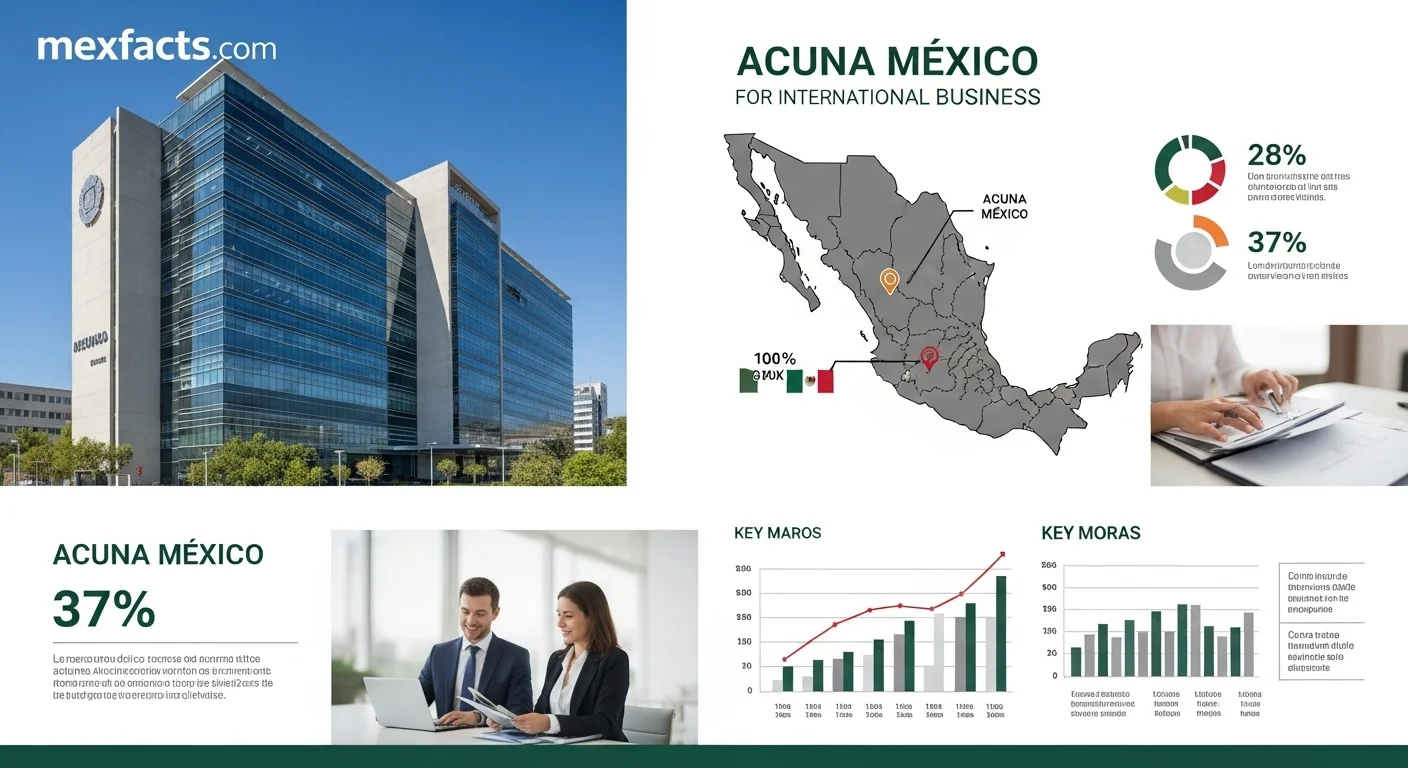
Data from Mexico's Secretariat of Economy (DataMéxico) and the National Institute of Statistics and Geography (INEGI) illustrates a concentrated export-driven economy. Ciudad Acuña generates more than $2.2 billion in annual international sales, driven overwhelmingly by intermediate and finished manufactured goods. Corresponding imports exceed $1.3 billion annually, consisting predominantly of raw plastics, specialized cabling, fasteners, and stampings routed directly to local assembly lines.
The city's industrial profile is concentrated within three primary sectors:
- Automotive and Commercial Transportation: The production of vehicle seating systems, brake systems, air-conditioning harnesses, and electronic control assemblies represents Acuña's largest economic output. Major global suppliers such as Bendix Commercial Vehicle Systems operate multiple facilities here, producing mission-critical safety and braking components for heavy-duty commercial trucks.
- Aerospace and Advanced Metallurgy: Tier-2 and Tier-3 aerospace suppliers produce structural fasteners, specialized components, and interior assemblies destined for commercial and military aircraft assembly lines across North America.
- Electrical Equipment and Medical Products: The local industrial ecosystem includes cleanroom facilities and assembly plants manufacturing industrial wiring systems, switches, and specialized personal protective and healthcare items.
Demographics, Labor Pool, and Industrial Parks
According to official census figures from INEGI, the municipality of Acuña is home to approximately 163,000 residents, with recent regional estimates placing the metropolitan labor shed around 172,000 inhabitants. The population distribution remains structurally young, with a median age under 30 years old, providing industrial employers with a dependable workforce for technical operations.
Industrial operations in Acuña are primarily clustered within master-planned developments, notably the Amistad Industrial Park and the Internacional Industrial Park. These developments provide foreign investors with Class A manufacturing space, substation-level electrical distribution, integrated wastewater treatment, and private security perimeters. Furthermore, technical institutions such as the Instituto Tecnológico Superior de Ciudad Acuña (ITSA) and local campuses of the Universidad Tecnológica de Coahuila provide specialized curricula in mechatronics, industrial logistics, and robotic manufacturing, helping sustain an engineering talent pipeline aligned with IMMEX operator demands.
Safety Profile, Operational Risk, and Travel Advisory Analysis
Corporate risk assessment requires separating generalized narratives regarding the Mexico-U.S. border from local municipal data. Ciudad Acuña benefits from the broader security architecture of Coahuila, a state that has pursued centralized policing and statewide intelligence coordination over the past decade. Unlike states along the Pacific coast or parts of northeastern Mexico, Coahuila is classified under the U.S. Department of State travel advisory system as Level 2: 'Exercise Increased Caution,' which is the same advisory tier assigned to major European travel hubs and peaceful Mexican states such as Yucatán and Quintana Roo.
Within Coahuila, the northern border cities maintain an integrated security corridor. When evaluating regional risk, enterprise planners frequently compare local conditions to Piedras Negras travel safety dynamics. Both cities report significantly lower homicide and violent crime rates than neighboring Tamaulipas or Chihuahua border hubs. Violent crime incidents in Acuña rarely involve international business travelers, corporate personnel, or registered cargo shipments, which transit securely between industrial parks and the international bridge.
Standard enterprise security practices remain recommended for travelers and visiting managers:
- Schedule border crossings during daylight hours through the Del Rio–Ciudad Acuña International Bridge.
- Avoid non-essential nighttime travel on isolated secondary rural highways, utilizing Mexico Federal Highway 2 (Carretera Ribereña) and Highway 29 exclusively during daylight.
- Utilize reputable corporate transport or prearranged executive transit when traveling between commercial airports (such as Del Rio International Airport or Piedras Negras International Airport) and local industrial facilities.
- Remain within designated commercial districts and industrial zones, avoiding marginalized peri-urban neighborhoods along the municipal periphery.
Nearshoring Expansion and Infrastructure Projects
The acceleration of nearshoring—the strategic relocation of manufacturing capacity from Asia to North America—has heightened industrial interest in Ciudad Acuña. Key operational drivers include compliance with rules of origin under the United States-Mexico-Canada Agreement (USMCA), risk reduction in maritime logistics, and reduced working capital cycles.
To support this next phase of industrial growth, regional authorities and binational stakeholders are advancing plans for the proposed Acuña II International Bridge (Puente Internacional Acuña II). This proposed second span would separate commercial freight traffic from non-commercial passenger transit, substantially expanding heavy-vehicle throughput and insulating local supply chains from customs delays. Concurrent infrastructure priorities include investments in regional electrical grid substations and potable water treatment to ensure long-term sustainability for high-consumption manufacturing plants.
Frequently Asked Questions About Ciudad Acuña
- Is Ciudad Acuña safe for business travelers and corporate site visits?
- Yes, provided travelers exercise standard situational caution. The U.S. State Department rates Coahuila as Level 2 ('Exercise Increased Caution'), and Acuña exhibits lower rates of violent crime compared to many other border municipalities. Business travel within industrial parks, commercial hotels, and primary corridors is routinely conducted without incident.
- What are the primary industries operating in Ciudad Acuña?
- Acuña's manufacturing base is dominated by automotive components (heavy-vehicle braking systems, electrical wiring harnesses, seating), aerospace parts, electrical machinery, and precision plastics.
- Which ports of entry connect Del Rio, Texas, and Ciudad Acuña?
- The primary crossing is the Del Rio–Ciudad Acuña International Bridge, which handles passenger vehicles, pedestrians, and commercial cargo. The Amistad Dam International Crossing also connects the two jurisdictions for non-commercial vehicular traffic.
- How does Ciudad Acuña compare to other border manufacturing cities?
- Acuña offers lower commercial border wait times and a stable security environment compared to high-volume border crossings, making it attractive for specialized, medium-to-large scale industrial operations requiring consistent cross-border delivery schedules.
Expert Reviews
Michael Chen, Supply Chain Director ⭐⭐⭐⭐⭐
As someone who manages logistics across the US-Mexico border, this article was a fantastic read. It cuts through the noise and gets to the heart of why Acuña is so critical. The insights on the local industry and the balanced take on safety were incredibly helpful for my team's planning.
Sofia Garcia, Former Expat Engineer ⭐⭐⭐⭐⭐
I lived in Acuña for two years working on a project for an automotive company. This article truly captures the spirit of the city! It's a place of hard work and opportunity. I always felt welcomed and safe in the community. It’s great to see a piece that focuses on the positive reality of business and life there.
Robert Peterson, Investor ⭐⭐⭐⭐⭐
We were considering Northern Mexico for a new facility, and this guide to Acuña provided the clarity we needed. It addresses the 'is it safe' question head-on with data, not fear, which we appreciated. The breakdown of the economic landscape and future opportunities helped solidify our decision.