
The Mexican Caribbean and Cancún: Economics, Infrastructure, and Tourism Growth
Cancún and the Mexican Caribbean represent one of the most successful master-planned economic developments in modern Latin America. Conceived in the late 1960s by Banco de México economists and developed under FONATUR, the territory evolved from a remote barrier island into an economic engine that today generates over thirty percent of Mexico's international tourism revenue. Beyond its world-famous beaches, the destination anchors the economy of Quintana Roo, supports hundreds of thousands of jobs, and drives sustained multi-billion-dollar investments across aviation, hospitality, and regional rail transit.
Table of Contents
- The Genesis of Cancún: Master Planning and Regional Transformation
- The Resort Hospitality Ecosystem and Economic Multipliers
- Transportation and Aviation Logistics: The Movement of Millions
- Cancún by the Numbers: Passenger Volume, Occupancy, and State GDP
- Real Estate Dynamics and Capital Reinvestment
- Infrastructure Catalysts: The Tren Maya and Regional Integration
- Economic Diversification and Environmental Resilience
- Frequently Asked Questions About the Mexican Caribbean Economy
The Genesis of Cancún: Master Planning and Regional Transformation
Many travelers view Cancún purely as a tropical vacation hotspot, yet its existence is the result of deliberate macroeconomic engineering. In 1968, economists at the Banco de México led by Ernesto Fernández Hurtado and Enrique Savignac initiated an analytical study to identify new sources of foreign exchange, stimulate regional employment, and diversify the national economy away from heavy reliance on manufacturing and crude oil.
Using early computer algorithms and statistical modeling, the team evaluated coastline across the republic against rigorous criteria: average rainfall, water temperature, beach bathymetry, hurricane frequency, and potential access to international flight corridors. The computer models singled out a narrow, uninhabited barrier island on the northeast tip of the Yucatán Peninsula—then inhabited by only a few dozen residents and coconut plantation workers. The Mexican government created the infrastructure trust fund INFRATUR (which merged into FONATUR in 1974) to execute the country's first Centro Integralmente Planeado (Integrally Planned Center).
Construction began in 1970 under challenging conditions, carving out access roads, potable water plants, power grids, and an international airport out of dense jungle and mangrove wetlands. The strategic gamble reshaped the geopolitical map of southeastern Mexico: the demographic and financial influx was so rapid that it propelled Quintana Roo from an underdeveloped federal territory into a fully recognized sovereign Mexican state in October 1974.
The Resort Hospitality Ecosystem and Economic Multipliers
The core engine of this economic model resides along the 21-kilometer sandbar known as the Cancún Hotel Zone, extending north into Costa Mujeres and south along the coastal corridor. Over five decades, the resort ecosystem has shifted from modest motor inns to massive luxury complexes and sophisticated all-inclusive properties operating as self-contained micro-cities.
The business mechanics of the all-inclusive model—championed by major Spanish, Mexican, and North American hospitality chains—rely on high inventory volumes and integrated operations. A large resort property encompassing 500 to 1,000 rooms requires round-the-clock coordination among front-office staff, culinary brigades, housekeeping, facility engineers, and security teams. This framework creates substantial direct payrolls while generating extensive local and regional supply chains. Regional farms in Yucatán and Campeche supply poultry, produce, and citrus; regional transport companies move cargo; and commercial maintenance contractors handle frequent post-season refurbishments.
Furthermore, consumer demand for all-inclusive resort packages allows hotel operators to maintain predictable cash flows and high forward-booking visibility, stabilizing the local economy even through international economic cycles.
Transportation and Aviation Logistics: The Movement of Millions
A destination of this magnitude requires an advanced logistics network. The foundational component is Cancún International Airport (CUN), privatized in 1998 under Grupo Aeroportuario del Sureste (ASUR). Operating across four passenger terminals and handling flights from dozens of global airlines, CUN serves as the gateway not only to Cancún but to the entire Mexican Caribbean.
The airport acts as the central distribution node for regional ground transportation. High volumes of arriving international travelers require prompt, regulated ground transfers to disperse safely across hundreds of hotels spanning the hotel zone, Puerto Juárez, and Federal Highway 307 south toward the Riviera Maya and Tulum. Licensed private shuttle operators, shared hotel vans, and luxury transport fleets coordinate flight tracking and terminal dispatch, serving as an indispensable operational link that protects destination satisfaction and maintains fluid passenger turnover.
Cancún by the Numbers: Passenger Volume, Occupancy, and State GDP
The statistical profile of Cancún highlights its indispensable contribution to both Quintana Roo and Mexico's national accounts. Data from the Mexican Ministry of Tourism (SECTUR), ASUR, and the Quintana Roo Tourism Promotion Council (CPTQ) demonstrate the sheer scale of the destination:
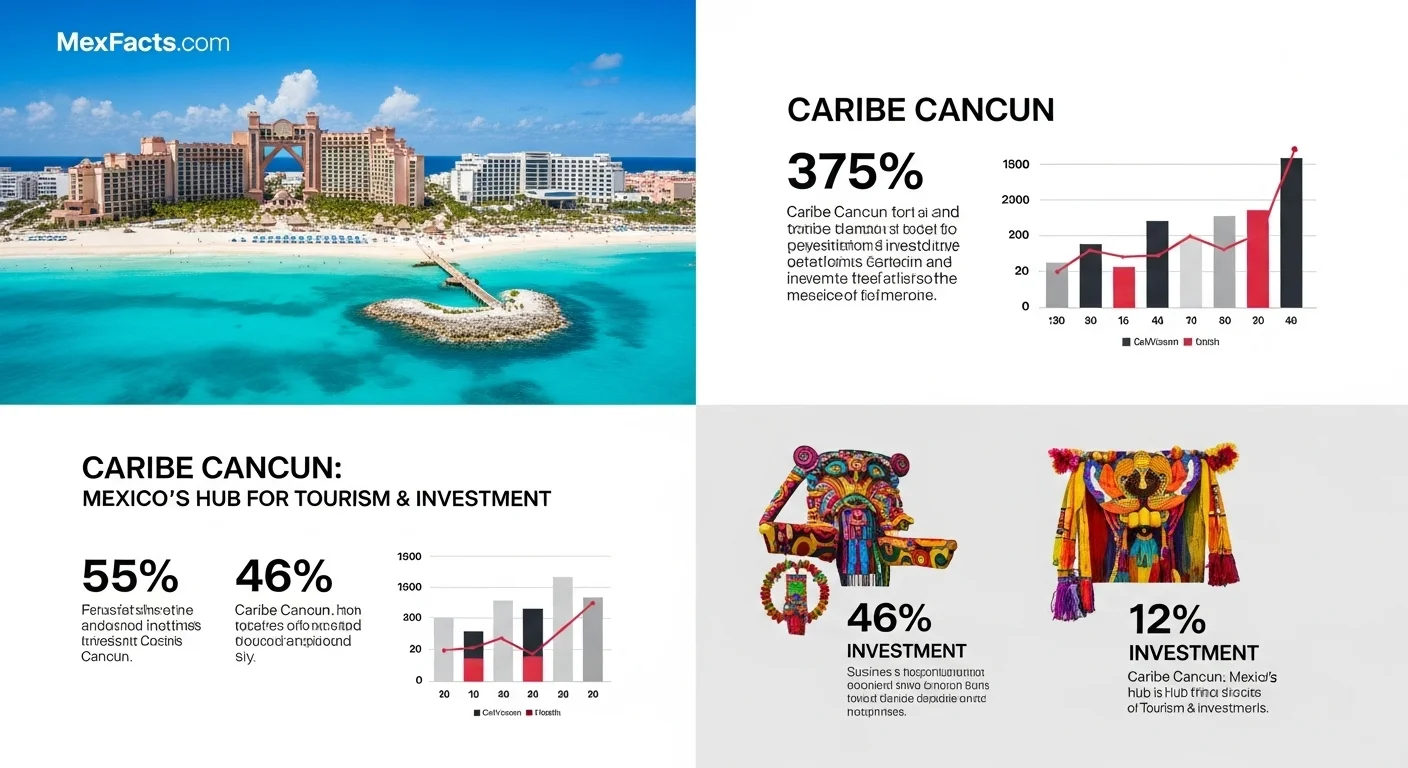
- Aviation Traffic: Cancún International Airport consistently manages more than 30 to 32 million commercial passenger movements annually, establishing it as Mexico's second busiest airport overall and the undisputed leader for international visitor arrivals nationwide.
- Hotel Occupancy Performance: Despite having over 40,000 hotel rooms in Cancún proper and more than 130,000 across Quintana Roo, average annual occupancy rates typically remain between 72% and 82%. During winter high season and peak spring periods, occupancy routinely exceeds 88%.
- State Economic Contribution: Tourism activity generates approximately 80% to 85% of Quintana Roo's Gross State Product (PIB estatal), making the state one of the most tourism-dependent economies in the Americas.
- Foreign Exchange Generation: The Mexican Caribbean is responsible for generating over $10 billion USD annually in visitor spending, representing more than 30% of Mexico's total national international tourism revenues (divisas turísticas).
- Labor Multiplier: Hospitality and leisure services provide direct employment for over 200,000 workers in the northern corridor of Quintana Roo. Economists estimate an indirect multiplier effect of 2.5 to 3.0, supporting auxiliary jobs in food production, freight transport, building maintenance, and retail commerce across the broader peninsula.
Real Estate Dynamics and Capital Reinvestment
Because prime beachfront real estate within the historic Cancún Hotel Zone is largely built out, investment has transitioned into redevelopment, brand repositioning, and geographical expansion. Institutional real estate investment trusts (FIBRAs) and international hotel conglomerates regularly allocate tens of millions of dollars to acquire older properties and overhaul them into modern luxury resorts.
This ongoing capital reinvestment elevates Average Daily Rates (ADR) and Revenue Per Available Room (RevPAR). Meanwhile, new development capital has pushed outward into emerging micro-destinations such as Costa Mujeres to the north and Puerto Cancún, where master-planned residential marinas, luxury condominiums, and golf communities cater to affluent second-home buyers and high-net-worth travelers.
Infrastructure Catalysts: The Tren Maya and Regional Integration
Regional connectivity in the Mexican Caribbean is entering an evolutionary phase driven by strategic federal infrastructure investments, chief among them the Tren Maya. Spanning approximately 1,554 kilometers across the states of Quintana Roo, Yucatán, Campeche, Tabasco, and Chiapas, the railway network features a central hub station adjacent to Cancún International Airport.
For the tourism economy, the Tren Maya is designed to dismantle the traditional single-resort vacation model. By linking the high-volume gateway of Cancún directly with archaeological sites like Chichén Itzá and Palenque, as well as colonial urban centers such as Mérida, the rail corridor encourages international visitors to spend deeper into the wider Yucatán Peninsula. For hospitality operators, this regional integration creates opportunities to package beach-and-culture itineraries, while the planned freight capacity of the line aims to lower supply-chain costs for regional goods flowing into the hotel zone.
Economic Diversification and Environmental Resilience
Sustaining Cancún's economic momentum over the next quarter-century requires addressing acute structural vulnerabilities. The monoculture of beach tourism makes the region sensitive to external shocks, climate phenomena, and shifting consumer preferences.
To mitigate this concentration risk, private and public leaders are expanding into higher-margin specialized sectors:
- MICE Tourism (Meetings, Incentives, Conferences, Exhibitions): Expanding convention center infrastructure to attract global corporate conventions and trade shows during historical shoulder seasons.
- Medical and Wellness Tourism: Capitalizing on modern private hospital networks in Cancún to provide elective medical, dental, and regenerative procedures at competitive price points for North American patients.
- Ecological Protection: Managing pelagic sargassum beach arrivals through barrier networks and collection logistics, alongside conservation of the Mesoamerican Barrier Reef System, which acts as a natural breakwater against coastal erosion.
The long-term viability of Cancún's economic miracle rests on this delicate equilibrium: balancing intense commercial development with rigorous environmental conservation, ensuring that the natural assets that made the destination possible remain resilient for future generations.
Frequently Asked Questions About the Mexican Caribbean Economy
Why was Cancún specifically chosen by the Mexican government for development?
In the late 1960s, Banco de México and INFRATUR used mathematical modeling to locate optimal coastal conditions for a brand-new resort city. Cancún was selected due to its stable tropical climate, calm turquoise waters protected by Isla Mujeres, white sand that does not retain heat, and proximity to major international aviation routes from North America.
How much of Mexico's tourism income comes from the Mexican Caribbean?
The Mexican Caribbean, led by Cancún and the Riviera Maya, generates more than thirty percent of Mexico's total foreign exchange revenue from international tourism. In Quintana Roo alone, tourism accounts for between 80% and 85% of the state's total economic output.
How important is Cancún International Airport to Mexican aviation?
Cancún International Airport (CUN) is Mexico's second busiest airport by overall passenger volume (handling over 30 million travelers annually) and ranks first in the nation for international passenger arrivals, outpacing Mexico City International Airport (AICM) in foreign leisure traffic.
What is the primary operational challenge facing resorts in Cancún?
Resorts balance high operating capacity with logistical hurdles, including seasonal sargassum seaweed management along shorelines, securing skilled hospitality labor in an expanding market, and navigating rising infrastructure demands for fresh water, energy distribution, and waste management.
Expert Reviews
Michael Chen, International Investor ⭐⭐⭐⭐⭐
As an investor looking into Latin American markets, this article was a fantastic starting point. It cut through the usual tourist fluff and gave me a solid understanding of Cancun's economic backbone and future potential, especially with the Tren Maya project. Very practical.
Sarah Jenkins, University Student ⭐⭐⭐⭐
I used this for a paper on tourism development, and it was invaluable. The explanation of FONATUR's role and the real-world examples of hotels like Riu helped me connect theory to practice. It’s well-written and easy to follow.
Gabriela Diaz, Travel Advisor ⭐⭐⭐⭐⭐
I've been sending clients to Cancun for years, but this gave me a much deeper appreciation for the region's complexity. Understanding the logistics and economic impact helps me explain the value of the destination better. A truly insightful read.