
The Soul of Mexico in Motion: A Journey Through Mexican Dance

Mexican dance, or *baile folklórico*, is so much more than movement; it's the heartbeat of our nation, a living storybook that carries centuries of history, faith, and regional pride in every step. I've spent my life immersed in these traditions, and I can tell you that to understand Mexico itself. This journey will take you from the ceremonial dances of our pre-Hispanic ancestors to the dramatic fusion that occurred under Spanish influence, and finally to its powerful role in forging our national identity after the Revolution. We'll explore the magic of iconic dances like the flirtatious Jarabe Tapatío and the wise, humorous Danza de los Viejitos. We'll also marvel at the incredible artistry of the traditional dress, a language all its own. But this is not just a story of the past. We'll look at how this cultural treasure fuels our economy today through tourism, supports entire communities of artisans, and opens doors for international business. This is a celebration of how folklore becomes a dynamic force, preserving our heritage while paving the way for the future.
- What is Mexican Dance and Why Does It Matter?
- The Living Economy of Mexican Dance: By the Numbers
- The Future Beat: Opportunities in Mexican Dance
What is Mexican Dance and Why Does It Matter?
The world of Mexican dance is a stunning tapestry woven from threads of vibrant color, powerful rhythms, and deep cultural stories. It’s not one single style but a beautiful mosaic of regional and indigenous traditions, each with its own soul, music, and distinct clothing. This art form, which we passionately call baile folklórico, is a living chronicle of Mexico's journey. I see it as a conversation between our Indigenous roots, the European influences that arrived centuries ago, and even echoes from Africa that have all shaped who we are. It’s more than just entertainment; it’s a pillar of our culture, a way to bind our communities together, and one of our proudest exports to the world. The story of Mexican folk dance history begins long before the Spanish ships ever reached our shores. For the great Mesoamerican civilizations like the Aztecs and Mayans, dance was a sacred act, woven into the very fabric of religious and social life. They danced to honor the gods, to celebrate the life-giving harvest, and to mark the great passages of life. The Spanish conquest in the 16th century was a cataclysmic shift. The colonizers saw many of these dances as pagan and tried to stamp them out. But you cannot simply erase the spirit of a people. While some official rituals were lost, the more popular, community dances survived. A fascinating process of syncretism began, where our ancestors cleverly blended their traditions with the new faith. They began dancing for the Virgin Mary and the saints, embedding their own worldview into a new context. This fusion gave birth to the mestizo (mixed-heritage) dances that are so iconic today. European forms like the waltz, polka, and fandango were also thrown into the mix, creating entirely new expressions of joy and courtship. This was the seed from which our national dances would grow. After we won our independence in the 19th century, a wave of nationalism swept the country. We looked to our folk traditions as a source of pride, a way to define ourselves as uniquely Mexican. The Jarabe, a courtship dance, became so tied to the spirit of freedom that it was renamed the Jarabe Mexicano and became a symbol of our new nation. This pride was rekindled with even greater force after the Mexican Revolution (1910-1920). Our government began a mission to celebrate our Indigenous and mestizo heritage, making folkloric dance a part of every child's education and inviting groups from all over the country to perform in the capital. This was the moment that truly solidified baile folklórico in the national consciousness. You can’t talk about the global impact of our dance without honoring the legendary Amalia Hernández. In 1952, she founded the Ballet Folklórico de México, a true cultural treasure. Amalia was a visionary. She took our raw, beautiful folk dances and polished them for the grand theater stage, blending them with ballet techniques and dazzling choreography. Her work took our stories to over 80 countries, and it was through her ballet that dances like the Jarabe Tapatío became beloved around the world. The costumes, the Mexican dance clothes, are just as important as the steps. Each outfit tells you a story about a region’s landscape, its history, its people. The famous traditional Mexican dance dress for the Jarabe Tapatío is the China Poblana. It’s a spectacular outfit with an embroidered blouse and a skirt glittering with sequins. Its legend is tied to Catarina de San Juan, a woman from India who lived in Puebla in the 17th century, whose distinct way of dressing became an inspiration. Over time, the skirt was adorned with patriotic symbols like our eagle and serpent, making it an icon of Mexican femininity. Her partner, in his dashing charro suit, represents a powerful ideal of Mexican masculinity. Another dance I hold dear is the Danza de los Viejitos (Dance of the Little Old Men) from my beloved state of Michoacán. It’s a pre-Hispanic ritual that originally honored the old god of fire. You see young men disguised in masks of smiling old men, moving slowly and hunched over. Then, suddenly, they burst into an energetic, foot-stomping zapateado, a humorous and powerful display of life and vitality. It’s a beautiful tribute to our elders and the enduring spirit of the Purépecha people. The world has taken notice. UNESCO has recognized several of our traditions, including the Ritual Ceremony of the Voladores ('flying men'), as Intangible Cultural Heritage of Humanity. When you witness this ancient fertility dance, primarily from the Totonac people of Veracruz, it’s an experience that stays with you forever. Five men climb a towering pole. Four of them, tied by ropes, launch themselves into the air, spinning gracefully to the ground while the fifth plays a flute and drum at the very top. It’s a breathtaking prayer for harmony with nature and the divine. In essence, Mexican dance is our history in motion. It's a story of resilience, fusion, and pride that continues to captivate hearts in Mexico and far beyond.
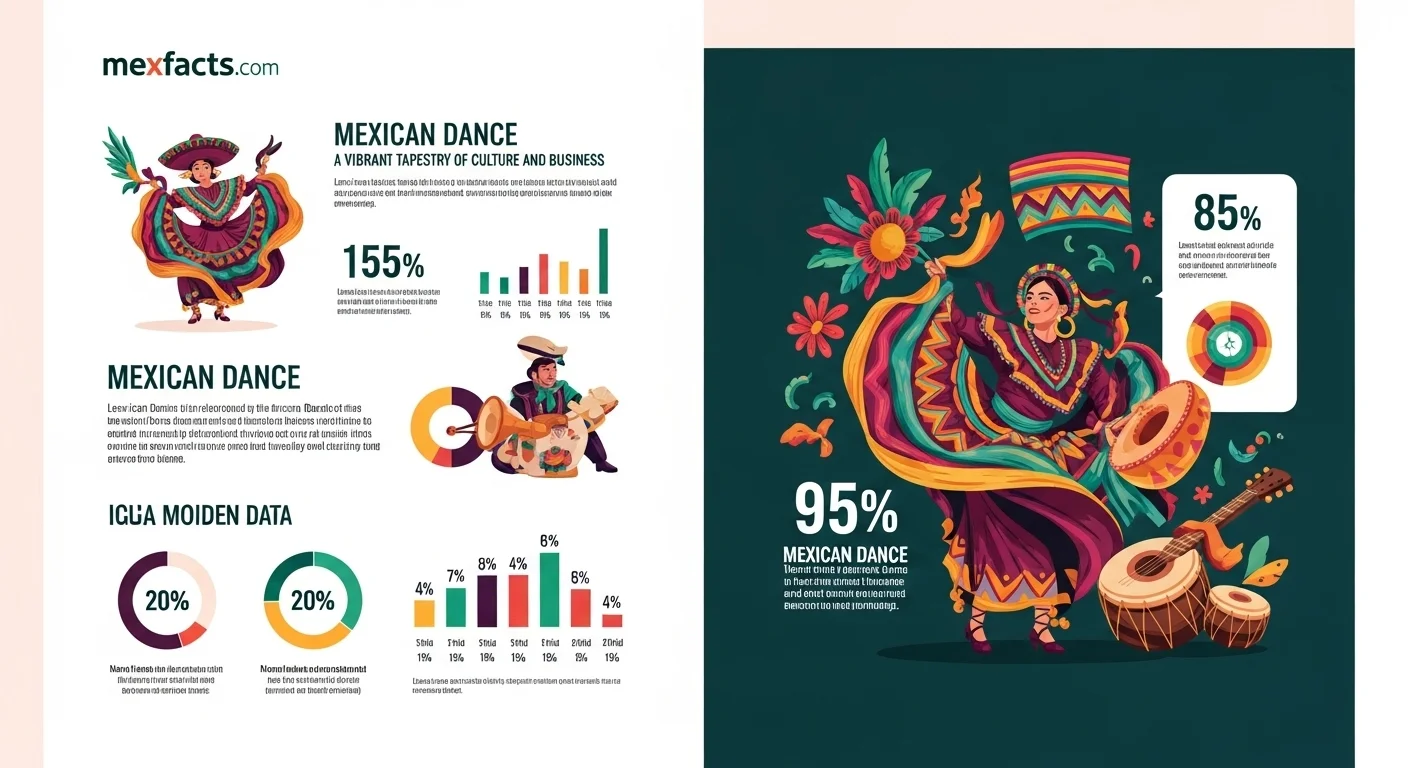
The Living Economy of Mexican Dance: By the Numbers
The cultural heartbeat of Mexican dance also powers a very real and tangible economy. When you look at the numbers, you start to see how this art form supports families and promotes our country. While it's hard to find one single statistic for the entire folk dance sector, we can see its incredible impact by looking at tourism, the artisan economy, and the sheer number of dance groups thriving at home and abroad. Tourism is where you see the most visible connection. I've seen countless international visitors who come to Mexico and have their first, magical encounter with baile folklórico at a resort, a historic plaza, or a grand theater. The Ballet Folklórico de México, performing for decades at the magnificent Palacio de Bellas Artes in Mexico City, is a cornerstone of our cultural tourism. It's not just a show; it's an institution that has enchanted over 45 million people worldwide. The revenue from tickets, combined with what those tourists spend on hotels, food, and souvenirs, is a significant boost to our economy. When UNESCO recognizes traditions like the Voladores ritual or Mariachi music (the soul-stirring accompaniment to dances like the Jarabe Tapatío), it's like a global seal of approval that attracts even more visitors. Our World Heritage Cities like Oaxaca, Puebla, and Guanajuato are vibrant hubs where you can experience authentic regional dances, especially during the joyous chaos of local festivals. The world of Mexican dance clothes and the iconic traditional Mexican dance dress is the lifeblood of our artisan economy. Creating these garments is a sacred craft, a skill passed down from mother to daughter, from father to son. It supports thousands of artisans—weavers, embroiderers, seamstresses—especially in our rural and indigenous communities. I've had the honor of visiting workshops where every stitch tells a story. The market for their work is huge. Dance troupes in Mexico and across the United States need a constant supply of these detailed costumes. But beyond that, there's a growing global appreciation for authentic, handmade Mexican textiles. High-fashion designers are now collaborating with artisans from places like Oaxaca and Chiapas, bringing their incredible work to the world's runways. This not only creates income but also raises the profile of these timeless crafts. The government has long recognized the power of folk dance. Since the Revolution, it has been promoted as a source of national pride, even becoming a required subject in our public schools. While funding can sometimes be a challenge for smaller, independent groups, there is a deep-rooted tradition of state support for preserving our culture. In Veracruz, for example, the government has supported university dance groups for decades to keep the Jarocho traditions alive and vibrant. The sheer number of folk dance groups is a testament to its enduring power. In Mexico, nearly every school, community center, and university has its own grupo folklórico. This passion has traveled with our people wherever they've gone. Across the United States, you'll find thousands of dance groups. For Mexican-American communities, these groups are vital cultural centers, helping to keep the heritage alive and connecting young people to their roots. I've seen groups in places like Chicago and Indianapolis that started with just a handful of dancers and have grown into large, professional companies performing at major events. They are true cultural ambassadors. The history of the dance itself shows this blend of tradition and formalization. When Amalia Hernández created her Ballet Folklórico, she transformed regional dances into a spectacular theatrical art form. She set a new standard, and her school has trained generations of professional dancers. In economic terms, this entire ecosystem is incredibly diverse. It includes ticket sales, dance classes, and workshops. It includes the entire supply chain for Mexican dance clothes, from the farmer growing the cotton to the artisan selling a finished dress. And it has a powerful ripple effect, strengthening our tourism industry and our international brand as a place of rich, living culture. While it's hard to put a single number on it, the evidence is all around us: Mexican dance is not just a relic of the past; it's a dynamic economic engine that sustains communities and shares the soul of Mexico with the world.
The Future Beat: Opportunities in Mexican Dance
Looking ahead, the future of Mexican dance is a thrilling dance in itself—a balance between preserving the sacredness of our traditions and embracing the opportunities of a connected, modern world. For anyone interested in culture, business, or investment, this landscape is filled with potential, but it must be navigated with respect and understanding. One of the most exciting frontiers is digital. Technology gives us powerful new ways to protect and share Mexican traditional dance. I dream of seeing high-quality digital archives with 3D motion capture of dance steps, virtual reality experiences that place you in the middle of a performance, and online encyclopedias detailing the meaning behind every dance and every piece of clothing. This not only safeguards our heritage but also creates new products for education and tourism. Imagine a student in Japan learning the zapateado from a master in Guadalajara through a virtual workshop, or a museum visitor using an app to understand the symbolism on a traditional Mexican dance dress. These are the tools that can bring our culture to an even wider audience. The global hunger for authentic cultural experiences and ethically made products is another huge opportunity. People want to buy things with a story, and believe me, the world of Mexican dance clothes is filled with incredible stories. Creating e-commerce platforms that connect our artisan communities directly with international buyers is a business model that is both profitable and profoundly impactful. It can ensure fair pay for the creators and give consumers access to authentic, beautiful work. I see a future where collaborations between our artisan groups and international designers become more common, celebrating our traditional dress on the world stage. Cultural tourism will, of course, remain a powerful engine. There is so much room to create more immersive travel experiences built around our Mexican folk dance history. Instead of just watching a show, imagine a tour that takes you to the very villages where these dances were born. You could visit an artisan's workshop to see how the costumes are made, take a dance class from the locals, and join a real fiesta where the dance is performed not for a stage, but for the community. This kind of sustainable tourism creates a deeper connection and ensures the economic benefits go directly to the people who are the keepers of the tradition. However, this promising future comes with challenges we must face with care. The biggest challenge is finding the right balance between commerce and authenticity. As our dances become more popular, there's a risk they can be simplified or stripped of their cultural context just to please a tourist audience. We must avoid this 'flattening' of our culture. The key is to develop business models where our own practitioners and communities are the primary decision-makers, guiding how their heritage is shared. Another challenge is making sure the economic benefits are shared fairly. While big city venues and famous companies might do well, we have to make sure that smaller regional groups and artisans in remote villages aren't left behind. We need to bridge the digital divide and help these communities connect to the global market. Lastly, we must be vigilant about cultural appropriation. As Mexican styles become trendy, we sometimes see our sacred designs used by big brands without any credit or compensation to the communities that created them. We need to champion intellectual property rights for traditional designs and lead a global conversation about what it means to engage with a culture respectfully. To any international investor or business person reading this, the opportunities are clear: sustainable tourism, ethical fashion, cultural technology, and supporting dance tours. But the key to success in Mexico is partnership. Our business culture is built on relationships, trust, and mutual respect. A patient, respectful approach will always be more successful than a purely transactional one. The future of Mexican dance is bright because its spirit is resilient. By using technology to preserve our stories, fostering business models that empower our people, and carefully navigating the path of commercialization, we can share this incredible cultural gift with the world in a way that is both profitable and profoundly respectful.
Expert Reviews
Sarah W., Traveler ⭐⭐⭐⭐⭐
I was planning a trip to Oaxaca and this article was a godsend. I knew about the food, but understanding the dances, like those in the Guelaguetza, gave my trip so much more meaning. I felt like I was seeing a story, not just a performance. Thank you!
Alejandro Cruz, Student ⭐⭐⭐⭐⭐
As a Mexican-American, I've always seen folkloric dance at family parties, but I never knew the deep history behind it. Learning about the China Poblana dress and the Danza de los Viejitos has connected me to my roots in a way I can't explain. This was beautifully written.
Chloe and Ben, Artisan Shop Owners ⭐⭐⭐⭐⭐
We run a small shop importing artisan goods from Mexico. This article provided incredible context on the importance of the costumes and the artisans who make them. It's helping us tell the story behind our products more authentically to our customers. A truly valuable resource.