
Accessible Playa del Carmen: Public Beaches, Mobility Routes, and Inclusive Travel

Playa del Carmen has become one of Mexico's foremost destinations for accessible and inclusive travel, offering adapted public beaches, a pedestrianized central corridor, and progressive local policies. While municipal investments at Playa Fundadores and Punta Esmeralda provide dedicated boardwalks and amphibious beach wheelchairs, navigating the Riviera Maya requires realistic preparation. This guide outlines step-free routes along Quinta Avenida, specialized airport transfers from Cancun, LGBTQ+ safety, and the essential questions to ask resorts before booking an accessible stay.
Table of Contents
- Accessible Public Beaches in Playa del Carmen
- Navigating Quinta Avenida and Downtown Streets
- Resort Accessibility: Verifying Room and Facility Features
- Accessible Airport Transfers and Local Transport
- LGBTQ+ and Broad Community Inclusivity
- Frequently Asked Questions
Accessible Public Beaches in Playa del Carmen
Coastal vacations often present serious mobility barriers, from soft sand that traps standard wheelchair wheels to steep dunes lacking ramps. In Playa del Carmen, municipal authorities and the local System for Integral Family Development (DIF) have addressed these hurdles by creating designated inclusive beach zones equipped with adapted infrastructure.
The most prominent accessible coastal area is Playa Fundadores, located directly south of the Cozumel ferry terminal and adjacent to the iconic Portal Maya sculpture. This beach features a permanent wooden boardwalk extending from the paved plaza toward the shoreline, allowing wheelchair users, parents with strollers, and visitors with limited mobility to traverse the sand without sinking. During scheduled daytime hours, municipal personnel oversee specialized amphibious wheelchairs (sillas anfibias), engineered with buoyant wheels and reclining seating to facilitate safe entry into the gentle Caribbean surf. Shaded palapas with firm wooden flooring, accessible changing rooms, and nearby dedicated parking spaces complete the setup.
Further north, Punta Esmeralda serves as a second accessible beach option. Known for the freshwater cenote stream that flows into the shallow coastal lagoon, Punta Esmeralda provides a barrier-free access ramp, wide boardwalk paths, and calm, low-energy water conditions that are especially gentle for visitors with balance concerns or mobility devices. However, beachgoers should verify daily conditions locally: high surf, tidal changes, and seasonal sargassum accumulation can temporarily restrict water entries, and municipal staff operating amphibious equipment typically follow specific daytime operating schedules.
Navigating Quinta Avenida and Downtown Streets
Playa del Carmen's primary commercial artery is Quinta Avenida (Fifth Avenue), a pedestrian thoroughfare running parallel to the beach for more than five kilometers. Because motorized vehicles are barred from the avenue, it serves as the town's most continuous step-free corridor for wheelchair users, power scooters, and travelers walking with assistive devices.
While Fifth Avenue is paved with interlocking stone pavers and smooth concrete slabs, navigating it involves several practical considerations:
- Pavement transitions and crowd density: The central pedestrian strip is largely flat, but cross-street intersections have uneven stone transitions. During the peak evening hours (between 6:00 PM and 10:00 PM), dense crowds and outdoor restaurant tables can restrict navigable lane widths.
- Cross-streets and side avenues: Moving off Quinta Avenida toward Tenth Avenue (Avenida 10) or toward the beach often involves steep drop-offs, broken sidewalks, missing curb ramps, or decorative cobblestones that can challenge manual wheelchairs.
- Beach access paths: Calle 2, Calle 4, Calle 6, and Calle 8 lead directly toward the ocean, but several dead-end in deep sand or uneven stairways without ramps. For reliable step-free beach access, travelers should enter via Avenida Juárez at Playa Fundadores or designated resort ramps.
Consult our comprehensive Playa del Carmen guide for detailed neighborhood layouts, seasonal climate advice, and municipal logistics.
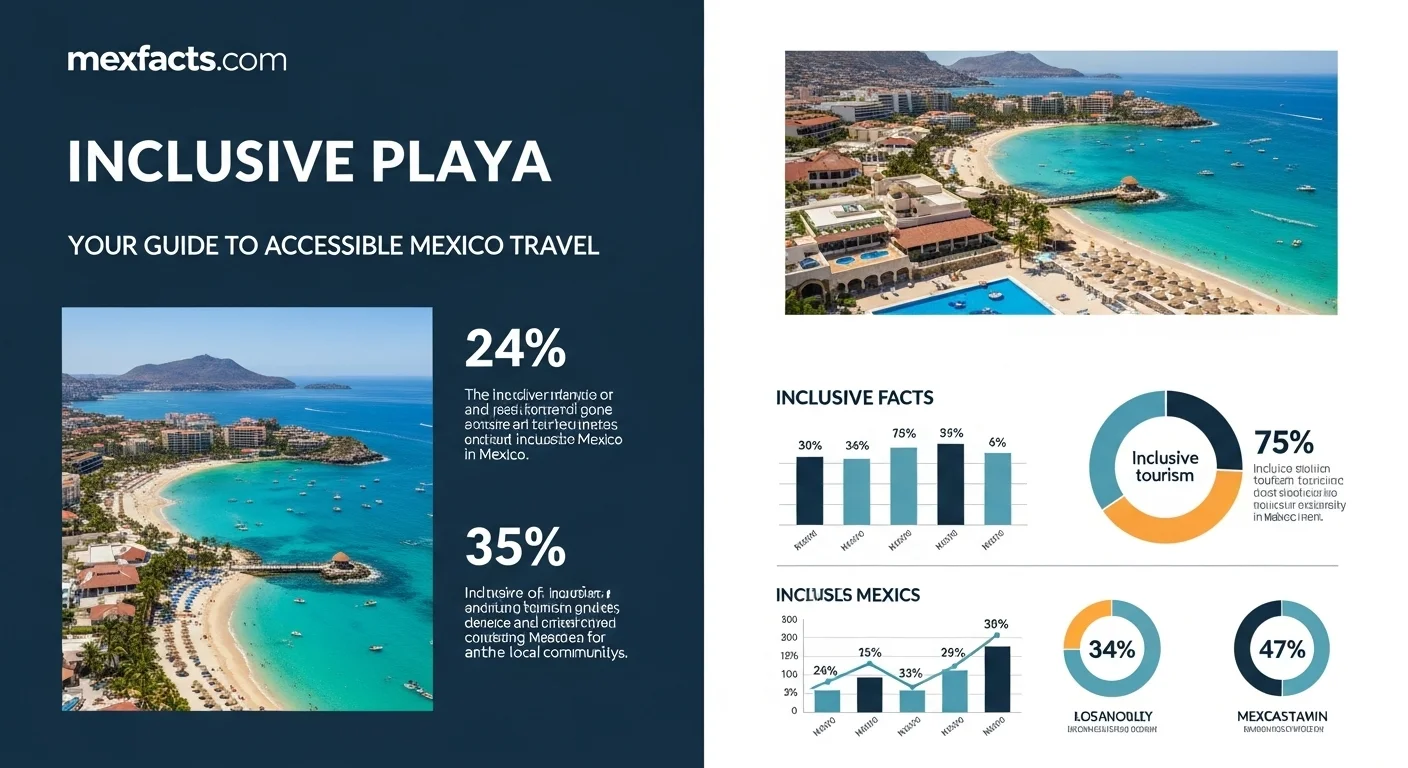
Resort Accessibility: Verifying Room and Facility Features
A frequent point of confusion among travelers is the distinction between commercial resort packages and verified physical accessibility. An all-inclusive stay guarantees bundled meals, beverages, and entertainment, but it does not guarantee that a property complies with international barrier-free design standards. While federal standards such as NOM-030-SSA3-2013 and NOM-001-SEDATU-2023 promote universal accessibility across public and commercial buildings in Mexico, implementation across private hotels ranges from state-of-the-art adapted suites to mere ground-floor rooms with minor modifications.
Leading resort properties in the Riviera Maya corridor—including the Fairmont Mayakoba, Grand Palladium Colonial, Hotel Xcaret Mexico, and Secrets Moxché—have invested in architectural modifications such as zero-threshold elevators, wide corridors, zero-entry lagoon pools, and paved pathways through garden complexes. However, travelers with disabilities should never rely on generic booking engine filters alone. Always contact the property's reservations management directly to confirm these specific architectural criteria in writing:
- Doorway clearances: Ensure entrance, bedroom, and bathroom doors measure at least 32 inches (81 cm) in clear width to accommodate standard and power wheelchairs.
- Bathroom mechanics: Confirm a genuine roll-in shower without a curb threshold, equipped with wall-anchored grab bars, a handheld shower wand, and an anchored or sturdy portable shower seat. Many properties label rooms "accessible" even when they feature a standard bathtub with a step-over rim.
- Pool and beach access: Ask whether swimming pools are equipped with zero-depth sloped ramps or functioning ADA-compliant hydraulic pool lifts. Inquire whether beach boardwalks extend to the water or terminate at elevated decks.
- Internal transportation: Large sprawling resorts often utilize golf carts or electric shuttles to transport guests between rooms, dining venues, and the beach. Verify whether the resort maintains adapted shuttles with ramps or flat boarding platforms.
For broader regional comparisons, review our overview of inclusive tourism Mexico initiatives across Quintana Roo and beyond.
Accessible Airport Transfers and Local Transport
Transportation logistics from Cancun International Airport (CUN) to Playa del Carmen require advance planning. The distance is roughly 55 kilometers (34 miles) down Federal Highway 307, taking approximately 45 to 60 minutes depending on traffic.
Standard airport taxis and shared shuttle vans parked outside airport terminals rarely feature hydraulic lifts or wheelchair docking systems. While drivers are generally willing to assist manual wheelchair users into standard passenger seats and fold the chair into the trunk, passengers who use heavy power wheelchairs or who cannot safely transfer must arrange specialized private adapted transport prior to flying. Several licensed private transport operators in Quintana Roo operate full-size vans fitted with rear wheelchair ramps, floor tie-down anchor tracks, and three-point safety restraints.
For independent travelers on a budget, ADO operates first-class express motorcoaches directly between Cancun Airport and the two central Playa del Carmen bus terminals (the Terminal Turística at Quinta Avenida and Avenida Juárez, and the Terminal Alterna on Avenida 20). These modern intercity coaches are air-conditioned and reliable, but boarding requires climbing three to four steep entry steps. Wheelchairs must be collapsed and stowed in the lower luggage hold during transit. Within downtown Playa del Carmen, local street taxis (taxis de sitio) are standard passenger sedans without accessible modifications.
LGBTQ+ and Broad Community Inclusivity
Beyond mobility infrastructure, inclusivity encompasses community safety, respect, and diversity. Playa del Carmen stands out as one of Mexico's most progressive and welcoming resort destinations for LGBTQ+ travelers. Quintana Roo became one of the first states in Mexico where same-sex marriages were legally performed in 2011 and 2012, based on the gender-neutral language of its civil code, long before federal nationwide mandates were formalized.
Unlike destinations where LGBTQ+ nightlife is sequestered in isolated quarters, Playa del Carmen's culture is thoroughly integrated into the broader fabric of the town. Same-sex couples and diverse families navigate Quinta Avenida, beach clubs, and dining establishments comfortably. Annual events such as Playa Pride in June celebrate diversity with civic marches and cultural gatherings along the coast. In addition, international festivals and local venues cultivate open-door policies that emphasize respect for all sexual orientations and gender identities.
This inclusive culture also extends to multi-generational travel and specialized dietary needs. According to the World Health Organization's Global Report on Health Equity for Persons with Disabilities, approximately 1.3 billion people—around 16% of the global population—experience significant disability, a proportion that expands rapidly as the world's traveling population ages. In response, Riviera Maya resorts have adapted by offering sensory-friendly zones, extensive gluten-free and plant-based kitchen certifications, and step-free communal areas designed so that grandparents, young children, and travelers with diverse needs can holiday together seamlessly.
Frequently Asked Questions
- Which beaches in Playa del Carmen have wheelchair ramps and amphibious chairs?
- Playa Fundadores and Punta Esmeralda are the two primary public beaches equipped with accessible infrastructure. Playa Fundadores features a solid wooden decking extending from Avenida Juárez and amphibious beach wheelchairs operated by DIF municipal personnel during daylight hours. Punta Esmeralda offers ramp access and calm water near a freshwater cenote outflow.
- Can I hail a wheelchair-accessible taxi at Cancun Airport on arrival?
- No. On-demand taxis at Cancun Airport terminals are standard sedans and unmodified passenger vans. If you require a vehicle with a hydraulic lift, ramp, and floor tie-downs, you must book a specialized accessible transfer service with a licensed Riviera Maya operator well in advance of your flight.
- Is Quinta Avenida easy to navigate in a manual or electric wheelchair?
- Yes, Fifth Avenue is a flat, pedestrian-only avenue paved with interlocking stones, making it the easiest route through central Playa del Carmen. However, side streets often have missing curb ramps, and the avenue can become crowded between 6:00 PM and 10:00 PM when restaurant seating expands onto the walkway.
- How do I confirm that a resort room is truly barrier-free before booking?
- Contact the resort directly rather than relying solely on third-party booking websites. Ask for written confirmation of door widths (at least 32 inches / 81 cm), a zero-threshold roll-in shower with grab bars and a mounted shower seat, and step-free access to all dining rooms, pools, and public elevators.
- Are theme parks like Xcaret and Xel-Ha accessible for guests with disabilities?
- Major eco-parks like Xcaret and Xel-Ha offer wheelchair rentals, designated paved routes, and accessible restrooms. While natural terrain, jungle trails, and underground rivers present unavoidable physical barriers, both parks provide adapted service maps and staff assistance at primary attractions.
Expert Reviews
Sarah from Toronto ⭐⭐⭐⭐⭐
My father uses a wheelchair, and we always struggled to find a good beach vacation. Reading this gave us the confidence to book a trip to Playa. The tips on accessible hotels were spot on. We had the most incredible, stress-free time. Seeing my dad in the ocean for the first time in years was priceless.
Mark and Alex ⭐⭐⭐⭐⭐
As a gay couple, we're always looking for places where we can just be ourselves. This article perfectly captured the open and welcoming vibe of Playa del Carmen. It's not just about a few gay bars; the whole city feels inclusive. We felt so safe and had a blast!
Brenda P. ⭐⭐⭐⭐⭐
I travel solo with a mobility scooter, and the logistics can be a nightmare. This guide was a lifesaver. It helped me understand what 'Inclusive Playa' really means on the ground—from the ramps on the beach to the helpful staff at the resorts. It made me feel seen and valued as a traveler.