
The Maya Family in Mexico: Traditional Kinship, Contemporary Realities, and Tourism

The term Maya family encompasses two interconnected realities in southeastern Mexico: the enduring social and kinship structures of contemporary Indigenous Maya households, and the commercial family tourism industry that defines the Riviera Maya. Across the Yucatán Peninsula and Chiapas, traditional Maya families maintain vital community bonds rooted in the multi-generational household compound, sustainable milpa agriculture, and language preservation. Simultaneously, the region's rapid development as an international vacation corridor has deeply influenced local livelihoods, creating both economic opportunities and pressing socioeconomic challenges. This comprehensive guide examines traditional Maya family structures, demographic data, and the evolving relationship between Indigenous communities and Mexico's family travel sector.
1. What is the 'Maya Family' in Mexico?
2. Traditional Maya Family Structure and Kinship
3. Domestic Roles, the Milpa, and Cultural Heritage
4. The Riviera Maya and Family Tourism
5. Demographics and Socioeconomic Realities
6. The Tourism Economy and Maya Communities
7. Preserving Heritage and Future Opportunities
8. Frequently Asked Questions
What is the 'Maya Family' in Mexico?
In contemporary Mexico, the term 'Maya family' carries two distinct meanings. At its core, it designates the kinship institutions and domestic arrangements of the Maya people, an Indigenous civilization whose descendants have inhabited the Yucatán Peninsula (the states of Yucatán, Quintana Roo, and Campeche) as well as Chiapas and Tabasco for thousands of years. In this cultural context, the family is the foundational social institution responsible for transgenerational transmission of language, agricultural knowledge, and communal solidarity.
In the commercial realm, however, 'Maya family' has also been adopted as a branding concept within international tourism. The Riviera Maya and Cancún corridor market themselves globally as ideal destinations for multi-generational family vacations, utilizing the ancient history, tropical environment, and archaeological landmarks of the Maya civilization as a backdrop for luxury resorts and theme parks. Understanding the reality of southeastern Mexico requires distinguishing between these living Indigenous family systems and the commercial tourism industry operating within their ancestral homeland.
Traditional Maya Family Structure and Kinship
Historically and within many contemporary rural villages, the traditional Maya family operates as an extended household rather than an isolated nuclear unit. Multiple generations—often grandparents, married sons, daughters-in-law, and grandchildren—reside together within a shared residential compound known in the Yucatán Peninsula as the solar (or solar maya). This arrangement provides a collective social safety net, allowing families to pool labor, share childcare, and distribute economic responsibilities efficiently.
Within the solar, individual nuclear units often occupy separate sleeping dwellings, traditionally built from local timber, limestone, and thatched palm leaves, surrounding a communal open-air yard. This central yard functions as a shared domestic workspace containing the family kitchen hearth (k'óoben), fruit orchards, medicinal herb gardens, and pens for domestic animals such as turkeys, pigs, and chickens. This residential pattern fosters intense intergenerational interaction and mutual dependency.
Domestic Roles, the Milpa, and Cultural Heritage
The traditional Maya household economy relies upon complementary gender roles and collective cooperation. Men historically lead agricultural work in the milpa (known as kool in Yucatec Maya), an ancient Mesoamerican polyculture system centered on the intercropping of maize (corn), beans, and squash. The milpa is far more than an agricultural plot; it is a sacred cultural framework tied to communal ceremonies such as the Ch'a Cháak rain-petitioning ritual. Men also participate in home construction, seasonal timber harvesting, and traditional beekeeping, historically utilizing native stingless bees (Melipona beecheii, or xunan kab).
Women direct household management, food preparation, and infant care, while serving as primary stewards of traditional botanical knowledge and textile artistry. The production of hand-woven garments, hammocks, and intricate embroidery (such as the traditional xokbil chuuy or cross-stitch adorning traditional hipiles) serves as both cultural expression and an important source of independent household income. Children participate in daily domestic and agricultural routines from an early age, learning skills through observation and apprenticeship. A defining milestone in early childhood is the Het Mek ceremony, a traditional Maya rite of passage in which godparents carry infants astride the hip and present them with symbolic tools of adult life, welcoming them into active community membership.
The Riviera Maya and Family Tourism
Over the last half-century, the northeastern coast of Quintana Roo underwent one of the fastest tourism transformations in the Western Hemisphere. Beginning with the planned founding of Cancún in the 1970s and the subsequent development of the coastal corridor stretching through Playa del Carmen to Tulum, the region established itself as a major hub for international family travel.
The commercial hospitality sector developed comprehensive all-inclusive resorts specifically engineered for multi-generational travel. These properties integrate supervised children's clubs, water parks, teen facilities, and multi-bedroom suites to simplify vacation planning. Travelers seeking all-inclusive family resorts in Mexico frequently choose the Riviera Maya because it combines modern amenities with proximity to natural and cultural attractions, including cenotes, coastal marine reserves like Akumal, and major archaeological ruins such as Tulum and Cobá. However, this commercial success stands in sharp contrast to the economic realities of the Maya families living just inland from the coast.
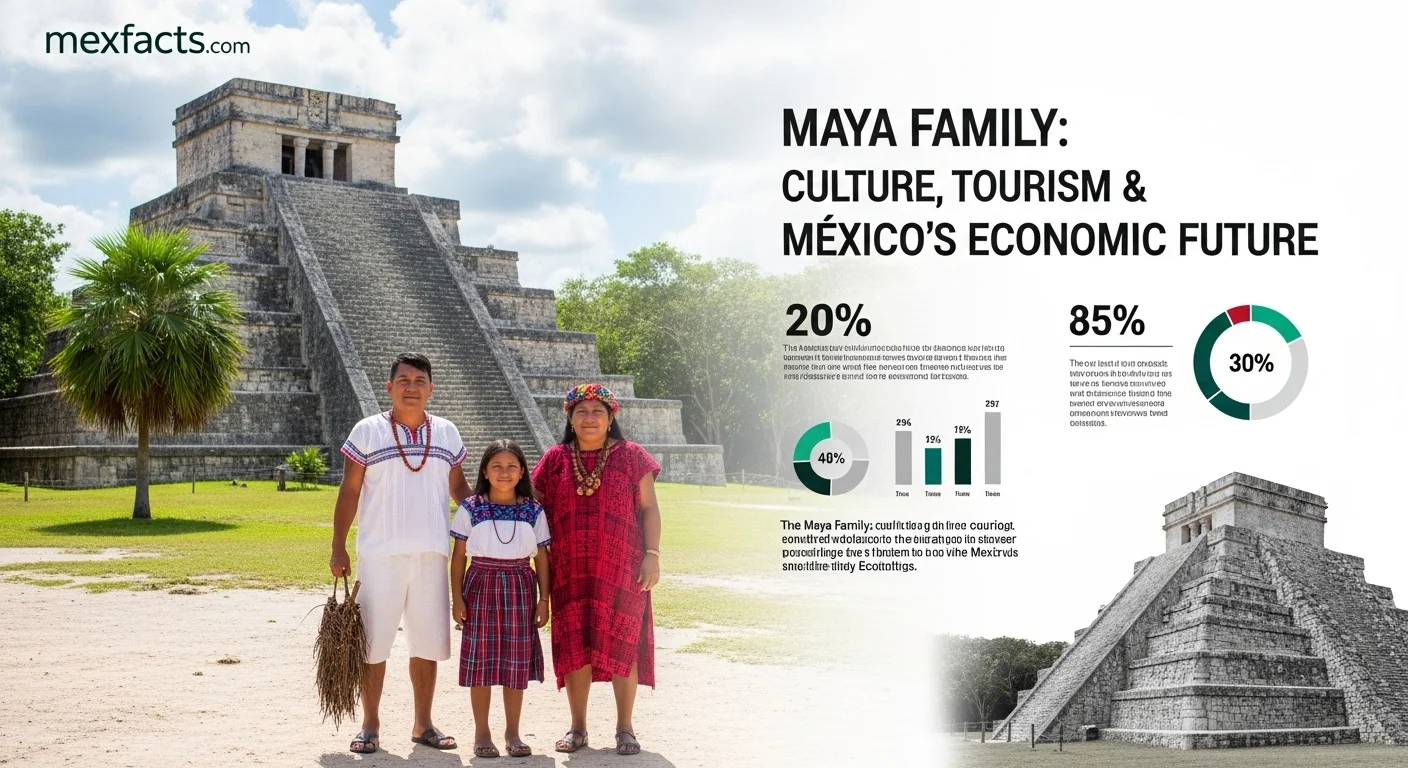
Demographics and Socioeconomic Realities
Examining the intersection between Indigenous Maya society and the regional tourism industry requires analyzing demographic data alongside tourism performance metrics. The data reveals two distinct socioeconomic spheres: an ancient linguistic and cultural community navigating structural economic barriers, and a multi-billion-dollar tourism sector operating on their ancestral territory.
The Maya Population Today: Demographics and Language
The Maya constitute one of Mexico's largest Indigenous ethnic populations. In southeastern Mexico, Maya communities are concentrated primarily in the Yucatán Peninsula—encompassing the states of Yucatán, Quintana Roo, and Campeche—as well as the highlands and lowlands of Chiapas. According to official data from the National Institute of Statistics and Geography (INEGI), more than 800,000 people speak Yucatec Maya (Maaya t'aan) across the peninsula, with the largest concentration residing in the state of Yucatán, where over a quarter of the population speaks an Indigenous language. Nationwide, when accounting for the broader Mayan linguistic family—which includes Tzotzil, Tzeltal, Ch'ol, and Tojolabal in Chiapas—the total Maya-speaking population exceeds 1.6 million individuals.
Cultural self-identification extends well beyond fluent speakers. Millions of residents throughout southeastern Mexico identify as of Maya descent, preserving domestic customs, food traditions, and community organization even where Spanish has become the primary language. Nonetheless, rural Maya municipalities consistently report poverty levels exceeding national urban averages. While basic public education is tuition-free, ancillary costs for uniforms, books, and transit often present significant hurdles for rural families, prompting young adults to seek employment in coastal tourist centers rather than pursuing higher education.
The Tourism Economy and Maya Communities
The tourism economy of the Mexican Caribbean operates on an immense scale. According to official reports from the Secretariat of Tourism of Quintana Roo (SEDETUR), the state welcomed over 20 million tourists in 2023. Cancún International Airport serves as Mexico's busiest airport for international arrivals, funneling vacationers into high-density hotel zones and luxury eco-resorts across the Riviera Maya.
This tourism expansion has generated tens of thousands of service and construction jobs, attracting widespread labor migration from rural Maya communities in Yucatán and central Quintana Roo. Maya workers form the backbone of the regional tourism labor force, filling essential roles in building construction, resort landscaping, housekeeping, culinary support, and maintenance. While resort employment provides formal cash wages and statutory benefits absent in subsistence farming, it also brings notable social costs. Workers often endure lengthy daily bus commutes or live separated from their families in coastal dormitory towns, creating social strain on traditional household structures and reducing time spent maintaining the communal milpa.
Furthermore, Indigenous workers remain disproportionately concentrated in entry-level, lower-wage service roles, while managerial and ownership positions are predominantly held by individuals from outside the region or international corporate entities. Bridging this wage and leadership gap represents one of southeastern Mexico's foremost socioeconomic challenges.
Preserving Heritage and Future Opportunities
The coexistence of living Maya communities and a massive hospitality industry places southeastern Mexico at an important crossroads. Sustaining regional prosperity requires protecting natural resources, preserving cultural traditions, and ensuring that Maya families derive equitable benefits from regional tourism growth.
Community-Based Tourism and Cultural Revitalization
A promising model for equitable development is the rise of community-based tourism (turismo comunitario). Organized into rural cooperatives, Maya communities in areas such as central Quintana Roo (the Zona Maya) and interior Yucatán manage their own tourism enterprises. Rather than serving solely as external wage labor, community members act as guides, hosts, and business managers on their own terms.
These community initiatives offer visitors authentic, respectful cultural experiences, such as guided walks through communal forest reserves, visits to family-run melipona apiaries, workshops in traditional Maya cuisine, and sustainable exploration of local cenotes. Revenues from community-based tourism remain directly within the village, funding local infrastructure, scholarships, and healthcare while reinforcing pride in ancestral customs and encouraging younger generations to retain the Yucatec Maya language.
Alongside economic initiatives, cultural organizations, educators, and community radio broadcasters are actively promoting bilingual education and digital literacy in Maya languages. Ensuring that young Maya individuals can achieve economic mobility without sacrificing their cultural identity is essential for the long-term vitality of the Maya family unit.
Responsible Family Tourism and Ethical Engagement
Visitor preferences are also evolving. An increasing number of family travelers seek meaningful, environmentally sustainable experiences that go beyond standard resort entertainment. Modern travelers are eager to teach their children about cultural stewardship, biodiversity conservation, and fair economic practices.
Forward-thinking hospitality operators and travel agencies in the Riviera Maya are responding by establishing direct partnerships with Maya cooperatives. Resorts that purchase seasonal produce from local farmers, feature authentic regional Maya dishes, support fair-trade handicrafts, and direct guest excursions to community-owned cultural sites help build a more sustainable travel ecosystem. By respecting both the living culture of Indigenous families and the vacation needs of visiting families, southeastern Mexico can cultivate a tourism model that honors the heritage from which it draws its identity.
Frequently Asked Questions
- What is a traditional Maya family structure?
- The traditional Maya family is typically an extended domestic unit where multiple generations—including grandparents, parents, and children—live within a shared compound called a solar. Family members pool labor for farming, household tasks, and childcare, maintaining strong intergenerational bonds.
- Where do most Maya families live in Mexico today?
- Most Maya families in Mexico live across the Yucatán Peninsula (in the states of Yucatán, Quintana Roo, and Campeche) and in the highlands and lowlands of Chiapas. Yucatán state has the largest concentration of Yucatec Maya speakers, while Chiapas is home to Maya groups speaking Tzotzil, Tzeltal, and Ch'ol.
- How has Riviera Maya tourism affected Maya families?
- The tourism boom created extensive employment opportunities in construction, resort operations, and services, bringing cash income to rural households. However, it also introduced challenges, such as labor migration away from rural villages, rising living costs, and pressures on traditional language and agricultural practices.
- How can travelers support Maya communities respectfully?
- Travelers can support Maya communities by patronizing community-based tourism cooperatives, hiring certified local Indigenous guides, purchasing handicrafts directly from artisans at fair prices, and showing respectful curiosity toward Maya customs, language, and sacred sites.
Expert Reviews
Laura Chen, Traveler ⭐⭐⭐⭐⭐
We stayed at an all-inclusive in the Riviera Maya, which was fantastic for the kids, but the real highlight was a day trip we took to a small Maya village. This article perfectly explains the two sides of that experience. It gave me a much deeper appreciation for the culture behind the beautiful scenery. A must-read before you go!
Michael Byrne, Cultural Analyst ⭐⭐⭐⭐
As someone studying sustainable development, this piece was invaluable. It cuts through the marketing fluff and presents the economic and social realities of the region with clarity and respect. The connection it draws between the traditional family structure and the modern tourism economy is a crucial point, and it's very well-made here.