
Northern Mexico: Economic Powerhouse, Nearshoring Hub, and Regional Culture

Northern Mexico, broadly known as El Norte, represents the industrial backbone of Mexico and the primary epicenter of the North American nearshoring boom. Spanning six border states—Baja California, Sonora, Chihuahua, Coahuila, Nuevo León, and Tamaulipas—the region accounts for a decisive share of national manufacturing output, foreign direct investment, and bilateral trade with the United States. Beyond its sprawling industrial parks and corporate headquarters in metropolitan hubs like Monterrey, Tijuana, and Ciudad Juárez, Northern Mexico maintains a distinct Norteño cultural identity rooted in ranching heritage, distinctive gastronomy, and an entrepreneurial tradition. This comprehensive overview examines the economic drivers, industrial specializations, urban development, and structural challenges shaping Mexico's northern frontier.
Table of Contents
What Is El Norte and Why Does It Matter Globally?
A Unique Cultural Identity: The Norteño Way of Life
The Urban Landscape: Growth, Investment, and Regional Dynamics
What Is El Norte and Why Does It Matter Globally?
To understand modern Mexico's economic trajectory, one must look to 'El Norte'—the vast northern frontier. Encompassing the six border states of Baja California, Sonora, Chihuahua, Coahuila, Nuevo León, and Tamaulipas, Northern Mexico shares a nearly 2,000-mile border with the United States. This geographic proximity is not merely a borderland reality; it is the structural foundation that has shaped the region's economic integration, demographics, and cultural landscape. The territory spans diverse topographies, ranging from the arid expanses of the Sonoran and Chihuahuan deserts and rugged mountain corridors to modern, densely populated industrial centers that serve as indispensable links in international supply chains.
Globally, Northern Mexico stands as an advanced manufacturing titan. For more than five decades, the maquiladora framework—now modernized under the IMMEX program (Industria Manufacturera, Maquiladora y de Servicio de Exportación)—has attracted multinational manufacturing investment to border cities such as Tijuana, Ciudad Juárez, Reynosa, and Mexicali. Under this regulatory model, companies import raw materials, components, and capital machinery duty-free for specialized processing and assembly, before exporting finished goods predominantly into the North American market. The sector produces everything from medical instruments and consumer electronics to sophisticated automotive and aerospace components.
In recent years, the global reorganization of trade known as nearshoring has accelerated this industrial expansion. Seeking to mitigate transpacific supply chain risks, reduce shipping transit times, and capitalize on tariff preferences under the United States-Mexico-Canada Agreement (USMCA), international corporations have directed substantial Foreign Direct Investment (FDI) into northern hubs. Metropolitan areas like Monterrey, the capital of Nuevo León, have become premier destinations for multinational investment, firmly reinforcing the North's role as the central engine of Mexico's export economy.
A Unique Cultural Identity: The Norteño Way of Life
Beyond industrial metrics, El Norte possesses a cultural identity distinct from central and southern regions of Mexico. Norteño culture was forged by a resilient frontier history where self-reliance, cross-border interaction, and an entrepreneurial spirit defined community life. This heritage is evident across the region's music and folklore. Norteño music, anchored by the accordion and the twelve-string bajo sexto, blends European folk rhythms with Mexican narrative traditions, chronicling regional history, border life, and social realities that resonate across northern Mexico and the southwestern United States.
The gastronomy of the North is equally reflective of its ranching heritage. While southern Mexican cuisine is rooted in corn-based dishes and tropical ingredients, northern cuisine centers on cattle ranching, beef, and wheat flour. The weekend carne asada (grilled beef) represents far more than a meal; it is a defining social and familial tradition centered around the grill. Wheat flour tortillas (tortillas de harina) are the essential staple of northern households, forming the base for regional specialties such as burritos—which originated in Ciudad Juárez—machaca con huevo (shredded dried beef with eggs), arrachera, and Monterrey's revered cabrito (roasted kid goat). Northern gastronomy showcases a proud culinary tradition that pairs rustic frontier heritage with contemporary culinary innovation.
The Urban Landscape: Growth, Investment, and Regional Dynamics
Northern metropolitan areas are expanding rapidly, propelled by sustained industrial job creation and domestic migration from across Mexico. This expansion has generated robust demand across commercial, industrial, and residential real estate. Unlike tourism-dependent destinations or central urban districts driven primarily by leisure travelers and bohemian lifestyle appeal, urban development in the North is anchored directly in industrial productivity and corporate headquarters.
In metropolitan Monterrey, municipalities such as San Pedro Garza García and Santa Catarina illustrate this economic vitality. San Pedro Garza García hosts corporate headquarters, financial institutions, and executive housing, while neighboring corridors accommodate major automotive and advanced manufacturing facilities. The sustained influx of engineers, corporate executives, and technical specialists has stimulated high-end housing, commercial infrastructure, and private services, creating an urban real estate landscape directly tied to Mexico's deep integration into the North American trade architecture.
Key Economic Indicators: A Statistical Profile of Northern Mexico
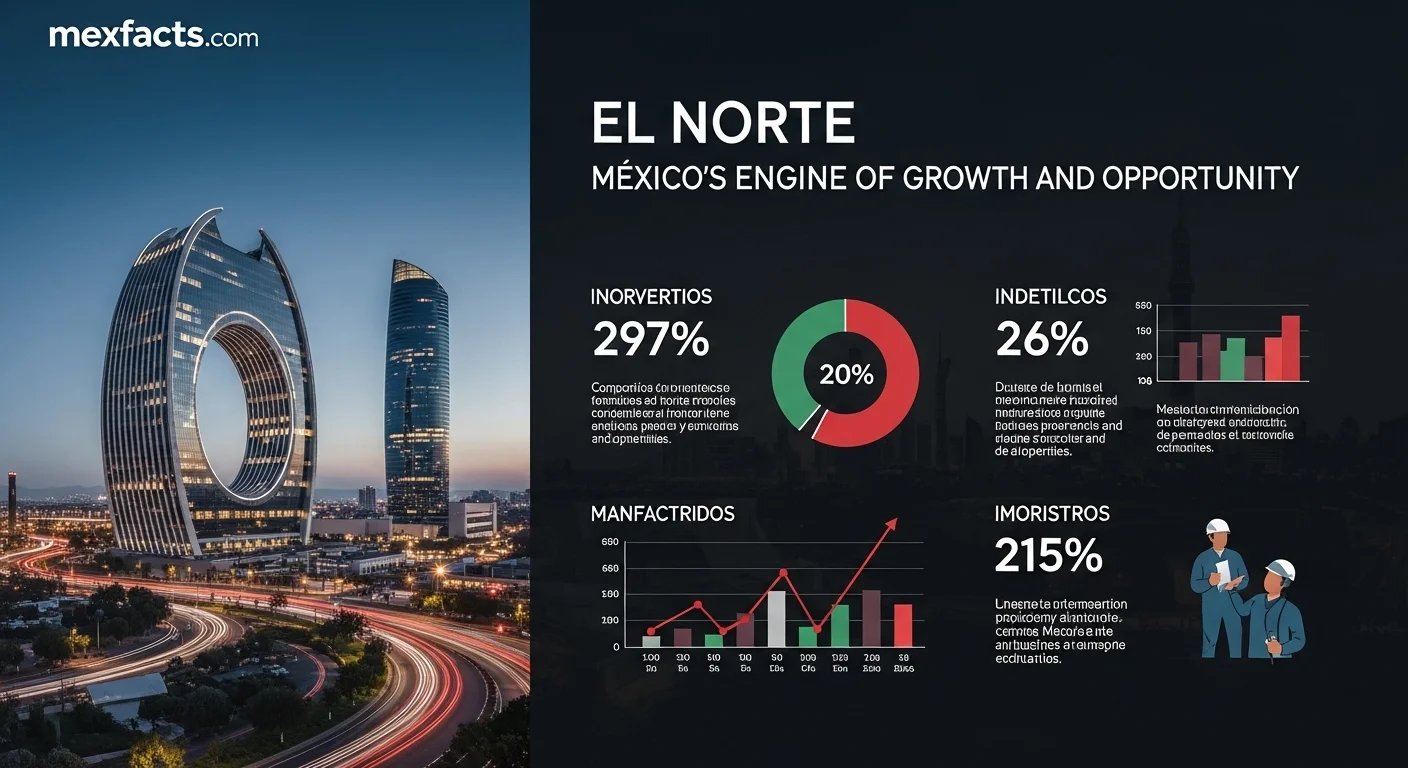
Economic data underscores Northern Mexico's outsized role in driving national performance. The six border states—Baja California, Sonora, Chihuahua, Coahuila, Nuevo León, and Tamaulipas—consistently generate a disproportionate share of national manufacturing gross domestic product and export revenues, sustained by strategic geographical alignment with the United States market and robust infrastructure networks.
Foreign Direct Investment and Nearshoring in Numbers
Foreign Direct Investment (FDI) inflows into Mexico have reached historic levels, with manufacturing consistently absorbing between 40% and 50% of total inbound capital according to official Ministry of Economy (Secretaría de Economía) data. Northern border states capture the majority of manufacturing-directed FDI. Nuevo León frequently competes with Mexico City as the leading destination for inbound FDI, with Monterrey acting as the primary focal point for nearshoring relocation and supplier expansions.
Key indicators highlighting this industrial momentum include:
- Industrial Absorption: Monterrey led Mexico in industrial real estate absorption, leasing over 15 million square feet of industrial space in peak absorption years, heavily driven by nearshoring suppliers.
- Low Vacancy Rates: High tenant demand in key northern manufacturing clusters—including Monterrey, Ciudad Juárez, and Tijuana—has compressed industrial vacancy rates to historic lows, frequently dipping below 3% to 4%.
- Rental Appreciation: Severe supply constraints for Class A industrial parks have spurred double-digit percentage increases in industrial lease rates across primary northern logistics corridors.
- Sector Concentration: Manufacturing continues to absorb over 40% of all national FDI, led by automotive assembly, electronics, aerospace components, and medical devices.
Core Industrial Sectors Driving the Border Economy
The North's economic strength is built on diverse, high-value manufacturing clusters established across specialized state economies:
- Automotive: Coahuila and Nuevo León serve as leading automotive manufacturing hubs, housing assembly plants for global manufacturers such as General Motors, Stellantis, and Kia, supported by extensive Tier-1 and Tier-2 supply chains. Mexico achieved record production of approximately 3.9 million light vehicles in 2024, with northern assembly lines and component plants contributing a substantial portion of total output.
- Aerospace: Baja California, Sonora, and Chihuahua have developed world-class aerospace clusters. More than 350 to 400 aerospace and defense companies operate throughout Mexico, with northern facilities fabricating precision turbine components, wiring harnesses, avionics, and fuselages for global aviation leaders.
- Electronics: Tijuana and Ciudad Juárez represent vital centers for electronics manufacturing, producing high-volume consumer electronics, communication equipment, and semiconductor assemblies with direct just-in-time access to U.S. distribution channels.
- Medical Devices: Baja California—particularly Tijuana and Mexicali—is recognized as the foremost medical device manufacturing cluster in North America, manufacturing surgical tools, catheters, pacemakers, and diagnostic instruments under stringent international standards.
Urban Demographics and Residential Growth
This industrial expansion drives corresponding growth across demographic and service sectors. In northern cities, the expansion of skilled industrial employment has increased demand for retail services, education, and housing. In Monterrey, residential property values have reflected this upward pressure, with the Sociedad Hipotecaria Federal (SHF) index recording annual residential price increases near 9.9%. This housing demand is anchored in industrial employment growth, technical workforce relocation, and sustained corporate expansion.
Future Outlook: Strategic Opportunities and Structural Challenges
Northern Mexico stands at the forefront of a long-term reconfiguration of global trade. The nearshoring phenomenon reflects structural realignment in international manufacturing, positioning El Norte as a central pillar of North American economic security. Realizing the full potential of this industrial cycle requires capitalizing on emerging sectors while addressing critical infrastructure bottlenecks.
Strategic Opportunities on the Horizon
The coming decade presents significant opportunities for value-added industrial and economic development:
- Advanced Manufacturing and Electric Vehicles: Industrial development is progressing from basic assembly toward high-value automation, robotics, and engineering. The transition toward electric vehicles (EVs) has spurred major investments in battery production, EV assembly, and specialized component manufacturing across Coahuila and Nuevo León.
- Technology and Industrial Innovation: Concentrated manufacturing has catalyzed software, industrial IoT, and logistics-technology ecosystems. Supported by prominent academic institutions like Tecnológico de Monterrey, northern hubs are cultivating engineers and technical professionals who support advanced factory automation.
- Clean Energy Integration: Vast desert terrain across Sonora and Chihuahua offers world-class solar irradiance, creating substantial opportunities for private solar power development and industrial clean energy integration to fulfill corporate sustainability mandates.
- Logistics and Border Infrastructure: Modernizing land ports of entry, expanding freight rail connectivity, and optimizing cross-border customs infrastructure represent urgent priorities that offer high-yield potential for public-private partnerships.
Navigating Structural Challenges
Sustained economic growth across Northern Mexico will depend on addressing several key structural hurdles:
- Water Scarcity: The semi-arid climate of Northern Mexico presents persistent hydrological challenges. Meeting the water needs of growing populations and industrial processes requires continued investment in wastewater recycling, desalination, and comprehensive water management policies.
- Electric Grid Transmission Capacity: The rapid proliferation of industrial parks has placed pressure on regional power grids. Upgrades to transmission and distribution infrastructure managed by the Federal Electricity Commission (CFE) and CENACE remain vital to prevent energy bottlenecks.
- Border Bottlenecks: Sustained trade expansion requires continuous efficiency improvements at major cross-border ports of entry, including Nuevo Laredo, Ciudad Juárez, and Tijuana, to minimize commercial freight congestion.
- Human Capital and Technical Training: The evolution toward advanced manufacturing requires continuous investment in engineering faculties, technical institutes, and corporate apprenticeships to supply the specialized labor required by high-tech industries.
Northern Mexico's trajectory reflects a unique combination of geographic advantage, industrial capability, and cultural resilience. As global supply chains continue to integrate within North America, El Norte will remain central to Mexico's national prosperity and cross-border partnership. For additional economic context on Mexico's macroeconomic outlook and trade policies, refer to the World Bank.
Expert Reviews
Carlos Gutierrez, FDI Consultant ⭐⭐⭐⭐⭐
As an analyst exploring opportunities outside Asia, this article was a game-changer. It perfectly explained the 'why' behind the nearshoring boom in Northern Mexico and provided a clear-eyed view of both the opportunities and the challenges like water and energy. Invaluable.
Brenda Lee, Cultural Enthusiast ⭐⭐⭐⭐⭐
I loved this! I'm from Texas and have always enjoyed Norteño music and food, but this article connected it all to the region's history and economic strength. Understanding that a simple 'taco del norte' is a symbol of so much more was a beautiful insight. It felt like it was written by someone who truly knows and loves the culture.
Michael Chen, Project Manager ⭐⭐⭐⭐⭐
My company relocated me to Monterrey six months ago. Reading this felt like reading my own experience. The description of the work ethic, the social importance of carne asada, and the sheer pace of growth here is spot on. It really helped me appreciate the unique character of my new home.