
Mexico Luxury Villas: Stays, Resort Models, and Investment Insights

Resort villas in Mexico combine the privacy and living space of a standalone luxury residence with the comprehensive amenities and security of an internationally branded resort. Featuring multi-bedroom layouts, private terraces, plunge pools, and full kitchens, these properties cater to multigenerational families, extended-stay travelers, and luxury buyers seeking effortless property management alongside world-class Mexican hospitality.
From the planned tourism corridors of Cancún and the Riviera Maya to exclusive enclaves in Los Cabos and Nayarit, this guide analyzes the operational models of leading villa resorts, evaluates the economic forces driving branded residential growth, and provides essential legal due diligence for foreign buyers navigating Mexico's constitutional property framework.
What Defines a Mexican Resort Villa?
A Mexican resort villa represents an upscale hybrid accommodation model positioned between a conventional luxury hotel suite and an independent private residence. Unlike standard hotel rooms, a resort villa provides expansive residential architecture: multi-bedroom layouts, dedicated living and dining rooms, fully equipped gourmet kitchens, and private outdoor living zones such as expansive sun terraces and plunge pools. At the same time, the villa operates as an integrated component of a full-service hospitality resort.
Guests and resident owners enjoy unfettered access to five-star resort infrastructure, including 24-hour gated security, professional on-site concierge teams, daily housekeeping, full-service spas, fitness facilities, supervised children's clubs, and diverse gourmet restaurants. This operational structure solves the logistical limitations of traditional vacation homes by eliminating self-management burdens while preserving residential seclusion. The model is especially advantageous for multigenerational families, corporate executive retreats, and extended-stay travelers seeking home-like independence without compromising on service consistency.
Resort Villas vs. Standalone Vacation Rentals
While standalone vacation rentals booked through peer-to-peer platforms offer privacy, they frequently suffer from operational inconsistencies, unvetted security, and variable maintenance standards. In contrast, Mexican resort villas provide standardized institutional management backed by hospitality operators. Key distinctions include:
- On-Site Services and Staffing
- Resort villas feature daily professional housekeeping, dedicated concierge desks, and immediate on-call engineering support, whereas standalone rentals often rely on off-site property managers or third-party cleaners with delayed response times.
- Security and Controlled Access
- Resorts provide perimeter fencing, surveillance systems, and 24-hour guarded access points, delivering essential peace of mind for international visitors and high-net-worth families.
- Dining and Leisure Amenities
- Villa guests enjoy immediate proximity to multiple resort restaurants, beachfront bars, lagoon-style pools, tennis courts, and wellness spas, avoiding the need to drive off-property for every meal or recreational activity.
- Maintenance and Accountability
- Mechanical systems, water filtration, air conditioning, and electrical backups are maintained under commercial hotel engineering protocols, drastically reducing the disruption risk common in private rental villas.
The Evolution of Master-Planned Tourism in Mexico
The contemporary resort villa market is deeply anchored in Mexico's strategic tourism modernization, which began in the 1970s. The federal government established FONATUR (Fondo Nacional de Fomento al Turismo) to design comprehensively planned resort cities known as Centros Integralmente Planeados (CIPs), inaugurating the master development of Cancún before expanding into Ixtapa, Los Cabos, and Huatulco.
Initial development centered on high-density beachfront hotel towers to establish international airline connectivity and municipal infrastructure. However, as international travel preferences matured toward longer stays and experiential luxury, master developers diversified into low-density residential enclaves. Resort operators recognized that affluent repeat visitors desired larger floor plans and turnkey vacation ownership. By integrating multi-bedroom villas into master-planned resort complexes, operators created a sustainable ecosystem that combines transient hotel revenues with branded residential real estate sales.
Premier Resort Villa Models in Cancún
Cancún's established Hotel Zone illustrates two distinct operational implementations of the resort villa model:
Wyndham Grand Cancun All Inclusive Resort & Villas: This property represents an integrated hybrid resort. Alongside traditional luxury hotel suites, the complex features multi-level standalone villas designed specifically for multigenerational families and travel groups. Each villa incorporates a full kitchen, generous living quarters, and private patio space, while seamlessly participating in the resort's comprehensive all-inclusive program. Guests benefit from a private residential atmosphere without sacrificing access to multiple international restaurants, a full-service spa, beachfront pools, and family activity programs.
The Royal Cancun All Villas Resort: Operating on an all-villa architectural footprint, this property is designed as a tranquil residential enclave on Cancún's sheltered north-facing bay. The resort exclusively offers spacious two-bedroom villas equipped with full kitchens, dining areas, and private outdoor terraces. What distinguishes its business model is commercial flexibility: guests can book under a European Plan (accommodations only, enabling self-catering through the on-site convenience market and local dining) or choose an all-inclusive culinary package. The calm, shallow waters and dedicated children's facilities make it a benchmark for family-oriented villa hospitality.
Economic Impact and Tourism Data in Mexico's Luxury Lodging
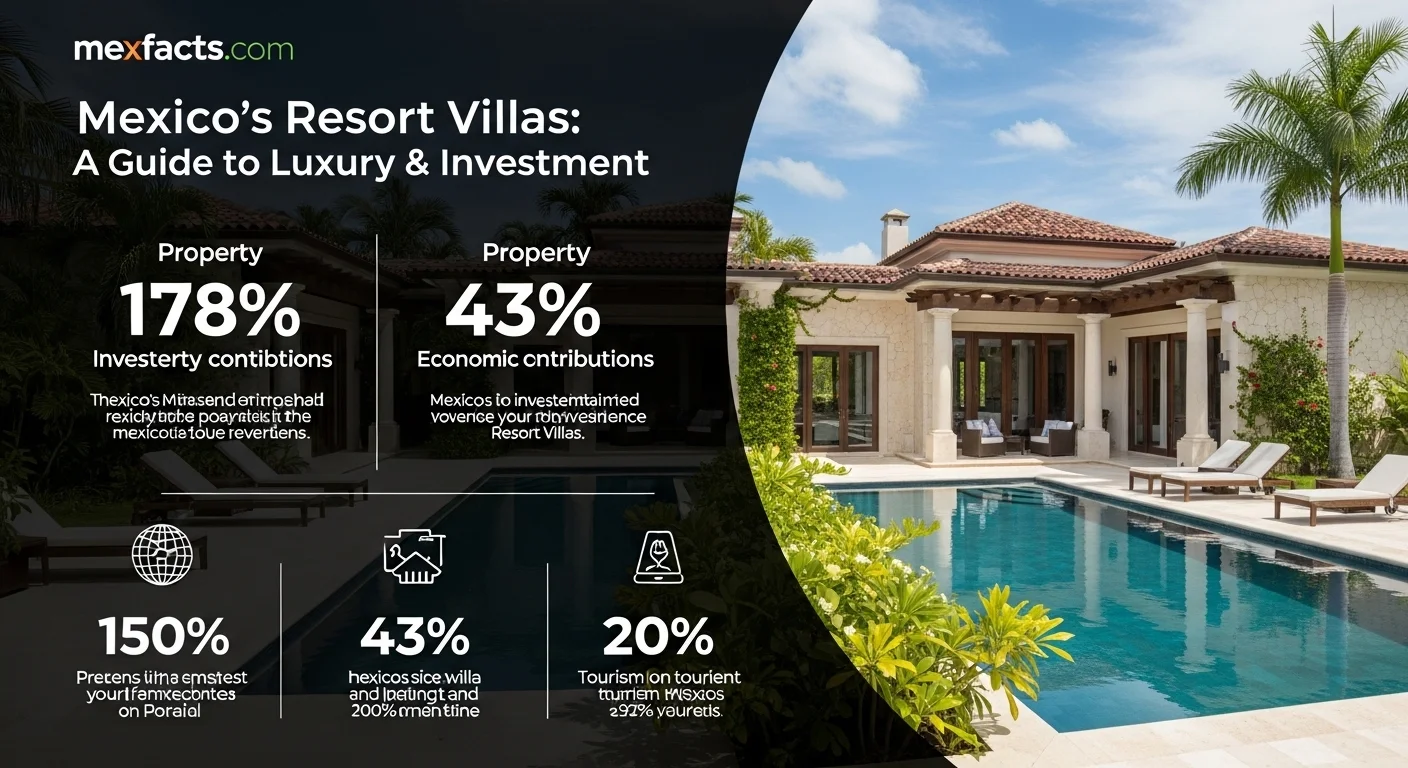
The growth of resort villas aligns directly with Mexico's robust macroeconomic tourism indicators. Official data from the National Institute of Statistics and Geography (INEGI) indicates that tourism activities contribute approximately 8.5% to 8.7% of Mexico's national Gross Domestic Product (GDP). Furthermore, employment statistics from Mexico's Ministry of Tourism (SECTUR) reflect that the tourism sector directly sustains approximately 4.8 million jobs across the republic.
Within this macroeconomic landscape, the luxury accommodation sector drives disproportionate economic value. High-end villa guests typically register longer average lengths of stay and spend substantially more per capita on gastronomy, private excursions, and wellness services than standard hotel patrons. Regional hotel infrastructure reflects this specialization. In Quintana Roo—encompassing Cancún, Riviera Cancún, and the Riviera Maya—the hotel room inventory exceeds 130,000 rooms, representing the single largest regional concentration in Mexico's nationwide hospitality capacity of roughly 870,000 rooms. A significant share of new pipeline developments in this corridor focuses on low-density luxury inventory, including branded villas and private residences.
Foreign Direct Investment and the Surge of Branded Residences
Institutional confidence in Mexico's resort real estate sector remains exceptionally strong. According to figures released by Mexico's Ministry of Economy, the country received more than $36 billion in Foreign Direct Investment (FDI) in 2023, with substantial capital channeled into coastal infrastructure, hospitality, and residential tourism assets.
Global luxury hospitality flags—such as Four Seasons, Ritz-Carlton Reserve, St. Regis, Rosewood, and Montage—have accelerated the rollout of branded residences across premier Mexican corridors, including Los Cabos, Punta Mita, and the Riviera Maya. For developers, branded resort villas provide critical advantages:
- Capital Efficiency: Pre-sales of luxury residential villas fund ongoing resort construction and reduce developer debt load.
- Brand Premium: Properties affiliated with top-tier international hotel brands command price premiums between 25% and 35% over unbranded comparable real estate.
- Operational Synergy: Homeowners place their villas into professionally managed rental pools when not in residence, maintaining high occupancy and generating premium Average Daily Rates (ADR) during peak holiday seasons.
Operating Frameworks: European Plan vs. All-Inclusive Villas
The commercial management of Mexican resort villas generally splits into two operational models, each serving distinct guest profiles and investor goals:
- All-Inclusive Hybrid Model
- Properties like Wyndham Grand Cancun incorporate villa accommodations into prepaid resort packages. This model provides high baseline occupancy, predictable food and beverage forecasting, and minimal out-of-pocket friction for large family groups, appealing directly to travelers seeking complete budget certainty.
- European Plan and Flexible Dining Model
- Resorts such as The Royal Cancun enable guests to choose between self-catering European Plans and optional meal packages. By accommodating guests who prefer cooking in their villa kitchens or dining at independent regional restaurants, these properties capture extended-stay travelers and seasonal winter residents who view standard all-inclusive fees as redundant.
Legal Framework: Acquiring Resort Property via Fideicomiso
Foreign buyers seeking to purchase real estate within Mexico's coastal regions must navigate the legal framework established under Article 27 of the Mexican Constitution. This article defines the Restricted Zone as any territory located within 50 kilometers (approximately 31 miles) of Mexico's coastlines or 100 kilometers (approximately 62 miles) of international borders.
Because premier resort villa destinations—such as Cancún, Los Cabos, and Puerto Vallarta—fall entirely inside the Restricted Zone, foreign individual buyers acquire residential property through a 50-year renewable bank trust known as a fideicomiso. Under a fideicomiso:
- An authorized Mexican financial institution holds legal title as the trustee (fiduciario).
- The foreign purchaser is designated as the primary beneficiary (fideicomisario), retaining absolute equitable ownership rights to inhabit, remodel, lease, bequeath, or sell the property at fair market value.
- The trust is held for an initial 50-year term and is perpetually renewable upon formal application under Mexican foreign investment law.
Prospective investors researching acquisitions in master-planned communities can review vetted opportunities among Mexico villas for sale to evaluate regional pricing structures and established condominium regimes.
Financial Due Diligence: HOA Dues, Maintenance, and Yields
Evaluating a resort villa purchase requires rigorous financial analysis beyond gross rental marketing figures. Prospective buyers should conduct meticulous due diligence on recurring operational expenditures:
- Homeowners Association (HOA) Fees
- Resort villa HOA dues cover 24-hour security, grounds keeping, swimming pool sanitation, exterior structural insurance, and common utility infrastructure. In coastal environments, maintenance reserves must adequately account for saltwater corrosion, humidity, and tropical weather mitigation.
- Rental Management Revenue Splits
- When participating in an on-site hotel rental program, management operators typically retain between 40% and 50% of gross booking revenues. This split covers global distribution system (GDS) marketing, front-desk staffing, concierge operations, housekeeping turnaround, and credit card processing.
- Closing Expenses and Closing Notary
- Acquisition closing costs in Mexico typically range from 5% to 8% of the purchase price, encompassing state property acquisition taxes (ISAI), fideicomiso establishment fees, public registry inscription, and fees for the government-appointed Notario Público, who is legally obligated to verify clear title and tax compliance.
Future Trends: Sustainability, Wellness, and Regional Transit
The resort villa sector in Mexico is evolving in response to structural shifts in international travel behavior:
- Ecological Stewardship: High-net-worth travelers increasingly demand low-impact development standards. Modern villa enclaves integrate solar microgrids, advanced on-site wastewater reclamation facilities, rainwater harvesting, and architectural biomimicry that preserves native mangroves, cenotes, and coastal dune ecosystems.
- Integrated Wellness: Contemporary villa designs incorporate dedicated wellness facilities, including private cold-plunge pools, yoga terraces, open-air meditation courtyards, and dedicated treatment rooms for in-villa holistic therapies and private nutritionists.
- Extended Workcations: High-speed fiber connectivity, dedicated executive work suites, and redundant satellite backup systems cater to remote executives and entrepreneurs booking extended multi-week residencies.
- Regional Infrastructure Connectivity: Transportation infrastructure developments across southern Mexico—including modernized regional airports and the Tren Maya network—continue to improve accessibility to emerging villa destinations along the Yucatán Peninsula.
Frequently Asked Questions
- What distinguishes a resort villa from a standard vacation rental?
- A resort villa combines independent multi-bedroom residential living with full access to five-star resort amenities, including daily housekeeping, 24-hour security, on-site dining, kids' clubs, and professional concierge services, whereas standard vacation rentals operate without centralized hotel staffing.
- Can non-Mexican citizens legally own coastal resort villas in Mexico?
- Yes. Under Mexican foreign investment law, foreign citizens legally own coastal residential property in the Restricted Zone through a renewable 50-year bank trust called a fideicomiso, which grants complete rights to sell, lease, or transfer the real estate.
- What net rental yields can an investor realistically expect from a resort villa?
- Realistic net rental yields generally range between 4% and 7% after deducting HOA dues, property taxes, insurance, routine maintenance, and the resort operator's management split. Prospective buyers should be cautious of speculative promotional yields exceeding 10%.
Expert Reviews
Laura P., Toronto, Canada ⭐⭐⭐⭐⭐
This article perfectly captured why we chose a villa for our family reunion in Cancún. Having our own space with a kitchen, but still getting the fun of the resort pools and restaurants, was a game-changer. It felt like our own private piece of paradise. This guide is spot on!
Michael Chen, Real Estate Investor ⭐⭐⭐⭐⭐
As someone looking to invest in international property, this guide was incredibly clear and helpful. It broke down the market trends and the 'why' behind Mexico's success. The information on branded residences and the fideicomiso gave me the confidence I needed. A must-read.
Sofia Garcia, Frequent Traveler ⭐⭐⭐⭐
I've been vacationing in Mexico for years, and I've watched the shift from hotels to these incredible villas. This article explains the trend beautifully. It truly captures the unique blend of privacy, luxury, and authentic Mexican hospitality that makes these places so special. It made me want to book my next trip immediately!