
Rosarito Beach, Mexico: Travel Guide, Safety, and Coastal Living

Playas de Rosarito, commonly known as Rosarito Beach, is a vibrant coastal municipality located along the Pacific Ocean in Baja California, approximately 20 miles south of the San Diego-Tijuana international border. Renowned for its wide sandy beaches, premier Pacific surf breaks, and historic 1920s architecture, the town serves as an accessible introduction to the Baja California peninsula. While official travel advisories urge caution across the broader border region, tourist corridors and scenic highways remain active and frequented by millions of North American travelers each year. From sampling authentic Puerto Nuevo spiny lobster and exploring artisan markets to evaluating coastal real estate opportunities through the Mexican bank trust (fideicomiso) system, this comprehensive guide delivers practical travel logistics, objective safety context, accommodation realities, and investment facts.
Table of Contents
- Overview and Location
- Historical Background: From Kumeyaay Heritage to Hollywood Escape
- Travel Logistics: Driving and Transit from the U.S. Border
- Safety Advisories and Practical Precautions
- Beaches, Surfing, and Culinary Highlights
- Accommodations: Hotels vs. All-Inclusive Resorts
- Real Estate Overview and Market Dynamics
- Legal Property Ownership: The Fideicomiso System
- Regional Infrastructure and Future Projects
- Frequently Asked Questions
Overview and Location
Playas de Rosarito is situated on the coastal plains of northern Baja California, bordered by Tijuana to the north and Ensenada to the south. Positioned roughly 20 miles (32 kilometers) south of the San Ysidro Port of Entry, it offers travelers immediate access to Pacific oceanfront landscapes without requiring domestic air travel. The city experiences a mild Mediterranean marine climate characterized by pleasant daytime temperatures, refreshing ocean breezes, and occasional morning marine layer fog that typically burns off by midday.
Beyond its traditional role as a weekend getaway for Southern Californians, Rosarito functions as an important cultural and economic link in the cross-border Cali-Baja mega-region. Its bustling coastal thoroughfare, Boulevard Benito Juárez, hosts hotels, seafood restaurants, craft galleries, and residential developments that cater to international visitors, retirees, and remote professionals alike.
Historical Background: From Kumeyaay Heritage to Hollywood Escape
Long before European contact, the coastal valley was inhabited by the indigenous Kumeyaay people, who referred to the area as Wa-cuatay, translating to "big houses." Following Spanish colonization and Mexico's independence, the land was granted to Don José Manuel Machado in 1827 as part of the El Rosarito Ranch. For nearly a century, the territory remained largely pastoral, dedicated to livestock and dry farming.
The town's modern identity emerged during the 1920s. With the onset of American Prohibition, prominent entrepreneur Manuel Barbachano transformed the family ranch house into the Rosarito Beach Hotel. The property quickly evolved into an exclusive refuge for Hollywood luminaries seeking legal cocktails, casino entertainment, and Pacific coastal luxury. Notable figures including Orson Welles, Rita Hayworth, Spencer Tracy, and Dolores del Río frequented the resort, establishing the glamorous reputation that still marks the town's historic core.
In subsequent decades, Rosarito continued its cultural evolution. In 1996, 20th Century Fox constructed Fox Baja Studios (now Baja Studios) just south of town in Popotla to film James Cameron's cinematic blockbuster Titanic. The facility's massive ocean-facing water filtration tanks later accommodated major maritime productions such as Master and Commander and Pearl Harbor. In December 1995, Playas de Rosarito officially incorporated as Baja California's fifth autonomous municipality, having previously operated as a sub-delegation of Tijuana.
Travel Logistics: Driving and Transit from the U.S. Border
Reaching Rosarito Beach from Southern California is straightforward, with the vast majority of visitors arriving by automobile through the San Ysidro or Otay Mesa border crossings. For motorists unfamiliar with northern Baja roads, choosing the proper transit corridor is essential for safety and convenience.
- The Coastal Toll Road (Carretera Federal 1D): The recommended driving route is Highway 1D (Autopista Escénica Tijuana-Ensenada). This four-lane divided toll highway bypasses congested downtown Tijuana streets, providing direct ocean vistas and well-maintained asphalt. Drivers pass through two toll booths between Tijuana and southern Rosarito (Playas and Rosarito booths), each charging modest fees payable in Mexican pesos or exact U.S. dollars.
- Border Crossing Preparation: Travelers must carry a valid passport book or passport card. While Mexican entry permits (FMM - Forma Migratoria Múltiple) are routinely processed at border checkpoints, drivers must also secure dedicated Mexican auto insurance. U.S. and Canadian domestic auto insurance policies do not provide valid third-party liability coverage in Mexico by law. Temporary policies can be purchased online prior to departure.
- Alternative Transit Options: Travelers preferring not to drive can utilize rideshare services like Uber, which operates extensively between the San Ysidro pedestrian border and Rosarito. Authorized airport taxis and regional bus shuttles provide additional transit options. Motorists driving federal toll highways also benefit from the Ángeles Verdes (Green Angels), a government-operated bilingual fleet providing free roadside mechanical assistance (dial 078 in emergencies).
For visitors exploring broader regional itineraries, reviewing our Tijuana destination guide provides helpful advice on border crossing lanes, SENTRI options, and urban transit.
Safety Advisories and Practical Precautions
Safety is a primary consideration for prospective visitors to Baja California. Official government advisories, including the U.S. Department of State Travel Advisory, classify Baja California under a Level 3 ("Reconsider Travel") advisory due to criminal activity and homicide statistics in the state.
However, understanding the local geographic distribution of crime is critical. The high homicide statistics in Baja California are largely concentrated in peripheral, non-tourist residential neighborhoods of Tijuana and inland industrial zones, where conflicts involve local drug distribution disputes. Main tourist zones, including Rosarito's primary coastal strip, beachfront hotel compounds, and the Puerto Nuevo culinary corridor, maintain a heavy police presence and experience far lower rates of violent crime involving visitors.
Travelers can maximize safety by observing established travel practices:
- Stick to Federal Toll Highways: Always use Highway 1D rather than the free inland road (Carretera Libre 1), especially when traveling between Tijuana, Rosarito, and Ensenada. Plan drives during daylight hours whenever possible.
- Maintain Discretion: Avoid displaying high-value jewelry, carrying large amounts of cash, or leaving valuables unattended inside parked vehicles. Use credit cards or bank ATMs situated inside grocery stores or banks along Boulevard Benito Juárez.
- Navigating Police Interactions: Municipal police conduct periodic patrols and sobriety checkpoints. If stopped for a minor traffic violation, drivers have the legal right to ask for a written citation (infracción) to be resolved at the local municipal station (comandancia), rather than paying on-the-spot cash payments. For urgent roadside assistance or emergency response, dial 911, which connects directly to Baja California's integrated C4/C5 bilingual dispatch.
Beaches, Surfing, and Culinary Highlights
Rosarito's enduring popularity stems from its outdoor recreation, artisan traditions, and distinct gastronomy. Visitors find diverse activities ranging from Pacific water sports to world-renowned culinary experiences:
- Beaches and Surfing: Rosarito is widely recognized as the historic cradle of surfing in Baja California. Point breaks and beach breaks along the coast generate consistent surf year-round. Premier spots include the central beach break near the Rosarito Pier, Popotla, and the legendary right-hand point break at Kilometer 38 (K-38) near El Morro, which attracts surfers from across the globe. Swimmers should exercise caution regarding rip currents and check for active lifeguard flags along central beaches.
- Puerto Nuevo Lobster Village: Located approximately 10 miles south of Rosarito's center, the coastal village of Puerto Nuevo is home to more than thirty dedicated seafood restaurants. The signature dish—Pacific spiny lobster split lengthwise and fried quickly in hot oil—is served with refried pinto beans, Mexican rice, warm handmade flour tortillas, and melted butter. This tradition draws hundreds of thousands of diners each year.
- Popotla Artisan Fishing Village: Just south of the municipal core lies Popotla, a rustic, working fishing cove where local pangas (wooden fishing skiffs) launch directly through ocean surf. Visitors can browse open-air fish markets right on the sand, selecting freshly caught crab, clams, and red snapper to be cooked to order in beachfront palapas (such as traditional pescado zarandeado).
- Artisan Corridors and Furniture Markets: Along Boulevard Benito Juárez and the southern coastal highway, artisanal shops display traditional hand-forged wrought iron, Talavera pottery, custom carved pine and mesquite furniture, and decorative tiles, making the town a favorite source for home decorators and designers.
Accommodations: Hotels vs. All-Inclusive Resorts
A common inquiry among international vacationers concerns the availability of all-inclusive resorts in Rosarito Beach. In major Mexican beach resort destinations such as Cancún, Riviera Maya, or Los Cabos, all-inclusive packages dominate the hospitality landscape. In Rosarito, however, the accommodation model is distinctly different.
Playas de Rosarito does not feature mega-scale, all-inclusive chain resorts. Instead, local hospitality centers on European-plan (room-only) historic beachfront hotels, boutique properties, and oceanfront vacation rental condominiums. This lodging model aligns naturally with Rosarito's appeal, encouraging travelers to step outside resort gates to explore local taco stands, seaside craft markets, and Puerto Nuevo restaurants.
Popular accommodation categories include:
- Full-Service Historic Resorts: The iconic Rosarito Beach Hotel remains the cornerstone of local lodging, featuring oceanfront hotel towers, historic adobe suites, multiple pools, an oceanfront spa, a long fishing pier, and on-site restaurants. Similarly, Las Rocas Resort & Spa, located further south near K-38, offers clifftop Pacific vistas, a dedicated oceanfront spa, and open-air bars.
- Oceanfront Vacation Rental Condominiums: Gated condominium communities such as Las Olas Grand, La Jolla Real, and Club Marena provide furnished multi-bedroom units with full kitchens, infinity pools, tennis courts, and 24-hour security gates. These rentals are especially favored by families, remote workers, and visitors planning stays of a week or longer.
- Boutique and Downtown Hotels: Properties situated directly along Boulevard Benito Juárez, such as Hotel Festival Plaza, offer immediate walking access to downtown shopping, nightlife venues, and central beaches at affordable nightly rates.
Real Estate Overview and Market Dynamics
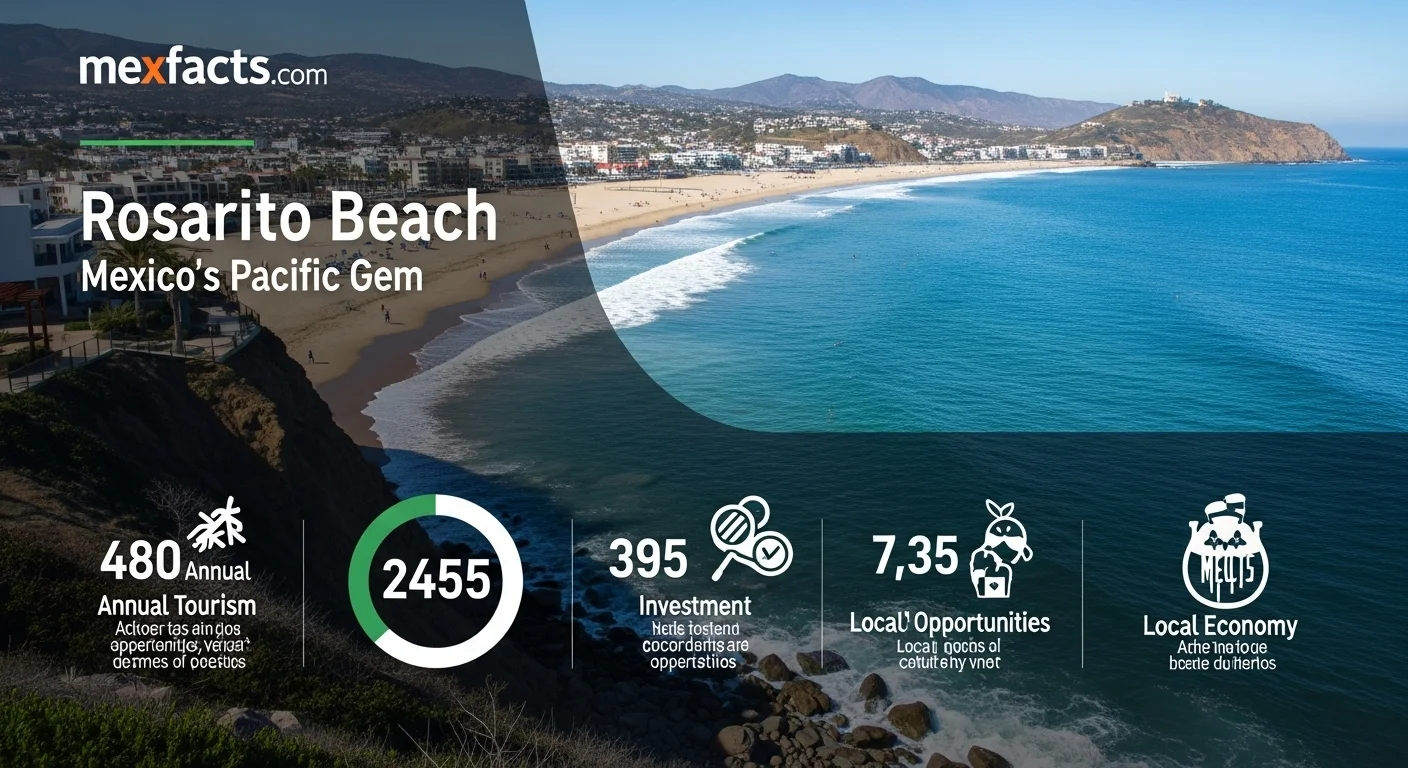
The real estate market in Playas de Rosarito has developed into one of the most dynamic coastal investment hubs in northern Mexico. Positioned less than an hour's drive from San Diego, the municipality offers oceanfront and ocean-view properties at purchase prices substantially lower than Southern California equivalents.
Key market drivers and pricing patterns include:
- Comparative Property Valuations: Modern oceanfront condominiums in gated complexes typically range from $200,000 to $550,000 USD, while standalone single-family residences in master-planned communities vary from $250,000 to over $800,000 USD depending on direct ocean frontage, construction quality, and community amenities. In contrast to neighboring coastal San Diego County, where median home prices exceed $900,000 USD, Rosarito offers a viable coastal living alternative for retirees and remote professionals.
- Buyer Demographics: Industry estimates from the Mexican Association of Real Estate Professionals (AMPI) indicate that a substantial majority of residential property transactions along the Tijuana-Rosarito coastal strip involve foreign purchasers, primarily U.S. citizens from California, Arizona, and Nevada, alongside bicultural Mexican-American cross-border commuters.
- Property Inventory Distribution: Market supply is balanced between modern multi-story condominium developments (representing approximately 48% of active coastal inventory) and detached single-family residential homes. Condominiums remain particularly attractive to part-time residents seeking turn-key HOA management, gated security, and rental potential through short-term vacation platforms.
- Sustainable Appreciation: Over the past decade, housing values along the northern Baja coastal corridor have recorded steady annual appreciation, supported by infrastructure improvements, ongoing U.S. living cost pressures, and steady demand for coastal second homes.
Legal Property Ownership: The Fideicomiso System
Foreign buyers acquiring real estate in Rosarito Beach must navigate Mexico's specialized constitutional property framework. A clear understanding of these legal mechanisms is vital for securing valid property titles and avoiding common transaction pitfalls.
- The Restricted Zone (Zona Restringida): Article 27 of the Mexican Constitution establishes a restricted zone encompassing all land within 50 kilometers (31 miles) of the coastline and 100 kilometers (62 miles) of international borders. Because Rosarito lies entirely within this restricted perimeter, non-Mexican citizens cannot hold direct fee-simple deed title to residential property in their individual names.
- The Bank Trust (Fideicomiso): Under the Mexican Foreign Investment Law, foreigners acquire residential real estate in the restricted zone through a fideicomiso. In this legal structure, an authorized Mexican commercial bank acts as the trustee (fiduciario), holding legal title, while the foreign buyer is designated as the primary beneficiary (fideicomisario). The beneficiary holds all legal rights of ownership: they can occupy, remodel, rent, sell, or transfer the property, as well as name successor beneficiaries upon death. The trust is granted for an initial 50-year term and is perpetually renewable by law.
- The Role of the Notario Público: All real estate title transfers in Mexico must be formalized through a licensed Mexican Notario Público. Unlike public notaries in common-law jurisdictions, a Mexican Notario is an experienced, state-appointed attorney with official legal authority. The Notario conducts formal title searches, verifies chain of title in the Public Registry of Property (Registro Público de la Propiedad), confirms tax clearances, calculates transfer taxes, and issues the official public deed (escritura pública).
- Caution Regarding Ejido Land and Informal Contracts: Buyers must exercise rigorous due diligence when evaluating private listings or "for sale by owner" agreements. A significant hazard in Baja California involves ejido land—communal agricultural property that cannot be legally transferred to private foreign buyers without undergoing an exhaustive federal regularization process (dominio pleno). Purchasing unregularized ejidal land via private contracts offers no legal title protection and can result in total forfeiture of investment.
Regional Infrastructure and Future Projects
As Playas de Rosarito matures from a seasonal tourist enclave into an integrated year-round coastal city, regional infrastructure projects are actively modernizing transit, resource security, and municipal services across the corridor.
- Transit Modernization: The Viaducto Elevado: The Viaducto Elevado de Tijuana (Elevated Viaduct) represents a major transportation project designed to connect the Tijuana International Airport and the Otay Mesa border crossing directly to Playas de Tijuana and the Highway 1D coastal toll road. Upon completion, this elevated highway bypasses urban congestion in Tijuana, substantially reducing driving times between the border and Rosarito Beach for cross-border commuters and international travelers.
- Water Resource Management: In the arid climate of northern Baja California, water stability is an essential prerequisite for sustainable growth. The coastal region has historically relied on the Río Colorado-Tijuana aqueduct. Regional planning initiatives include modernizing municipal wastewater reclamation systems, upgrading coastal sewer networks, and evaluating desalination projects to guarantee potable water for residential communities and commercial hospitality facilities.
- Urban Revitalization and Connectivity: Municipal authorities continue to upgrade core commercial corridors, including repaving and installing energy-efficient street lighting along Boulevard Benito Juárez. Meanwhile, high-speed fiber-optic broadband networks have expanded along the coastal highway corridor, enabling remote professionals to work effectively from oceanfront properties.
- Environmental and Coastal Protection: Sustained growth requires protecting the Pacific coastline. Local environmental regulations govern the Federal Maritime-Terrestrial Zone (ZOFEMAT), ensuring public beach access and enforcing building setbacks to preserve coastal bluffs and natural beach ecosystems.
Frequently Asked Questions About Rosarito Beach
- Is Rosarito Beach safe for tourists?
- Yes, the vast majority of visitors experience safe, incident-free trips. While official advisories urge caution in Baja California due to regional crime, violent crime in Rosarito is rarely directed at tourists and remains concentrated in non-tourist residential zones. Visitors should use the Highway 1D toll road, travel during daylight hours, avoid isolated areas late at night, and exercise standard situational awareness.
- How far is Rosarito Beach from San Diego, and what is the best route?
- Rosarito Beach is located roughly 20 miles (32 kilometers) south of the San Ysidro border crossing and about 35 miles south of downtown San Diego. The recommended driving route is Carretera Federal 1D (the coastal toll road), which bypasses central Tijuana traffic and provides well-paved, four-lane divided highway transit directly into Rosarito.
- Are there all-inclusive resorts in Rosarito Beach?
- No, Rosarito Beach does not feature mega-scale all-inclusive chain resorts like those in Cancún or Los Cabos. Accommodations consist of European-plan (room-only) historic beachfront hotels (such as the Rosarito Beach Hotel), boutique hotels, oceanfront spa resorts (such as Las Rocas), and private vacation rental condominiums. This room-only model encourages visitors to enjoy the town's renowned restaurants, taco stands, and Puerto Nuevo lobster eateries.
- Can U.S. and foreign citizens buy beachfront property in Rosarito?
- Yes. Under the Mexican Foreign Investment Law, foreigners can legally acquire residential property in the coastal restricted zone through a 50-year renewable bank trust called a fideicomiso. The bank holds legal title as trustee while the buyer maintains full ownership and beneficiary rights to use, lease, renovate, sell, or pass the property to heirs. All transactions must be closed through a licensed Mexican Notario Público.
- What currency is accepted in Rosarito Beach?
- Both Mexican pesos and U.S. dollars are widely accepted in Rosarito Beach. Toll booths, gas stations, grocery stores, hotels, and restaurants routinely accept U.S. dollars, though change is often returned in Mexican pesos. Major credit cards (Visa and Mastercard) are standard at established hotels and restaurants, though cash in pesos is recommended for street vendors, artisan markets, and small seafood stands.
Expert Reviews
Brenda K., California ⭐⭐⭐⭐⭐
My husband and I were nervous about visiting Rosarito after reading some news, but this article gave us the confidence to go. It was so realistic about safety. We followed the advice, stayed in the main tourist area, and had the most incredible, relaxing weekend. The lobster in Puerto Nuevo was everything promised and more!
Robert G., Investor ⭐⭐⭐⭐⭐
As someone looking to buy a second home, the real estate section was invaluable. The breakdown of prices and the explanation of the 'fideicomiso' were clearer here than on any other site. This guide helped me understand the market's real potential. I just closed on a condo last month, and I couldn't be happier.
Carlos Mendez, Frequent Visitor ⭐⭐⭐⭐
I've been coming to Rosarito for over 20 years, and I love how this article captures its evolution. It's not just a party town anymore, and this piece does a great job of showing its growth and potential. A very balanced and honest take on a place I love. Highly recommended reading.