
Mexico's Economy: A 7-Layer Guide to Sectors and Investment Opportunities

This comprehensive guide introduces an analytical 7-Layer Framework to evaluate Mexico's $1.5+ trillion economy across its core sectors: the Primary Sector and Natural Resources, Manufacturing and Industrial Production, Tourism and Hospitality, Energy and Infrastructure, Retail and Domestic Consumption, Financial Services and Fintech, and Emerging Technology and Professional Services.
Designed for corporate executives, institutional investors, and trade analysts, this structured framework moves past generalized headlines to provide data-grounded insights into Mexico's regional industrial hubs, North American supply chain integration under the USMCA, and accelerating nearshoring investment trends.
Table of Contents
- Layer 1: The Foundation — Primary Sector and Natural Resources
- Layer 2: The Industrial Engine — Manufacturing and Industry
- Layer 3: The Services Gateway — Tourism and Hospitality
- Layer 4: The Core Infrastructure — Energy and Logistics
- Layer 5: Domestic Demand — Retail and Consumer Goods
- Layer 6: Capital Intermediation — Financial Services and Fintech
- Layer 7: The Knowledge Economy — Emerging Tech and Professional Services
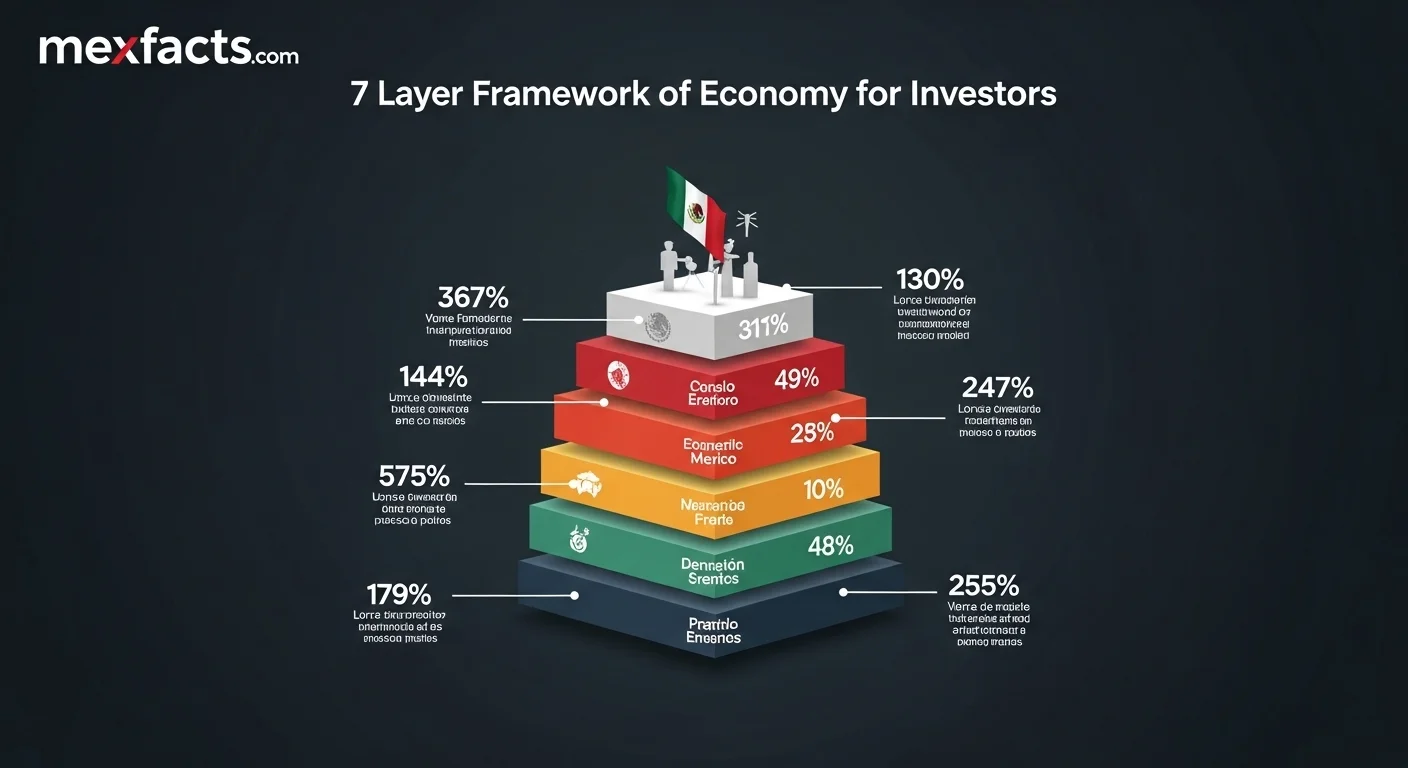
What is the 7-Layer Framework for Mexico's Economy?
The 7-Layer Framework is a macroeconomic model designed to evaluate Mexico's economy through a structured, multi-sector lens. International business discussions often reduce Mexico to either low-cost export assembly along the northern border or coastal beach tourism. While both are significant, evaluating Mexico through only two activities obscures the broader operational reality of a $1.5+ trillion economy supporting nearly 129 million people.
This framework decomposes the Mexican economic system into seven functional, interdependent tiers: foundational natural resources, industrial manufacturing, hospitality services, critical infrastructure, domestic consumer markets, financial capital networks, and knowledge-based services. By analyzing each layer independently and as part of an integrated whole, international investors, supply chain directors, and market analysts can identify specific commercial opportunities, evaluate regulatory structures, and assess operational risks under the United States-Mexico-Canada Agreement (USMCA).
Layer 1: The Foundation — Primary Sector and Natural Resources
The base layer of Mexico's economic structure comprises agriculture, livestock, forestry, fishing, and mineral extraction. While the primary sector generates approximately 3.6% to 4% of Mexico's gross domestic product (GDP) according to the National Institute of Statistics and Geography (INEGI), it represents a strategic pillar for rural employment, food security, and industrial inputs.
Mexico is an established global agricultural exporter, holding market-leading positions in avocados from Michoacán, greenhouse tomatoes from Sinaloa, berries from Jalisco, and agave for tequila and mezcal. In the extractive industries, Mexico maintains a historic legacy as the world's leading producer of silver, while holding globally significant reserves and production capacities in copper, gold, zinc, and fluorite. These natural resources feed directly into domestic processing facilities and supply international industrial buyers.
Layer 2: The Industrial Engine — Manufacturing and Industry
Manufacturing represents the undisputed powerhouse of Mexico's external economy, accounting for roughly 32% of total national GDP and generating the vast majority of non-oil merchandise exports. This layer forms the core of Mexico's participation in North American supply chains under the USMCA trade agreement.
Mexico's manufacturing base is regionally specialized and technologically advanced. The nation ranks among the world's top seven motor vehicle manufacturers and is the fourth-largest global exporter of light vehicles, hosting assembly plants and tier-1 suppliers for General Motors, Ford, Volkswagen, Stellantis, Nissan, BMW, and Toyota across the Bajío and northern industrial corridors. Beyond automotive production, Mexico has established world-class industrial hubs in electronics assembly in Baja California and Chihuahua, medical device manufacturing in Tijuana, and advanced aerospace manufacturing in Querétaro. Operating primarily through the IMMEX maquiladora regulatory framework, this sector is the principal recipient of Foreign Direct Investment (FDI) arriving via nearshoring.
Layer 3: The Services Gateway — Tourism and Hospitality
Tourism and hospitality serve as a primary generator of foreign currency and service-sector employment, directly contributing approximately 8.5% of national GDP according to the Ministry of Tourism (SECTUR) and INEGI. This layer encompasses international resort destinations, metropolitan business travel, cultural tourism, and transportation services.
With more than 30 UNESCO World Heritage sites, extensive coastlines along the Pacific Ocean and Caribbean Sea, and culinary heritage recognized worldwide, Mexico consistently ranks among the top ten most visited countries globally. The United States and Canada represent the overwhelming majority of inbound international travelers. Beyond leisure hospitality, this layer catalyzes private investment into regional infrastructure, airport modernizations, commercial aviation, and real estate development.
Layer 4: The Core Infrastructure — Energy and Logistics
The energy and infrastructure layer forms the physical and logistical backbone that enables all other economic activities. This sector encompasses hydrocarbon extraction and refining, electricity generation and transmission, multimodal freight railways, maritime ports, and highway logistics corridors.
Mexico remains a notable oil producer, with Petróleos Mexicanos (Pemex) and private operators managing extraction across onshore and offshore Gulf basins. Meanwhile, industrial expansion driven by nearshoring has placed urgent emphasis on power grid modernization and renewable energy capacity, including utility-scale solar and wind generation. Critical logistics hubs, including deepwater Pacific ports like Manzanillo and Lázaro Cárdenas, Gulf ports such as Veracruz and Altamira, and modern cross-border rail connections operated by Canadian Pacific Kansas City (CPKC) and Ferromex, are essential arterial links for cross-border freight.
Layer 5: Domestic Demand — Retail and Consumer Goods
The retail and consumer goods layer reflects the purchasing power and everyday economic activity of Mexico's domestic population of nearly 129 million residents. Broad commercial services and retail trade make up the largest overall component of the tertiary sector, which collectively represents over 60% of Mexican GDP.
Mexico's consumer landscape features a dynamic balance between organized modern retail—such as supermarket operators, warehouse clubs, convenience chains like OXXO, and department store chains—and traditional commercial networks like municipal markets and family-owned tienditas. Sustained middle-class expansion, steady inflows of family remittances, and rapid consumer adoption of e-commerce platforms have accelerated modern logistics fulfillment, omnichannel merchandising, and consumer brand expansion.
Layer 6: Capital Intermediation — Financial Services and Fintech
The financial services layer provides the banking liquidity, credit facilities, payment infrastructure, and capital intermediation necessary to support commercial growth. While traditional commercial banking in Mexico is concentrated among established domestic and international institutions (including BBVA México, Banorte, Santander, Citibanamex, and HSBC), the country has become a prominent fintech innovation hub in Latin America.
Following the enactment of Mexico's Financial Technology Institutions Law (Ley Fintech), the domestic market witnessed rapid growth in digital wallets, alternative SME lending, payment gateways, and digital neo-banks. Fintech platforms address historical financial inclusion gaps by offering digital accounts, mobile micro-credit, and low-cost remittance transfers to previously unbanked populations, fostering systemic efficiency across the wider economy.
Layer 7: The Knowledge Economy — Emerging Tech and Professional Services
The top layer represents Mexico's transition toward a high-value, knowledge-intensive economy. This layer includes information technology outsourcing, software engineering, enterprise cloud solutions, hyperscale data center operations, and corporate professional services such as legal, accounting, tax, and engineering consultancy.
Bolstered by a growing pool of technical talent—graduating more than 110,000 engineering and technology students annually—cities such as Guadalajara, Mexico City, Monterrey, and Querétaro have developed into major technology and shared-services hubs. Hyperscale cloud providers and multinational corporations continue to establish enterprise data centers and regional shared-services headquarters in Mexico, capitalizing on time-zone alignment with the United States, competitive operational overhead, and a bilingual technical workforce.
Macroeconomic Data and Statistical Evidence Across the 7 Layers
Evaluating Mexico's economic resilience requires examining official indicators published by Mexico's National Institute of Statistics and Geography (INEGI), the Secretariat of Economy (SE), and the Bank of Mexico (Banxico). Mexico's total nominal GDP exceeds US $1.5 trillion, supported by strong macroeconomic fundamentals, managed sovereign debt levels, and robust Foreign Direct Investment (FDI) inflows consistently surpassing US $35 billion annually.
Layer 1 Data: Primary Sector and Mining Indicators
The primary sector generates over 1.45 trillion MXN in annual economic output, representing between 3.6% and 4.0% of Mexico's total gross domestic product. While periodic agricultural droughts in northern and central states create quarterly volatility, the sector demonstrates structural export resilience. Mexican agri-food exports consistently generate more than US $40 billion annually, with fresh vegetables, avocados, berries, and malt beer leading total shipments to the United States.
In mineral commodities, data from the U.S. Geological Survey (USGS) and the Mexican Mining Chamber (CAMIMEX) confirms that Mexico remains the world's leading producer of mined silver, accounting for over 20% of global output. The nation is also among the top ten global producers of copper, gold, bismuth, and fluorite, driving billions of dollars in annual industrial raw material exports.
Layer 2 Data: Manufacturing and Export Performance
Manufacturing is the dominant recipient of foreign capital, capturing between 40% and 50% of total annual FDI into Mexico. Secondary activities as a whole generate approximately 32% of national GDP and more than 88% of total non-oil merchandise exports.
The automotive industry serves as the primary export driver, producing between 3.5 and 4.0 million vehicles annually and accounting for roughly 30% of Mexico's total manufacturing exports. The electronics manufacturing sector represents over US $70 billion in annual cross-border shipments, while medical device manufacturing generates over US $10 billion in exports, positioning Mexico as the leading supplier of advanced medical instruments to the North American market.
Layer 3 Data: Tourism Inflows and Foreign Exchange
Official data from SECTUR and INEGI indicates that Mexico welcomes more than 40 million international tourists annually, generating foreign exchange revenues exceeding US $30 billion. International visitor spending serves as a critical offset to the national merchandise trade balance.
Air passenger arrivals remain concentrated in major international gateways, primarily Cancún, Mexico City, Los Cabos, and Puerto Vallarta. Cruise tourism accounts for over 8 million arriving passengers annually across ports like Cozumel, Majahual, and Ensenada. The hospitality industry accounts for approximately 4.8 million direct and indirect jobs, representing nearly 9% of formal employment in Mexico.
Layer 4 Data: Energy Generation and Infrastructure Capital Flows
Hydrocarbon extraction continues to provide essential fiscal revenue, with crude oil production averaging between 1.6 and 1.8 million barrels per day through Pemex and private exploration contracts. The energy sector requires substantial capital expenditure to meet rising industrial consumption driven by nearshoring.
Industrial real estate indicators tracked by the Mexican Association of Industrial Parks (AMPIP) demonstrate the infrastructure strain: industrial vacancy rates across northern manufacturing hubs such as Monterrey, Ciudad Juárez, and Tijuana reached historic lows of under 2.5% in recent periods. Construction spending on logistics warehousing, electrical substations, and freight terminals attracted billions in private capital expenditure to absorb international tenant demand.
Layer 5 Data: Domestic Commerce and Consumer Spending
Mexico's tertiary services sector represents between 60% and 64% of national GDP. Retail trade activity monitored by the National Association of Supermarkets and Department Stores (ANTAD) reflects steady domestic consumption supported by real wage growth and annual foreign remittance inflows exceeding US $60 billion.
The Mexican e-commerce market has expanded into one of the fastest-growing digital commerce ecosystems in the world, with annual digital retail valuations exceeding US $30 billion. The adoption of omnichannel retail logistics, smart parcel lockers, and mobile shopping applications has fundamentally altered consumer distribution channels in major urban centers.
Layer 6 Data: Fintech Adoption and Financial System Metrics
The Mexican financial ecosystem is characterized by strong banking capitalization ratios and rapid fintech growth. According to reports from Finnovista and the Bank of Mexico, Mexico hosts more than 700 operating fintech companies, making it the second-largest fintech ecosystem in Latin America.
Venture capital investments into Mexican fintech have historically represented over 60% of all venture funding entering the country. With national smartphone penetration exceeding 80% among the adult population, mobile payments, digital payroll advances, and neobank card issuances have expanded formal banking access to millions of previously unbanked consumers and micro-enterprises.
Layer 7 Data: Technology Hubs and Professional Services Output
Information technology, software development, and professional corporate services represent Mexico's fastest-evolving high-value segment. Mexico produces more than 110,000 STEM and engineering graduates annually, providing the technical talent needed for enterprise IT services and software architecture.
Data center infrastructure investment in the Bajío corridor, particularly in Querétaro, has attracted multi-billion-dollar investments from global cloud service providers, establishing several hundred megawatts of planned server capacity. This high-value technological layer supports business process outsourcing (BPO), legal advisory, audit compliance, and engineering consulting for multinational firms operating across the hemisphere.
Strategic Outlook: Opportunities, Nearshoring Drivers, and Investor Due Diligence
The medium- to long-term outlook for Mexico's economy is defined by global supply chain reconfiguration and North American industrial integration. Nearshoring—the relocation of manufacturing and supply chain operations closer to final consumer markets—has positioned Mexico as the primary regional partner for international corporations seeking resilience against geopolitical disruptions and trans-Pacific maritime bottlenecks.
Nearshoring Dynamics Across the Value Chain
While early nearshoring discussions focused primarily on factory relocation, the actual impact reverberates across every layer of the Mexican economy. Tier-2 and Tier-3 suppliers are establishing regional plants to meet USMCA regional value content requirements, particularly in the automotive and electronics industries.
To maintain long-term competitive advantages, corporate decision-makers must prepare for the scheduled 2026 joint review of the USMCA. Compliance with trade rules of origin, environmental covenants, and labor enforcement standards under the Rapid Response Labor Mechanism will remain central to maintaining tariff-free market access across North America.
Operational Risk Factors and Due Diligence Priorities
Foreign corporate entities and institutional investors entering Mexico must conduct structured operational due diligence across several critical regulatory and logistical dimensions:
- Energy Reliability and Transmission: Rapid industrial park expansion in the north and Bajío regions has placed heavy demands on regional electricity transmission capacity. Investors must verify power availability, substation access, and clean energy procurement options early in the site-selection process.
- Water Availability: Arid northern and central manufacturing states face strict municipal water allocation policies. Industrial processes requiring substantial water usage must budget for recycling facilities, closed-loop systems, and local concessions from the National Water Commission (CONAGUA).
- Labor Compliance and Subcontracting Reforms: Mexico's labor reform strictly regulates specialized service contracting (REPSE) and establishes mandatory employee profit-sharing (PTU). Operations must adhere directly to federal labor statutes and collective bargaining legitimation processes.
- Corporate Legal Structuring: Foreign commercial operations are governed by Mexico's Foreign Investment Law. International companies typically structure local legal entities as a Sociedad Anónima de Capital Variable (S.A. de C.V.) or a Sociedad de Responsabilidad Limitada de Capital Variable (S. de R.L. de C.V.), requiring formal registration with the National Registry of Foreign Investments (RNIE) and tax registration with the Tax Administration Service (SAT).
Sector-by-Sector Growth Horizons
Future capital allocation across Mexico's seven layers is concentrated in specialized, high-productivity niches:
- Layer 1 (Primary Sector): High-efficiency protected agriculture, automated drip irrigation, biological crop protection, and sustainable mining processing.
- Layer 2 (Manufacturing): Electric vehicle (EV) component supply chains, battery assembly, aerospace composites, and precision medical manufacturing.
- Layer 3 (Tourism): High-yield eco-tourism, cultural heritage tourism in colonial cities, and extended-stay executive hospitality in commercial hubs.
- Layer 4 (Infrastructure): Multi-tenant industrial park development, private solar power purchase agreements (PPAs), and intermodal logistics terminals.
- Layer 5 (Retail): Automated warehousing fulfillment, last-mile cold-chain distribution, and digital payment integration across traditional retail.
- Layer 6 (Fintech): Cross-border B2B trade financing, digital supply chain factoring, and regulatory-compliant crypto-asset settlement rails.
- Layer 7 (Emerging Tech): Enterprise cybersecurity, AI-assisted business process services, and green data center development.
Frequently Asked Questions About Mexico's Economic Sectors
- What are the main sectors driving Mexico's economy?
- Mexico's economy is driven by three broad sectors: the tertiary services and commerce sector, representing roughly 60% to 64% of GDP; the secondary industrial and manufacturing sector, generating approximately 32% of GDP; and the primary agricultural and mining sector, accounting for 3.6% to 4% of GDP.
- Which sector receives the highest Foreign Direct Investment in Mexico?
- The manufacturing sector consistently receives the largest share of Foreign Direct Investment in Mexico, capturing between 40% and 50% of total annual FDI inflows, followed by financial services, commercial retail, and transport logistics.
- How does nearshoring impact sectors beyond manufacturing in Mexico?
- While nearshoring begins with factory relocation in automotive, electronics, and aerospace manufacturing, it generates substantial demand across industrial warehousing, electrical grid infrastructure, commercial lending, logistics software, and specialized legal and accounting advisory services.
- What legal structures are commonly used by foreign companies operating in Mexico?
- Foreign investors typically establish either a Sociedad Anónima de Capital Variable (S.A. de C.V.) or a Sociedad de Responsabilidad Limitada de Capital Variable (S. de R.L. de C.V.), registered with Mexico's National Registry of Foreign Investments (RNIE) and the Tax Administration Service (SAT).
Expert Reviews
Michael Chen, Logistics CEO ⭐⭐⭐⭐⭐
I was considering nearshoring options, and this article was a game-changer. The '7-layer' idea seemed quirky at first, but it perfectly organized the complexities of Mexico's market. It helped us see beyond the factory floor to the infrastructure and tech layers supporting it. We're now moving forward with an investment in the Bajío region's auto supply chain. ¡Gracias!
Sofia Herrera, Fintech Developer ⭐⭐⭐⭐⭐
As someone working in Mexico's tech sector, I'm tired of articles that only talk about tourism or old-school manufacturing. This piece truly 'gets it.' It understands our booming fintech scene and the potential in our knowledge economy. It's a respectful and insightful look at the modern Mexico I live and work in. Finally, an article that sees the whole picture.
Dr. Alan Jones, University Professor ⭐⭐⭐⭐
I used this as a resource for my international business class. The metaphor made it so much easier for my students to understand how different sectors, from agriculture in Sinaloa to the tech hubs in Guadalajara, all connect to form one powerful economy. A brilliant and highly effective teaching tool.