
Mexico in 2024: Economic Overview, Political Transition, and Tourism Trends

The year 2024 marked a defining turning point for Mexico, characterized by a historic presidential election, expanding nearshoring investment, and record-setting international tourism. The election of Claudia Sheinbaum Pardo on June 2, 2024, followed by her inauguration on October 1, 2024, established the nation's first female presidency alongside a commanding congressional majority for the ruling coalition. Economically, Mexico consolidated its status as the primary trading partner of the United States, drawing historic Foreign Direct Investment driven by profit reinvestment and industrial relocation. This comprehensive analysis details the political landscape, macroeconomic metrics, infrastructure milestones such as the Tren Maya, and key structural challenges facing the country.
What Does 2024 Mean for Mexico on the World Stage?
In 2024, Mexico solidified its standing as a critical geopolitical and macroeconomic anchor in North America. The year was defined by two central milestones: the historic general election that brought Claudia Sheinbaum Pardo to the presidency and Mexico's consolidation as the primary trading partner of the United States. Propelled by the global realignment of manufacturing supply chains known as nearshoring, Mexico navigated major constitutional and electoral transitions while maintaining unprecedented momentum across international trade and tourism.
Table of Contents
- The Political Climate and Its Global Relevance
- The Economic Landscape and the Nearshoring Wave
- Tourism: A Pillar of Economic Strength
- Investment and Nearshoring by the Numbers
- Trade and Economic Performance
- Tourism Statistics: A Tale of Success
- Future Business and Investment Opportunities
- The Strategic Evolution of Mexican Tourism
- Navigating the Challenges Ahead
The Political Climate and Its Global Relevance
The June 2, 2024 general election transformed Mexico's political landscape. Former Head of Government of Mexico City and environmental scientist Claudia Sheinbaum Pardo achieved a decisive victory, capturing nearly 60% of the popular vote and receiving more than 35.9 million votes—the highest tally in Mexican democratic history. She took office on October 1, 2024, as the nation's first female president, pledging continuity with the social programs and sovereignty agenda of her predecessor, Andrés Manuel López Obrador.
The ruling Sigamos Haciendo Historia coalition (Morena, PT, and PVEM) achieved a qualified two-thirds supermajority in the Chamber of Deputies and built a matching supermajority in the Senate. This legislative power enabled the swift passage of transformative constitutional initiatives in September 2024, most notably a fundamental reform of the federal judiciary mandating the direct popular election of judges and Supreme Court ministers. For international investors and trading partners under the United States-Mexico-Canada Agreement (USMCA), this concentrated political power provides robust legislative stability while prompting careful evaluation regarding institutional checks, regulatory predictability, and preparation for the upcoming mandatory 2026 USMCA joint review.
The Economic Landscape and the Nearshoring Wave
Mexico's economy in 2024 was heavily shaped by nearshoring—the strategic relocation of manufacturing capacity to countries geographically proximate to primary consumer markets. Driven by USMCA tariff protections, competitive manufacturing costs, and corporate efforts to mitigate transpacific logistics risks, multinational enterprises continued expanding their industrial footprint across northern and central Mexico. Strategic focus areas included automotive manufacturing, aerospace parts, medical devices, electronics, and semiconductor packaging.
To capitalize on this structural shift, the federal government promoted regional industrial development poles, offering targeted fiscal incentives and simplified administrative procedures in key logistics corridors such as the Interoceanic Corridor of the Isthmus of Tehuantepec (CIIT). Nevertheless, capital inflows highlighted a distinct trend: the overwhelming bulk of investment came from the reinvestment of earnings by companies with an established domestic footprint, while new greenfield entrants evaluated infrastructure bottlenecks, electrical grid capacity, water availability, and regulatory certainty.
Tourism: A Pillar of Economic Strength
Tourism remained one of the most reliable pillars of the Mexican economy throughout 2024, generating essential foreign exchange, regional employment, and widespread service-sector activity. The sector demonstrated remarkable strength, with traveler expenditures and visitor arrivals consistently surpassing pre-pandemic benchmarks.
Quintana Roo and the Mexican Caribbean retained their position as the country's preeminent travel engine. Cancun International Airport (CUN) functioned as the primary international gateway, receiving millions of travelers seeking world-class coastal resorts, Mayan cultural heritage, and ecological reserves along Mexico's renowned coastal destinations. The operational rollout of the Tren Maya (Mayan Train) network across the Yucatán Peninsula, coupled with the opening of Tulum International Airport, introduced direct overland connectivity between coastal hubs and historically underserved interior communities, establishing a modern multi-destination model for cultural and ecological exploration.
What the Numbers Tell Us About Mexico in 2024
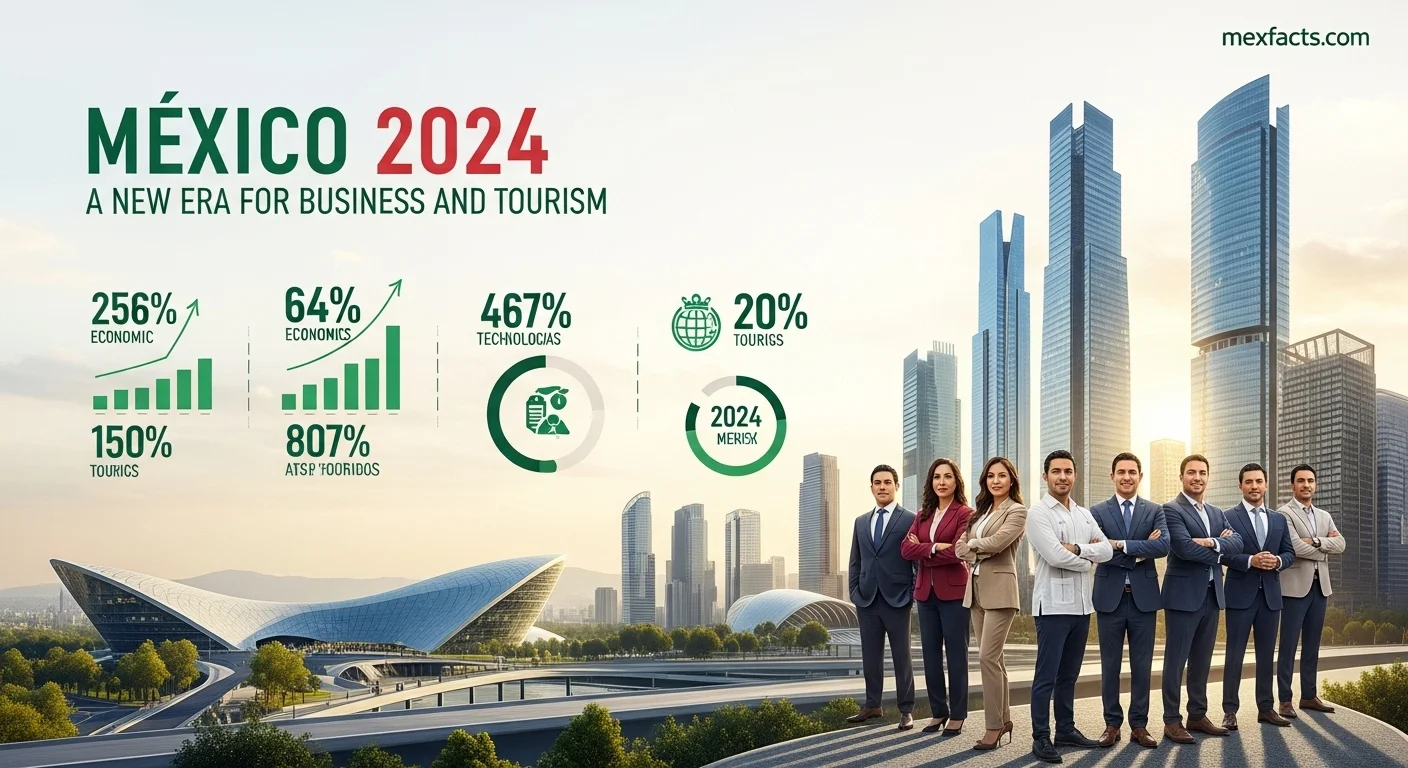
The macroeconomic and sector data for 2024 underscore a country experiencing strong external demand and robust service activity, balanced against tightening fiscal conditions and deliberate monetary constraints. Key figures across direct investment, cross-border commerce, and hospitality define the economic reality.
Investment and Nearshoring by the Numbers
Foreign Direct Investment (FDI) data published by Mexico's Secretariat of Economy (Secretaría de Economía) registered record totals in 2024, surpassing $31 billion in the first half of the year and climbing above $36 billion overall. This inflow highlighted steady corporate confidence among existing global manufacturers.
The internal structure of this capital, however, reveals critical nuances:
- Reinvestment of Earnings: Approximately 74% to 78% of total FDI was driven by existing companies reinvesting their profits into Mexican operations, illustrating high confidence from experienced market participants.
- Intercompany Transfers: Intercompany loans and debt accounts represented approximately 15% to 18% of aggregate flows.
- New Greenfield Investments: Brand-new capital accounted for less than 8% of recorded inflows, indicating that prospective new entrants adopted a cautious stance while analyzing constitutional reforms and infrastructure readiness.
- Origin and Geography: The United States remained the primary source country, contributing nearly 45% of total FDI, followed by Germany, Japan, and Canada. Inflows concentrated predominantly in Mexico City, Nuevo León, Baja California, and the State of Mexico, with manufacturing absorbing approximately half of all registered capital.
Trade and Economic Performance
In bilateral commerce, Mexico solidified its standing as the United States' top trading partner throughout 2024. Total two-way merchandise trade surpassed $800 billion, with Mexican goods capturing more than 15% of all U.S. imports. This milestone positioned Mexico ahead of both China and Canada in goods trade with the U.S., serving as clear statistical validation of supply chain realignment under the USMCA.
Broader macroeconomic metrics demonstrated moderation following previous years of rapid post-pandemic rebound:
- GDP Growth: Real gross domestic product expanded at an estimated rate of 1.5% to 2.0% in 2024, down from 3.2% in 2023, reflecting tighter monetary policy and deceleration in U.S. industrial output.
- Fiscal Deficit: The broad federal deficit (Public Sector Borrowing Requirements, RFSP) widened to approximately 5.9% of GDP—its highest level in more than three decades—resulting from the finalization of flagship public infrastructure projects such as the Tren Maya and the Dos Bocas refinery, alongside universal non-contributory pension programs.
- Monetary Policy: The Bank of Mexico (Banxico) maintained its benchmark interest rate in restrictive territory (above 10.00% through late 2024) to contain persistent core inflation and anchor medium-term inflation expectations near its 3.0% target.
Tourism Statistics: A Tale of Success
In sharp contrast to the slowing industrial growth rate, Mexico's tourism indicators set historical records in 2024. The country welcomed approximately 45 million international tourist arrivals, according to data from the National Institute of Statistics and Geography (INEGI) and the Secretariat of Tourism (SECTUR). This volume preserved Mexico's standing among the top seven most visited nations globally and confirmed its leadership as the leading tourism destination in Latin America.
Foreign exchange revenue generated by international visitors exceeded $31 billion in 2024, demonstrating that international travelers spent substantially more per visit than in prior years. Cancun International Airport continued to handle more than 40% of all international air passengers arriving in Mexico, underscoring Quintana Roo's enduring appeal. Concurrently, regional connectivity initiatives allowed destinations across the Yucatán Peninsula, Oaxaca, and Baja California Sur to register healthy occupancy and revenue gains.
The Future: What Opportunities Await in Mexico After 2024?
As Mexico enters the post-2024 era under the administration of President Claudia Sheinbaum, strategic opportunities and policy challenges stand closely intertwined. Capitalizing on industrial relocation, modernizing infrastructure, and maintaining macroeconomic discipline will determine Mexico's long-term competitive trajectory.
Future Business and Investment Opportunities
Significant commercial prospects exist across specialized sectors aligned with North American industrial priorities:
- Automotive and Electric Vehicle (EV) Ecosystem:
- Mexico represents the world's seventh-largest passenger vehicle producer. The global transition toward vehicle electrification presents major opportunities for Tier-1 and Tier-2 suppliers specializing in EV powertrains, lithium battery components, and lightweight structural materials complying with USMCA rules of origin.
- Semiconductor Packaging and Electronics:
- Through bilateral collaboration under the U.S. CHIPS Act, Mexico is developing back-end semiconductor assembly, testing, and packaging (ATP) capabilities in high-tech corridors like Jalisco, Baja California, and Chihuahua.
- Logistics Corridors and Interoceanic Trade:
- The Interoceanic Corridor of the Isthmus of Tehuantepec (CIIT), linking Salina Cruz on the Pacific with Coatzacoalcos on the Gulf of Mexico, provides a viable multimodal transshipment alternative between Asian manufacturing centers and eastern North American ports.
- Clean Energy and Resource Management:
- Fulfilling corporate decarbonization mandates necessitates large-scale private and public investment in electrical transmission lines, solar and wind generation, industrial wastewater recycling, and energy efficiency solutions.
The Strategic Evolution of Mexican Tourism
Mexico's tourism model is actively evolving from traditional resort concentration toward diversified, high-value cultural and eco-tourism. While coastal resorts remain essential economic anchors, visitor demand is expanding into culinary explorations, heritage preservation, and nature travel.
The operational network of the Tren Maya enables travelers to combine Quintana Roo's Caribbean coastline with ancient archaeological sites such as Calakmul, Palenque, and Uxmal, and historic colonial cities like Mérida and Campeche. This expanded transit network spreads tourism revenues across regional economies, incentivizes boutique and eco-certified hospitality projects, and mitigates congestion at traditional hotspots.
Navigating the Challenges Ahead
Realizing Mexico's full economic potential requires addressing key structural issues:
- Legal Predictability and Judicial Transition: The implementation of the 2024 constitutional judicial reform will be evaluated closely by domestic and foreign corporations. Preserving institutional predictability, contract enforcement, and independent dispute resolution mechanisms will be essential for attracting new greenfield investment.
- Infrastructure and Resource Bottlenecks: Industrial expansion in northern and central corridors requires rapid expansion of electrical transmission grids, renewable power generation, and sustainable water management systems to avoid growth bottlenecks.
- Fiscal Consolidation: The Sheinbaum administration must navigate a disciplined fiscal consolidation plan to reduce the public deficit from approximately 5.9% of GDP without undermining critical public investment or essential social safety nets.
- The 2026 USMCA Joint Review: The mandatory six-year review of the USMCA in 2026 will test commercial diplomacy between Mexico, the United States, and Canada, particularly regarding rules of origin in the automotive sector, energy regulation, and labor dispute mechanisms.
For authoritative macroeconomic data, development indicators, and institutional country assessments, refer to the World Bank Mexico overview.
Expert Reviews
David Chen, Tech CEO ⭐⭐⭐⭐⭐
As an entrepreneur looking to nearshore our operations, this article was a godsend. It cut through the political noise and gave a clear, balanced picture of the real opportunities and risks in post-election Mexico. The insights on the 'Mexico Plan' were particularly valuable for our strategic planning.
Sarah Jenkins, Traveler ⭐⭐⭐⭐⭐
My family and I were planning a trip to Cancun this year, and I was a bit nervous after reading headlines about the election. Reading this put my mind at ease. It explained everything so clearly and humanly, and now I'm even more excited to explore the Yucatan and maybe even try the new Tren Maya!
Alejandro Vargas, University Student ⭐⭐⭐⭐
A fantastic and balanced overview. As a political science student focusing on Latin America, I found the analysis of the Morena party's supermajority and the upcoming USMCA review challenges to be incredibly insightful. It’s well-explained for a broad audience without sacrificing depth.