
Mexico's Economy: A 7-Layer Guide to Uncovering Investment Opportunities

This article offers a unique '7-Layer' framework to truly understand Mexico's robust and multifaceted economy. It's crafted for international investors, business leaders, and anyone curious about what makes Mexico tick. Now, let's be clear about something I love: the famous '7-layer dip' that inspired this model is a Tex-Mex creation, not something you'd find in my grandmother's kitchen in Puebla. But its structure—distinct, delicious layers that create something amazing together—is the perfect metaphor for Mexico's economy. Having spent years traveling from the industrial heartlands of the north to the rich agricultural fields of the south, I've seen how these layers connect. We'll move from the foundational primary sector, the very soul of the land, to the dynamic, high-growth industries steering its future. Each layer is explored with current data and real-world insights, offering a clear map for those looking to partner with one of the world's most important emerging markets.
Table of Contents
- Layer 1: The Foundation (The Beans) - Primary Sector and Natural Resources
- Layer 2: The Defining Engine (The Guacamole) - Manufacturing and Industry
- Layer 3: The Welcoming Heart (The Crema) - Tourism and Hospitality
- Layer 4: The Powerful Core (The Meat) - Energy and Infrastructure
- Layer 5: The Vibrant Pulse (The Pico de Gallo) - Retail and Consumer Goods
- Layer 6: The Smart Connector (The Cheese) - Financial Services & Fintech
- Layer 7: The Future-Forward Finish (The Toppings) - Emerging Tech and Professional Services
What is the 7-Layer Framework for Mexico's Economy?
When international investors think of Mexico, their minds often jump to two things: sunny beaches or sprawling factories. But that's like looking at a masterpiece and only seeing two colors. The reality is far more complex, vibrant, and layered. To really grasp the opportunities in this Latin American powerhouse, I want to introduce a model I've developed: the 7-Layer framework. It's essential to start with a little cultural honesty. The **7-layer dip** is a beloved Tex-Mex dish, born from the beautiful fusion of cultures in Texas, not a traditional recipe from Mexico's heartland. I embrace this origin because it's the perfect metaphor for our economic exploration—a model for understanding diverse parts that, together, create a powerful and appealing whole. Just as every ingredient in a great dip has its own flavor, each sector of Mexico’s economy has its own story, strengths, and data that form a complete picture for global partners.
This framework isn't just a fun idea; it's a vital tool for strategy. With nearly 130 million people and an economy that ranks among the world's largest, Mexico is a landscape of profound opportunity. It’s a sophisticated blend of time-honored industries and cutting-edge sectors. For decades, Mexico has painstakingly built strong macroeconomic foundations and woven itself into the fabric of global trade, making it a critical player. This guide peels back these layers to give you clarity and strategic insight.
Layer 1: The Foundation (The Beans) - Primary Sector and Natural Resources
Every great dish, and every great nation, needs a solid foundation. In our model, this is the hearty base of refried beans. For Mexico, this foundational layer is its Primary Sector: agriculture, fishing, forestry, and mining. This sector might seem small in GDP terms (around 3.6%), but it's the bedrock of our national heritage, a huge source of jobs, and the raw material supplier for our world-class industries. You can't talk about Mexico without talking about the land. We are an agricultural powerhouse, famous for our avocados from Michoacán, tomatoes from Sinaloa, and berries from Jalisco. In 2022, sugar cane and our sacred maize were the top crops. The value here is immense. Beyond the fields, Mexico's history is written in silver—we're still the world's largest producer—and we are a top source for gold, copper, and zinc. To understand Mexico, you must first understand this foundational layer, the deep connection to the earth that feeds our people and our factories.
Layer 2: The Defining Engine (The Guacamole) - Manufacturing and Industry
Guacamole gives a dish its defining, iconic character. For Mexico, the defining layer of its modern economy is without a doubt its vast and sophisticated manufacturing sector. This industrial engine contributes nearly 32% to our GDP and powers our export economy. It's incredibly diverse, from the automotive giants in the Bajío region to the aerospace innovators in Querétaro and the electronics hubs along the border. Mexico is the 7th largest car producer in the world; names like GM, Ford, and VW are part of our landscape. The IMMEX (maquiladora) program turned our northern border into a key piece of the global supply chain, especially for electronics. This is where the world's products get made. It’s no surprise that in early 2024, manufacturing soaked up 43% of all Foreign Direct Investment (FDI). This layer's success is deeply intertwined with the US market under the USMCA, making it the 'guacamole' of our economy—rich, essential, and globally recognized.
Layer 3: The Welcoming Heart (The Crema) - Tourism and Hospitality
The cool, rich *crema* (sour cream's authentic cousin) in a dip connects all the other flavors. In Mexico, this is our tourism and hospitality sector—the welcoming heart of our economy. Tourism is a massive driver, contributing around 8.6% to the national GDP and supporting millions of families. People don't just come for the incredible beaches; they come for the magic of ancient sites like Chichén Itzá, the vibrant life of our cities, and the warmth of our culture. We have over 30 UNESCO World Heritage sites for a reason. This sector is booming. In early 2024, international visitor spending jumped 6.4% to over US $13 billion. The steady flow of travelers from the US, Canada, and around the globe highlights an enduring appeal. This layer isn't just about hotels and tours; it fuels construction, transport, and retail, making it a vital connector in our economic structure.
Layer 4: The Powerful Core (The Meat) - Energy and Infrastructure
For a heartier, more substantial dish, you add seasoned ground beef. This is Mexico's Energy and Infrastructure sector—our powerful core. Historically led by state companies, this sector is in a period of major transformation. We are a major oil producer, a cornerstone of our exports. But the real story now is the push to modernize our energy grid and develop renewable resources. The government is pouring investment into massive projects like railways, ports, and refineries to boost our economic muscle. These projects create huge opportunities for international firms with expertise in engineering, construction, and technology. A strong infrastructure is the core that supports everything else—from getting parts to a factory to getting tourists to a resort. It is a critical, powerful layer.
Layer 5: The Vibrant Pulse (The Pico de Gallo) - Retail and Consumer Goods
Fresh *pico de gallo* adds a zesty, vibrant kick. This represents Mexico's thriving Retail and Consumer Goods market—the daily pulse of our nation. Fueled by a large, young population and a growing middle class, this sector shows the health of our domestic economy. I love the contrast you see everywhere: the traditional, bustling *mercados* alongside sleek, modern shopping centers. The broader services industry, which includes retail, makes up over 64% of our GDP. With nearshoring, more consumer goods are being made right here, from cosmetics to toys. And e-commerce is exploding, creating new ways to reach customers. Understanding the tastes and trends of this 'zesty' layer is key for anyone wanting to connect with one of Latin America's biggest consumer markets.
Layer 6: The Smart Connector (The Cheese) - Financial Services & Fintech
The cheese layer melts and binds everything together. In our framework, this is Mexico's fast-evolving Financial Services and Fintech sector. This layer enables all the others, providing the capital and payment systems for business to flow. While big banks are still dominant, the real excitement is in Fintech. Mexico has become a Fintech hub in Latin America, with nearly 1,000 startups. This isn't just hype; in 2023, Fintech attracted a staggering $865 million in venture capital. Why? Because these companies are solving real problems, offering credit to small businesses and bringing millions of people into the formal financial system for the first time. This layer is a dynamic, high-growth engine in its own right.
Layer 7: The Future-Forward Finish (The Toppings) - Emerging Tech and Professional Services
The final toppings—the olives, the cilantro—are the finishing touch, the element of modern flair. This includes our growing IT sector, software development, data centers, and advanced business services. Thanks to nearshoring, Mexico is becoming a key hub for data centers serving North America. Global tech giants are expanding here, drawn by our skilled talent. The rollout of 5G will only accelerate this. Alongside tech, a sophisticated professional services industry—lawyers, accountants, consultants—has grown to support the complex needs of global companies. This layer shows our push towards a knowledge-based economy. It's the final, sophisticated polish that makes Mexico's economic 'dip' a truly world-class offering.
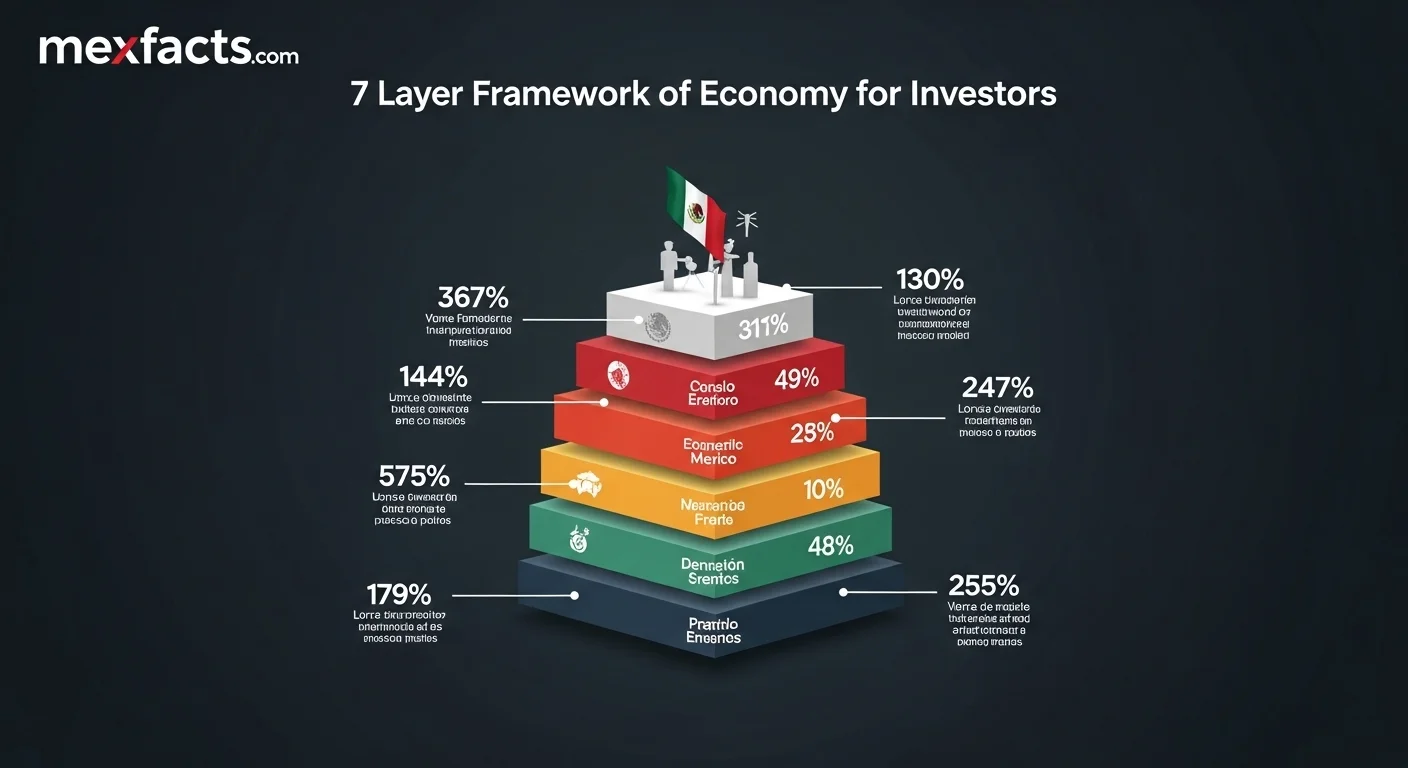
The Numbers Behind the Layers: A Look at Mexico's Economic Data
A good story needs evidence, and to truly understand Mexico's economy, we need to look at the numbers. They tell a fascinating tale about each of our seven layers, showing their contribution to our country, their role in the world, and their appeal to investors. Think of this data as the recipe—the exact measurements that guarantee a perfect result. Without these numbers, any analysis would be incomplete.
Mexico's economy has shown impressive resilience. After solid growth in 2023, forecasts for 2024 and 2025 are more moderate, reflecting global uncertainties and a potential slowdown in the U.S. economy. Yet, despite these headwinds, Foreign Direct Investment (FDI) remains remarkably strong, signaling long-term confidence. In the first quarter of 2024, Mexico attracted a record FDI of US$20.3 billion. Let's dig into the data for each of our seven layers.
Layer 1 Data: The Primary Sector
The foundational primary sector, while a smaller slice of the GDP pie, is incredibly significant. In late 2023, its GDP stood at $1.45T MX. However, its performance can be volatile. We've faced serious droughts that have impacted production. Yet, it showed a strong rebound in early 2024 with a remarkable 8.1% quarterly jump, proving its resilience. Specific crops generate immense value; Agave brings in over 1.4 million MXN per hectare. In trade, our agricultural exports to the U.S. are a cornerstone, with avocados, tomatoes, and berries leading the charge. This data points to clear opportunities in agricultural technology (agritech), smart irrigation, and logistics for high-value crops—all essential for strengthening this vital foundation.
Layer 2 Data: Manufacturing and Industry
The manufacturing sector is the undisputed heavyweight and the primary magnet for FDI. It consistently pulls in the largest share of foreign investment, receiving 50% of the total FDI in the first quarter of 2024. The automotive industry is our crown jewel; we are the world's 7th largest auto producer and 4th largest exporter of light vehicles. This sector alone accounts for about a third of Mexico's total exports. Beyond cars, the electronics sector has seen massive investment as companies shift production from Asia. The medical device industry is another giant, with Mexico being the largest supplier to the U.S. The health of this layer is closely tied to the U.S. economy; you can feel the direct connection between our manufacturing output and theirs. The data confirms this sector's role as the 'guacamole' of the economy—its most defining feature for global trade.
Layer 3 Data: Tourism and Hospitality
The data from our tourism sector paints a picture of a vibrant, expanding industry. In April 2024, Mexico saw a 13.5% increase in international tourists compared to the previous year. For the first four months of 2024, this growth powered a 6.4% jump in foreign currency inflows to $13.31 billion. The United States is by far our largest market, followed by Canada. The economic impact is huge. Cruise tourism is also booming, with 3.4 million passengers arriving in the first quarter of 2024, an 11.5% increase. These aren't just numbers; they represent millions of jobs and a powerful economic engine. The sector's consistent growth makes it one of the most reliable and appealing parts of our economic story.
Layer 4 Data: Energy and Infrastructure
Quantifying the energy and infrastructure layer involves looking at both production and investment. As a major oil producer, this industry is a key contributor to exports. But the real story is in the investment flowing into new projects. The government's focus on infrastructure, including railways and port modernization, represents substantial opportunities. Data on FDI in related sectors, like the $700 million in construction in Q1 2024, gives a partial view. Analyzing this layer requires looking at long-term development plans. It represents the substantial core that underpins our entire economy's potential. The need for a modern energy grid and expanded logistics networks signals long-term demand for international expertise and technology.
Layer 5 Data: Retail and Consumer Goods
This layer is best understood through data on the services sector, which is the largest part of the Mexican economy at over 64% of GDP. In late 2023, the services sector was the primary driver of overall growth, expanding by 2.3%, a sign of healthy domestic demand. Our internal market of 129 million people is a formidable economic force. The retail sector itself is part of a commercial category that attracted $1.3 billion in FDI in Q1 2024. The dynamism of this layer, our zesty *pico de gallo*, is reflected in the rapid adoption of e-commerce and the steady influx of international brands catering to the Mexican consumer.
Layer 6 Data: Financial Services & Fintech
The data from the financial services and Fintech layer tells a story of explosive, tech-driven growth. The Mexican Fintech market is projected to grow at a compound annual rate of nearly 13% through 2033. This growth is fueled by high digital penetration, with over 81% of the population online. As of 2023, we had over 770 local Fintech companies. The investment data is equally impressive. In 2023, Fintech captured 74% of all venture capital investment in the country. The broader financial services sector captured 24% of all FDI in Q1 2024, or $5.2 billion, second only to manufacturing. This shows that investors see immense value in this smart connector, the 'cheese' that facilitates all other transactions.
Layer 7 Data: Emerging Tech and Professional Services
This final, specialized layer showcases Mexico's move toward a higher-value economy. In late 2023, professional services were a key contributor to growth. The broader ICT and digital sectors are a priority, attracting significant U.S. investment. The adoption of advanced tech is remarkable; the number of Fintechs using AI jumped from 28% in 2021 to 52% in 2023. While consolidated data can be elusive, the evidence points to a vibrant and expanding sector. The growth of tech hubs in cities like Guadalajara and Mexico City is creating a powerful innovation ecosystem. This finishing 'topping' adds a sophisticated flavor to Mexico's economic offering, positioning us for the future.
The Future Outlook: Opportunities in Mexico's 7 Layers
So, where is Mexico headed? If you look closely through the lens of our 7-Layer framework, the future is already being written. It’s a future rich with opportunity but also marked by challenges. For any investor or business leader, understanding these dynamics is key. It’s like knowing which new ingredients can elevate a great dish to a spectacular one. The defining theme for Mexico's future is its strategic position in a changing world, driven by the powerful trend of nearshoring.
The global push to build more resilient supply chains has put Mexico in an incredibly fortunate position. Our border with the U.S., our skilled workforce, and our established manufacturing base make us the natural choice for companies moving operations closer to home. Nearshoring is more than a buzzword; it's a force that will drive growth across multiple layers of our economy, especially manufacturing, logistics, and tech. Realizing this potential means navigating challenges, like the upcoming USMCA review and shifts in trade policy. Let's explore the future outlook for each of our seven layers.
Future of Layer 1 (Primary Sector): Modernization and Sustainability
The future of Mexico's foundational agricultural layer lies in technology and sustainability. The challenges of water scarcity demand investment in agritech, from efficient irrigation to drone monitoring. There's a huge opportunity for companies that can help us grow more with less. Global demand for sustainably sourced products is also a major opening. Mexican producers who can meet these standards will win in high-value export markets. The future here is about making our foundation smarter, more resilient, and more valuable.
Future of Layer 2 (Manufacturing): Nearshoring and Advanced Production
Our manufacturing layer is poised for its next great evolution. The opportunity is to move beyond assembly into higher-value advanced manufacturing, like electric vehicles (EVs), aerospace components, and sophisticated electronics. Attracting this next wave of investment requires more than competitive wages; it needs a highly skilled workforce and world-class infrastructure. The challenge is ensuring that new capital builds new capacity. Success will hinge on public-private partnerships to develop industrial parks, upgrade energy grids, and invest in technical education to make our defining engine even more powerful.
Future of Layer 3 (Tourism): Diversification and Authentic Experiences
While our beautiful beaches will always be a major draw, the future of Mexican tourism lies in diversification. There is immense potential in eco-tourism, cultural heritage tours, medical tourism, and adventure travel. Today's travelers seek unique, authentic experiences. This is an opportunity for regions beyond the usual hubs to shine. Investing in boutique hotels, sustainable tours, and digital platforms that connect travelers with local culture will yield high returns. This is about expanding the appeal of our welcoming heart to a wider, more discerning audience.
Future of Layer 4 (Energy & Infrastructure): The Green Transition and Connectivity
Our powerful core faces a dual challenge: meeting the rising energy demands of industry while transitioning to cleaner sources. This creates a massive opportunity for investment in renewable energy—solar, wind, and geothermal. A modernized national grid is essential. Furthermore, the promise of nearshoring can only be fully realized with world-class infrastructure. Investment in ports, railways, and border logistics is critical to ensure the seamless flow of goods. This is about ensuring our core is not just strong, but also sustainable and efficient.
Future of Layer 5 (Retail & Consumer Goods): The Digital Revolution
The future of this vibrant layer is digital. Mexico's e-commerce market is exploding, but there's still so much room to grow. Opportunities are vast for companies in online retail, last-mile delivery, and digital payments. As more of our population gains access to financial services via Fintech, online consumption will soar. The key challenge is logistics in a large, diverse country. Success here means having your finger on the pulse of the domestic market and the digital tools to serve it.
Future of Layer 6 (Financial Services & Fintech): Deepening Inclusion and Smart Regulation
The Fintech explosion will continue, with the main opportunity being financial inclusion. A huge portion of the Mexican population is still underbanked, a massive untapped market for digital financial services. The potential for peer-to-peer lending, micro-insurance, and low-cost investment platforms is enormous. The challenge will be evolving our regulatory framework to keep pace with innovation, striking a balance between growth and stability. This 'cheese' layer will become even more valuable as it melts into every corner of our economy.
Future of Layer 7 (Emerging Tech & Professional Services): Building the Knowledge Economy
This final layer represents our ambition to become a true knowledge-based economy. The opportunity is to build on our success as an IT hub to become a center for innovation in AI, blockchain, and software development. The growing tech scenes in Mexico City and Guadalajara are proof of this potential. To accelerate this, we need continued investment in higher education and STEM programs. The goal is to create a vibrant innovation ecosystem that retains our best talent. This layer is the sophisticated, future-forward finish that signals Mexico's readiness for the global stage.
By viewing Mexico through this structured, multi-layered lens, you can move beyond generalizations and develop nuanced strategies that tap into the specific opportunities present in each sector, creating your own recipe for investment success.
Expert Reviews
Michael Chen, Logistics CEO ⭐⭐⭐⭐⭐
I was considering nearshoring options, and this article was a game-changer. The '7-layer' idea seemed quirky at first, but it perfectly organized the complexities of Mexico's market. It helped us see beyond the factory floor to the infrastructure and tech layers supporting it. We're now moving forward with an investment in the Bajío region's auto supply chain. ¡Gracias!
Sofia Herrera, Fintech Developer ⭐⭐⭐⭐⭐
As someone working in Mexico's tech sector, I'm tired of articles that only talk about tourism or old-school manufacturing. This piece truly 'gets it.' It understands our booming fintech scene and the potential in our knowledge economy. It's a respectful and insightful look at the modern Mexico I live and work in. Finally, an article that sees the whole picture.
Dr. Alan Jones, University Professor ⭐⭐⭐⭐
I used this as a resource for my international business class. The metaphor made it so much easier for my students to understand how different sectors, from agriculture in Sinaloa to the tech hubs in Guadalajara, all connect to form one powerful economy. A brilliant and highly effective teaching tool.