
Mexico City Profile: Urban Scale, Economic Power, and Cultural Heritage

Mexico City (CDMX) serves as the political, cultural, and financial nucleus of Mexico and stands as one of the world's most populous and vibrant urban centers. With 9.2 million residents in the city proper and nearly 22 million across the greater metropolitan area, the capital seamlessly bridges pre-Columbian foundations with a rapidly modernizing economy. From the ancestral temple ruins of Tenochtitlan and UNESCO-inscribed colonial plazas to bustling corporate corridors, tech incubators, and foreign direct investment inflows, CDMX operates as the definitive crossroads of Latin American commerce and heritage. This profile provides an authoritative analysis of Mexico City's urban scale, key macroeconomic metrics, cultural pillars, and strategic role in global trade and nearshoring.
Table of Contents
- Historical Foundations: From Tenochtitlan to Colonial Grandeur
- Cultural Landscape: World-Class Museums and Public Heritage
- Urban Fabric: Iconic Neighborhoods and Contemporary Life
- Economic Architecture: GDP, Foreign Investment, and Tourism
- Human Capital, Technology, and Mobility Infrastructure
- Strategic Horizon: Nearshoring, Real Estate, and Sustainable Growth
- Frequently Asked Questions
Historical Foundations: From Tenochtitlan to Colonial Grandeur
Mexico City's urban identity is defined by distinct architectural and historical layers constructed directly atop one another. Long before European contact, the Valley of Mexico was home to Tenochtitlan, the capital of the Aztec (Mexica) Empire founded in 1325 on an island within Lake Texcoco. The city represented a triumph of hydraulic engineering, featuring advanced causeways, aqueducts, and chinampas (floating agricultural plots) that supported hundreds of thousands of residents.
Following the Spanish conquest in 1521, the colonial capital was constructed directly over the razed structures of Tenochtitlan. Today, this profound historical juxtaposition is centered in the Centro Histórico, designated a UNESCO World Heritage Site in 1987. At its heart lies the Plaza de la Constitución, widely known as the Zócalo, which ranks among the largest public squares in the world. Flanking the square are two monumental landmarks: the Catedral Metropolitana, built over two centuries and showcasing a blend of Gothic, Baroque, and Neoclassical architecture, and the Palacio Nacional, which houses Diego Rivera's renowned murals depicting Mexican history.
Directly adjacent to the cathedral stands the excavated archaeological site of the Templo Mayor, rediscovered accidentally in 1978. The physical coexistence of pre-Hispanic pyramid foundations beside colonial stone buildings and contemporary administrative headquarters visually documents Mexico City's multifaceted heritage.
Cultural Landscape: World-Class Museums and Public Heritage
With more than 180 museums and cultural institutions, Mexico City ranks among the world's most prolific cultural capitals. Foremost among these is the Museo Nacional de Antropología (National Museum of Anthropology), located in the expansive grounds of Bosque de Chapultepec. Designed by architect Pedro Ramírez Vázquez and opened in 1964, the museum preserves the world's largest collection of pre-Columbian artifacts, including the monolithic Stone of the Sun (Piedra del Sol), monumental Olmec colossal heads, and treasures from Teotihuacán and the Maya lowlands.
Architectural and artistic heritage is equally celebrated across the city's civic venues. The Palacio de Bellas Artes combines ornate Art Nouveau exteriors with refined Art Deco interiors, serving as both Mexico's premier opera house and an exhibition gallery for masterpieces by José Clemente Orozco, David Alfaro Siqueiros, and Diego Rivera. In the southern borough of Coyoacán, the Museo Frida Kahlo (known as the Casa Azul) preserves the intimate personal and artistic environment of one of modern art's most influential painters.
Public green spaces and environmental monuments form an integral counterpoint to urban density. Bosque de Chapultepec, spanning nearly 1,700 acres, serves as the primary ecological buffer for the metropolitan center and houses Castillo de Chapultepec, the only royal castle in the Americas to have housed actual monarchs (Emperor Maximilian I and Empress Carlota), now home to the National Museum of History. To the south, the ancient agricultural canals of Xochimilco preserve working remnants of the Valley of Mexico's pre-Hispanic lacustrine landscape, where traditional trajineras navigate historic waterways alongside active chinampa farming.
Urban Fabric: Iconic Neighborhoods and Contemporary Life
Beyond its monumental civic core, Mexico City's dynamism thrives across distinct urban neighborhoods (colonias), each exhibiting unique architectural heritage and commercial profiles:
- Roma and Condesa: Developed during the late 19th and early 20th centuries, these adjacent neighborhoods feature tree-lined avenues, Porfirian mansions, and Art Deco apartment buildings. Today, they serve as international culinary, design, and creative centers hosting design agencies, boutique hotels, and culinary innovators.
- Polanco: Situated north of Chapultepec, Polanco functions as Mexico City's primary luxury residential and high-end retail corridor, home to multinational corporate offices, Michelin-rated dining establishments, and prominent diplomatic residences.
- Juárez and Cuauhtémoc: Flanking the historic Paseo de la Reforma financial corridor, these neighborhoods combine residential density with emerging contemporary galleries, diplomatic embassies, and commercial centers.
- Coyoacán and San Ángel: Located in the south, these historic towns preserved colonial cobblestone streets, peaceful plazas, artisanal markets, and lush residential compounds that reflect the capital's historic village origins.
Economic Architecture: GDP, Foreign Investment, and Tourism
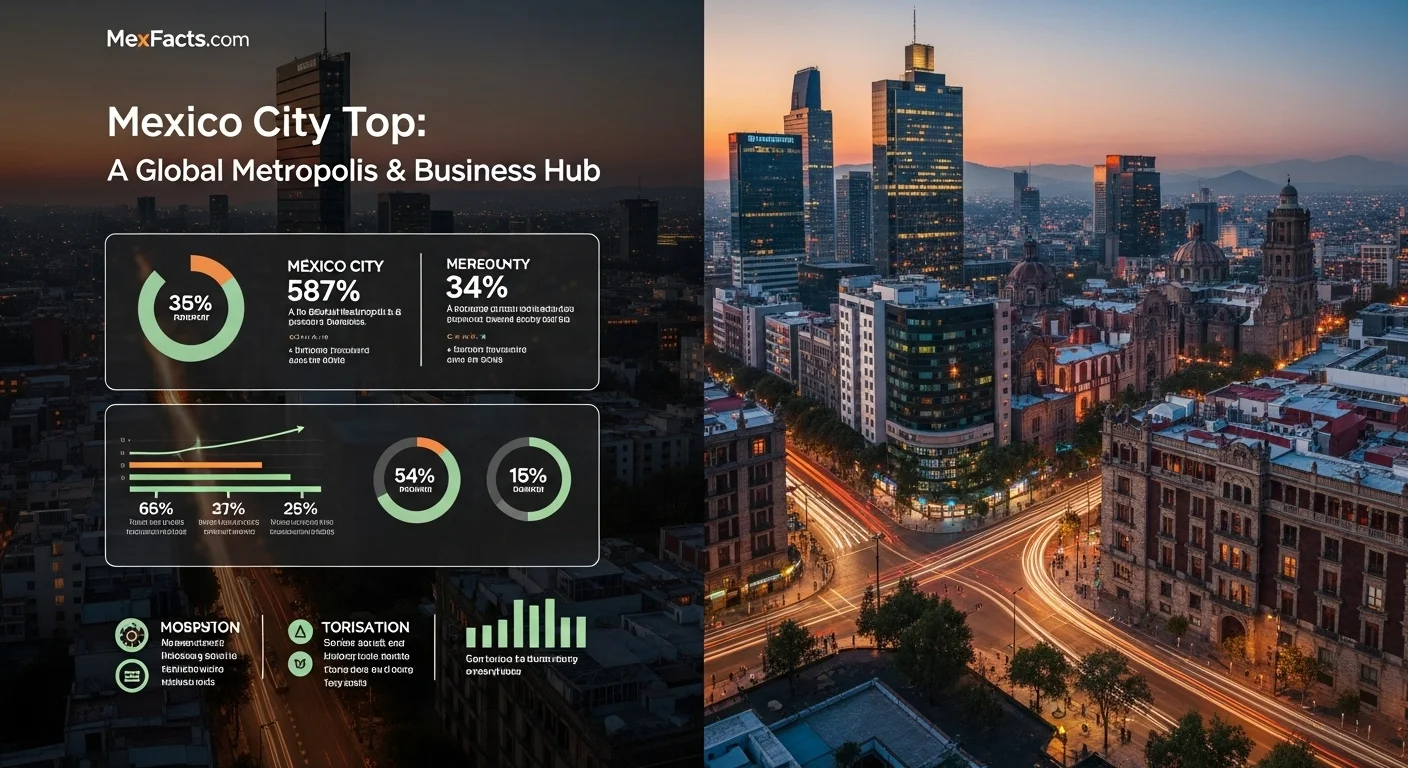
Mexico City is the undisputed financial and macroeconomic capital of Mexico, accounting for approximately 15% to 16% of the country's total Gross Domestic Product (GDP). When including the broader metropolitan area encompassing the State of Mexico and Hidalgo, the regional economic footprint contributes over 22% of national economic output, generating an economy comparable in scale to several sovereign Latin American nations.
The capital's economic profile is heavily oriented toward high-value tertiary activities, with financial intermediation, telecommunications, corporate headquarters, legal and accounting services, and retail commerce forming the core economic drivers. The Paseo de la Reforma and Santa Fe financial corridors house the headquarters of major regional banking institutions, the Bolsa Mexicana de Valores (Mexican Stock Exchange), and regional headquarters for multinational conglomerates.
Foreign Direct Investment (FDI) Inflows
Mexico City consistently serves as the primary magnet for Foreign Direct Investment (FDI) in the country. Official data from Mexico's Ministry of Economy (Secretaría de Economía) demonstrates that CDMX regularly captures between 35% and 55% of all national FDI inflows. International capital streams predominantly fund financial services, corporate restructuring, technological infrastructure, and commercial real estate developments, confirming global institutional investor confidence in the capital's economic stability.
Tourism and Hospitality Resilience
Tourism represents a cornerstone of Mexico City's local economy, generating between 8% and 10% of municipal GDP and supporting hundreds of thousands of direct and indirect service jobs. According to the Mexico City Tourism Secretariat (Secretaría de Turismo de la CDMX), hotel tourist arrivals reached 14.4 million visitors in 2023, surpassing pre-pandemic benchmarks.
With more than 60,000 hotel rooms across diverse hospitality tiers—from historic boutique properties in the Centro to international luxury flagships along Reforma and Polanco—the city maintains world-class capacity for business conventions, international exhibitions, and cultural travel. This capacity will undergo further expansion as Mexico City prepares to host key matches for the 2026 FIFA World Cup at the historic Estadio Azteca.
Human Capital, Technology, and Mobility Infrastructure
A defining competitive advantage of Mexico City is its vast human capital base. CDMX represents Latin America's largest and most concentrated market for digital, engineering, and managerial talent, supported by premier educational institutions:
- Universidad Nacional Autónoma de México (UNAM): The largest university in Latin America and a premier research center, consistently generating thousands of engineering, science, and business graduates each year.
- Instituto Politécnico Nacional (IPN): A public polytechnic powerhouse providing essential technical and industrial engineering leadership.
- Private Academic Institutions: Top private universities including Tecnológico de Monterrey (Campus Ciudad de México and Santa Fe), ITAM (Instituto Tecnológico Autónomo de México), and Universidad Iberoamericana feed executive and analytical talent into corporate and tech sectors.
This academic foundation has fueled an unprecedented startup and venture capital surge. Between 2021 and 2023, regional startups captured billions in venture funding, turning Mexico City into Latin America's premier hub for FinTech platforms, logistics automation, and enterprise software. Major international technology firms have expanded their regional headquarters and software development centers throughout the capital to leverage this competitive talent concentration.
Urban Transit and Mobility Systems
Facilitating economic activity across a metropolis of 22 million requires extensive, multimodal transit networks. The city's integrated mobility framework coordinates diverse transit modes:
- Metro (Sistema de Transporte Colectivo):
- Spanning 12 lines and over 200 kilometers of track, the Metro moves more than 4 million passengers every weekday, serving as the transit backbone of the urban core.
- Metrobús:
- A high-capacity Bus Rapid Transit (BRT) network operating along 7 dedicated corridors, effectively easing congestion along primary arterial thoroughfares including Insurgentes and Reforma.
- Cablebús:
- One of the world's longest urban cable car systems, providing rapid, non-polluting aerial transit connecting peripheral, densely populated hillside neighborhoods in Iztapalapa and Gustavo A. Madero to core transit hubs.
- Suburban Rail and Interurban Connections:
- The Tren Suburbano links the northern metropolitan perimeter to central CDMX, complemented by the Toluca-Mexico City interurban passenger rail link (El Insurgente).
Strategic Horizon: Nearshoring, Real Estate, and Sustainable Growth
The global restructuring of international supply chains—frequently termed nearshoring—has placed Mexico at the center of North American manufacturing and trade integration. While heavy manufacturing facilities and industrial assembly plants are predominantly concentrated in northern and central manufacturing corridors, Mexico City performs the indispensable role of administrative, legal, financial, and logistical command center.
Corporate multinationals reconfiguring operations under the USMCA trade agreement coordinate their treasury management, cross-border compliance, and regional supply logistics from headquarters situated in CDMX. Consequently, demand for prime Grade-A commercial office space and modern corporate campuses has rebounded sharply across core financial corridors.
Commercial and Industrial Real Estate
The metropolitan area continues to witness targeted real estate investment driven by two structural trends:
- Last-Mile Logistics Hubs: Rapid growth in e-commerce and retail distribution has triggered significant investment in modern logistics parks situated along the northern industrial belt (Cuautitlán, Tlalnepantla, and Tultitlán).
- Urban Mixed-Use Redevelopment: Densification policies have accelerated high-density residential and commercial mixed-use complexes along key transit avenues, revitalizing former industrial districts and supporting international professionals relocating to the capital.
Environmental and Infrastructure Priorities
Sustaining long-term metropolitan growth necessitates proactive management of critical structural challenges. Chief among these is urban water management and ground subsidence, caused by centuries of aquifer extraction in the historic lake basin. Municipal authorities and private partners are prioritizing investments in rainwater harvesting networks, wastewater treatment facilities, and distribution modernization.
Simultaneously, air quality management programs and aggressive clean-mobility transitions—including the electrification of Metrobús fleets and expansion of bicycle transit infrastructure (Ecobici)—demonstrate the capital's commitment to urban resilience and sustainable metropolitan growth.
Looking Ahead: The 2026 World Cup and Regional Leadership
Mexico City's selection as a tripartite host city for the 2026 FIFA World Cup serves as a major catalyst for infrastructure modernization. Comprehensive renovations to Estadio Azteca and upgraded airport transit linkages will showcase CDMX's organizational capacity to an estimated global audience of billions, solidifying its standing as North America's premier cultural and commercial gateway.
Frequently Asked Questions
- What is the population of Mexico City?
- According to the 2020 INEGI census, Mexico City proper has approximately 9.2 million residents. The broader Greater Mexico City metropolitan area (Zona Metropolitana del Valle de México) exceeds 21.8 million people, making it the most populous metropolitan area in North America.
- How significant is Mexico City's economy to the nation?
- Mexico City proper produces roughly 15% to 16% of Mexico's national GDP, while the broader metropolitan area contributes over 22%. It serves as the national center for banking, telecommunications, corporate management, and technological innovation.
- How many tourists visit Mexico City annually?
- In 2023, Mexico City registered 14.4 million hotel tourist arrivals according to the Mexico City Tourism Secretariat (SECTUR CDMX), fully recovering to and surpassing pre-pandemic tourism levels.
- What role does Mexico City play in nearshoring?
- While industrial manufacturing plants operate largely in northern and Bajío states, Mexico City serves as the corporate, legal, financial, and logistical decision-making hub where multinational corporations manage their supply chain relocations and compliance under USMCA.
Expert Reviews
Alex Chen, Tech Entrepreneur ⭐⭐⭐⭐⭐
As someone looking to expand my startup into LATAM, this article was invaluable. It went beyond the usual tourist fluff and gave me a real sense of the city's economic pulse and the opportunities in the tech sector. The data on venture capital and the talent pool was the final push I needed. Thank you!
Sarah Jenkins, Cultural Traveler ⭐⭐⭐⭐⭐
My husband and I are planning a trip to Mexico City next year, and we felt so overwhelmed. This guide was a godsend. I loved the way it connected the history of Tenochtitlan to the modern city. We've completely reshaped our itinerary based on the cultural insights here, especially the tip about Chapultepec Park being a whole cultural universe.
Daniel Schmidt, Graphic Designer ⭐⭐⭐⭐⭐
I've lived in CDMX for two years, and this article still taught me things. It perfectly captures the city's complex personality—that mix of ancient history, vibrant street life, and forward-thinking ambition. It's a fantastic read for anyone, from a first-time visitor to a seasoned resident.