
Tulum, Mexico: From Mayan Stronghold to Global Travel & Investment Hub

Perched on limestone cliffs overlooking the turquoise Caribbean Sea in Quintana Roo, Tulum represents one of Mexico's most remarkable cultural and economic transformations. Once an essential maritime trading hub of the Postclassic Maya known as Zama, the town evolved from a secluded backpacker haven into an internationally recognized center of eco-chic hospitality, wellness tourism, and real estate development. Today, Tulum's profile extends far beyond postcard imagery: it is an active economic engine shaped by major federal infrastructure projects—including the Felipe Carrillo Puerto International Airport (TQO) and the Maya Train—alongside a maturing property market and vital ecological conservation efforts. Whether evaluating travel logistics along the Cancun and Tulum corridor or analyzing vacation rental yields and property rights, understanding Tulum requires a clear look at its history, operational realities, and long-term sustainability.
What Is Tulum and Why Does It Matter Globally?
Tulum is a coastal municipality situated in the state of Quintana Roo on the eastern shoreline of the Yucatán Peninsula, approximately 130 kilometers (81 miles) south of Cancun. Over the past three decades, it has transitioned from an off-the-beaten-path archaeological site into a globally recognized lifestyle brand and a key anchor of the Mexican Caribbean tourism industry. Unlike northern neighbors designed primarily around high-density resort towers, Tulum carved out a distinct international reputation centered on boutique eco-architecture, holistic wellness, and an intimate connection to the surrounding tropical jungle.
Its global importance rests on two interconnected pillars: cultural heritage and high-value tourism. As the home to one of the most dramatically situated archaeological zones in the Americas, Tulum serves as a living classroom of Maya maritime history. Simultaneously, it functions as a modern laboratory for tourism-driven economic development, drawing international hospitality capital, digital nomads, and property investors seeking alternatives to traditional metropolitan real estate markets. Understanding its character requires examining the shared dynamics of Playa del Carmen and the Riviera Maya, while recognizing the unique environmental and urban factors defining Tulum's identity.
Historical Evolution: From Postclassic Mayan Port to Eco-Chic Pioneer
The historical foundations of Tulum date back to the Late Postclassic period of Maya civilization, flourishing primarily between the 13th and 15th centuries AD. The settlement was originally named Zama, a Yucatec Maya term meaning 'dawn' or 'sunrise,' reflecting its eastward orientation toward the Caribbean horizon. The modern name Tulum translates to 'wall' or 'fence' in Yucatec Maya, referring to the formidable stone fortification that encloses the ceremonial precinct on its landward sides, while 12-meter limestone cliffs protected the site from coastal approaches.
Zama operated as a vital maritime trading hub and fortress for the inland Maya metropolis of Coba. Seafaring merchant canoes utilized a natural break in the offshore barrier reef to navigate into the sheltered cove beneath the cliffs. From this vantage, traders distributed high-value commodities—including obsidian, jade, feathers, honey, salted fish, and woven textiles—throughout coastal trade routes extending toward Central America. The settlement remained populated during initial Spanish maritime expeditions in the early 16th century, enduring for several decades before abandonment, after which the stone temples were gradually reclaimed by dense sub-deciduous forest.
Modern Tulum's trajectory began shifting during the 1970s and 1980s, when federal planning established Cancun as a planned resort destination. While mass tourism flourished to the north, independent travelers and backpackers gravitated south toward Tulum's pristine, electricity-free beaches. In the early 2000s, local hoteliers and visionary entrepreneurs began replacing basic rustic shelters with upscale boutique properties that preserved low architectural profiles, utilized thatched palapa roofs, and emphasized wellness retreats. This gave rise to the 'eco-chic' aesthetic—a fusion of barefoot bohemian living and premium hospitality that captured international creative communities and reshaped global luxury travel trends.
Getting There: Navigating the Cancun to Tulum Corridor and Regional Transit
Historically, accessing Tulum required transiting through Cancun International Airport (CUN), followed by a two-hour southbound drive along Federal Highway 307. This highway connection became one of the most traveled tourism arteries in Latin America, linking Cancun through Puerto Morelos, Playa del Carmen, and Akumal before terminating in Tulum.
Travelers navigating this route rely on three primary transportation modes: first-class ADO coaches offering scheduled departures from Cancun airport terminals directly to downtown Tulum; licensed private transfers providing direct door-to-door transit; and rental vehicles that grant mobility to explore regional cenotes and archaeological ruins. In addition to Highway 307, the opening of Tulum's own airport and rail station has transformed regional mobility, turning what was once a mandatory highway journey into a multimodal transit network.
Top Things to Do: Ruins, Cenotes, Beaches, and Biosphere Reserves
The appeal of Tulum is anchored by an exceptional concentration of natural and historical attractions. Foremost among these is the Tulum Archaeological Zone, administered by the National Institute of Anthropology and History (INAH). Prominent structures include El Castillo, which served as both a ceremonial pyramid and a navigational beacon guiding canoes through reef openings; the Temple of the Frescoes, containing preserved interior murals; and the Temple of the Descending God. Arriving early in the morning allows visitors to explore before peak heat and tour group volumes intensify.
Inland, Tulum sits atop one of the most extensive subterranean karst river networks in the world. Rainwater filtering through porous limestone has carved thousands of sinkholes, or cenotes, revered by the ancient Maya as portals to the underworld (Xibalba). Renowned sites include Gran Cenote, famous for clear waters and semi-open cavern snorkeling; Cenote Dos Ojos, an international destination for certified cave and cavern divers; and Cenote Calavera, a circular sinkhole close to the town center. Strict local conservation guidelines mandate rinsing off chemical sunscreens, lotions, and repellents prior to entering these delicate freshwater ecosystems.
Tulum's coastal shoreline features powder-soft white sand formed from pulverized coral, which remains cool underfoot. Public beaches such as Playa Paraíso and Playa Pescadores offer open coastal access, while beach clubs along the southern hotel zone provide sunbed amenities and seaside dining. Directly south of the hotel zone lies the Sian Ka'an Biosphere Reserve, a UNESCO World Heritage site spanning over 500,000 hectares of coastal wetlands, pristine mangrove channels, and marine habitats home to manatees, dolphins, and hundreds of avian species.
The culinary landscape has also expanded from traditional Yucatecan eateries into an internationally recognized dining scene. Travelers can experience everything from roadside taquerías serving slow-roasted cochinita pibil—best explored through the broader culture of authentic Mexican street tacos—to open-fire jungle restaurants utilizing local heritage ingredients and contemporary gastronomic techniques.
Accommodations Landscape: Where to Stay in Tulum
Accommodations in Tulum are distributed across distinct geographical zones, each serving specific travel styles, budgets, and operational dynamics:
- The Beach Zone (Zona Hotelera): Extending along the coastal road between the archaeological park and Sian Ka'an, this strip is divided into North and South sectors. It hosts premier beachfront boutique properties and luxury eco-lodges, many operating with private solar-diesel hybrid systems and strict environmental noise ordinances. Learn more in our overview of Tulum hotel profiles and boutique resorts.
- Downtown Tulum (Pueblo): Centered around Federal Highway 307 and surrounding municipal avenues, the Pueblo features boutique town hotels, design hostels, and local dining. It provides a grounded, culturally rich base at substantially lower room rates than the coast.
- Aldea Zama: A planned residential and commercial district positioned between downtown and the beach. Aldea Zama features paved avenues, underground utilities, and contemporary condo-hotels that provide a balance of modern amenities and strategic access.
- La Veleta and Region 15: Developing residential neighborhoods inland that have become centers for private vacation rentals, modern villas, and extended-stay apartments favored by remote professionals.
Rates and availability fluctuate significantly throughout the year. Visitors planning trips can capitalize on favorable pricing by exploring traveling during Mexico's low season, when hotel rates drop and tourist density along coastal corridors decreases.
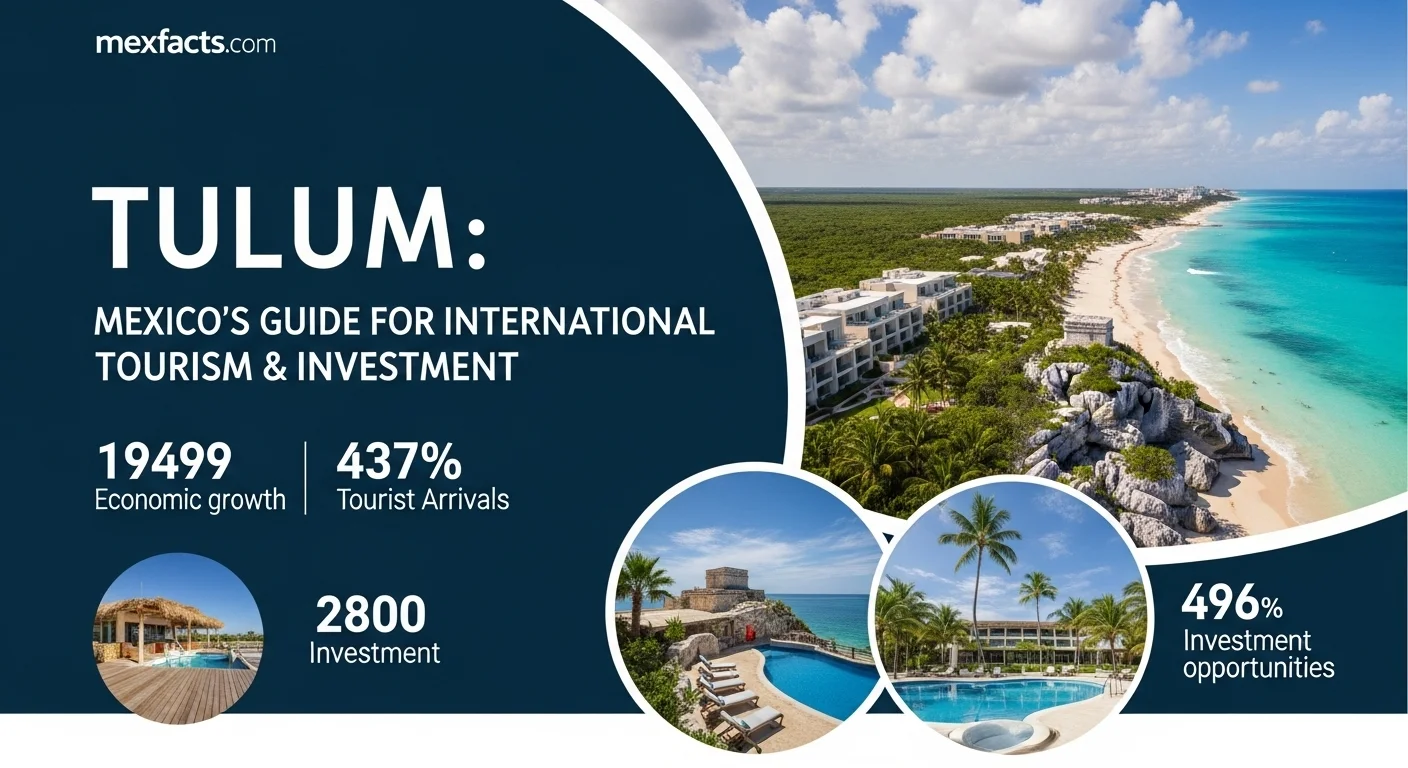
Economic Profile: Tourism Volume, Hotel Occupancy, and Market Trends
Behind Tulum's bohemian aesthetic lies an active economic sector tracked closely by state and federal authorities. According to data from the Quintana Roo Tourism Secretariat (SEDETUR), the Mexican Caribbean receives tens of millions of airport passengers annually, with Tulum serving as a major southern destination for leisure spending. Tulum's lodging inventory encompasses more than 10,000 registered hotel rooms, augmented by thousands of active vacation rental units listed across platforms such as Airbnb and Vrbo.
Official occupancy reports illustrate seasonal market behavior. While annual hotel occupancy across Tulum consistently averages between 69% and 74%, seasonal variations remain pronounced. Peak winter periods (December through April) regularly generate occupancy rates between 80% and 90% across prime beachfront and Aldea Zama inventory. Conversely, off-peak months (August through October) see hotel occupancy moderate to 50%–60%, reflecting broader Caribbean travel cycles. The visitor demographic remains predominantly North American (United States and Canada), with sustained expansion in European arrivals (United Kingdom, France, Germany, and Spain) and domestic Mexican travelers.
Real Estate Realities: Market Maturation, Rental Yields, and Title Due Diligence
The real estate market in Tulum experienced unprecedented expansion between 2018 and 2022, characterized by rapid pre-construction condo absorption and double-digit land value appreciation. By 2024–2026, the sector shifted from speculative expansion into market consolidation. Standardized studio apartments and small one-bedroom lock-off units—particularly in areas such as Region 15 and parts of La Veleta—experienced supply saturation, compressing average daily rates (ADR) and vacation rental occupancy.
Consequently, realistic net rental yields have recalibrated. While earlier promotional campaigns frequently advertised returns exceeding 15%, stabilized net yields typically range between 6% and 9% for professionally managed, differentiated properties. Investors increasingly prioritize single-family private villas, low-density developments, and properties within master-planned communities offering verified infrastructure. A detailed comparison of regional dynamics is available in our analysis of Tulum vs. Playa del Carmen real estate investments and our guide to Tulum condo purchasing strategies.
For foreign investors, navigating the Mexican legal framework requires strict adherence to constitutional rules:
- The Restricted Zone (Zona Restringida): Under Article 27 of the Mexican Constitution, foreign individuals purchasing real estate within 50 kilometers (31 miles) of the coastline must acquire property through a fideicomiso—a 50-year renewable bank trust where a Mexican financial institution holds legal title while the foreign buyer retains all beneficial ownership rights, including the right to lease, sell, or bequeath the property. Understand the details in our guide to how the Mexican bank trust (fideicomiso) functions.
- Ejido Land Risks: A critical title risk in the Tulum region involves terrenos ejidales—communal agrarian land created by post-revolutionary agrarian reform. Foreigners cannot legally hold title to ejido land. Any parcel must complete the formal privatization process (dominio pleno) overseen by the National Agrarian Registry (RAN), transitioning into private property with an official public deed (escritura pública) registered in the Public Registry of Property before purchase. Review the safeguards in our guide on avoiding ejido land scams in Mexican property purchases.
Infrastructure Transformation: Tulum Airport (TQO) and the Maya Train
Tulum's operational framework underwent a major transition with the completion of two federal infrastructure assets. The Felipe Carrillo Puerto International Airport (TQO), situated approximately 20 kilometers southwest of Tulum town, commenced domestic flight operations on December 1, 2023, followed by scheduled international flights in late March 2024. Built with a single commercial runway and a 70,000-square-meter terminal designed to accommodate up to 5.5 million passengers annually at full buildout, the facility surpassed 1 million passengers during its first full year of operation.
While the airport successfully established direct links to major US, Canadian, and domestic hubs, commercial airlines have regularly recalibrated routes and flight frequencies based on operating costs and ground transfer dynamics. Cancun International Airport (CUN) remains the primary high-capacity international gateway for northern Quintana Roo, but TQO provides a dedicated southern entry point that alleviates long highway transfers for travelers staying south of Playa del Carmen. Complementing the airport, the Maya Train (Tren Maya) operates dedicated passenger stations connecting Tulum Airport and Tulum town, linking the destination directly into the broader regional rail network extending north toward Cancun and south toward Bacalar and Chetumal.
Environmental Governance: Ecosystem Fragility and Sustainable Frameworks
Tulum's rapid growth has placed measurable strain on local ecological systems. The subterranean karst aquifer lacks surface river filtering, meaning untreated wastewater directly threatens freshwater cenotes and adjacent coral reef structures. Concurrently, pelagic sargassum landings during spring and summer months present ongoing logistical and environmental challenges along coastal beaches.
In response, federal, state, and municipal authorities have introduced enhanced regulatory frameworks. The federal government established the Parque del Jaguar (Jaguar National Park), an ecological conservation reserve spanning over 2,900 hectares that unites the historic Tulum National Park with federal conservation lands to curb uncontrolled urban expansion and protect feline biological corridors. Additionally, the municipality was integrated into Mexico's first Zona de Desarrollo Turístico Sustentable (ZDTS) framework covering 3,486 hectares, mandating higher wastewater treatment standards, strict density limits, and mandatory environmental impact assessments (MIA) for new construction.
Strategic Outlook: Opportunities, Growth Sectors, and Conservation Challenges
Tulum stands at a pivotal stage in its developmental lifecycle. The era of unchecked speculative real estate presales has given way to an environment that demands rigorous financial planning, environmental compliance, and differentiated value propositions. Investors, business operators, and prospective residents must weigh structural growth drivers against documented infrastructure bottlenecks.
Long-Term Regional Projections and Demographic Shifts
The convergence of dedicated international aviation access and regional passenger rail fundamentally redefines Tulum's demographic trajectory. Rather than operating solely as an ephemeral vacation escape, the municipality is gradually establishing a permanent resident base of remote professionals, entrepreneurs, and lifestyle retirees. This shift requires expanded civic infrastructure, including accredited bilingual educational institutions, private healthcare clinics, and upgraded municipal services.
Furthermore, intermodal connectivity via the Maya Train allows visitors to use Tulum as a central base for exploring southern Quintana Roo, including the historic Maya Ka'an zone, Lake Bacalar, and the border hub of Chetumal. This expanded travel corridor helps disperse tourist spending beyond the immediate beach zone, encouraging regional economic diversification.
High-Potential Investment and Business Niches
As the local market matures, commercial opportunities have shifted toward specialized segments that address existing market gaps:
- Low-Density Residential Architecture & Custom Villas: With the condo market saturated by compact studio apartments, strong demand exists for spacious two- to four-bedroom single-family homes, private villas, and low-density boutique developments that offer private outdoor living and verified green building certifications. Explore strategic principles in our guide to investing in the Tulum property market.
- Professional Hospitality Asset Management: The abundance of privately owned vacation rentals has created a high-value niche for institutional-grade property management firms capable of delivering dynamic pricing, direct multi-channel marketing, concierge services, and preventative maintenance.
- Regenerative Tourism & Experiential Services: High-net-worth travelers increasingly seek curated, low-impact experiences. Operators offering guided scientific cenote diving, certified eco-tours in Sian Ka'an, organic farm-to-table dining, and accredited holistic wellness programs command premium pricing.
- Renewable Energy and Water Infrastructure: Commercial developments integrating reliable solar arrays, battery storage, and advanced biological wastewater treatment systems (biodigesters and tertiary filtration) achieve lower operational costs and appeal directly to eco-conscious tenants.
Key Operational Challenges and Investor Checklist
Achieving sustained success in Tulum requires direct engagement with operational realities. Prospective investors and business owners should execute a comprehensive due diligence checklist prior to committing capital:
- Title and Legal Verification: Confirm that any real estate asset possesses full private property status (propiedad privada) backed by a registered public deed (escritura pública) and a clear Certificate of Freedom of Encumbrances (Certificado de Libertad de Gravamen). Avoid informal contracts on unregularized ejido parcels.
- Environmental Permitting (MIA): Ensure that developments have obtained an approved Environmental Impact Assessment (Manifestación de Impacto Ambiental) from the federal Ministry of the Environment and Natural Resources (SEMARNAT) alongside municipal building permits.
- Utility Connections: Verify whether the property is connected to the municipal water and sewage authority (CAPA) or utilizes an authorized on-site treatment system, and confirm electrical interconnection capacity with the Federal Electricity Commission (CFE).
- Authentic Community Engagement: Sustainable operations must respect indigenous Maya cultural heritage, support fair local labor practices, and contribute actively to regional reef and aquifer conservation initiatives.
By balancing economic ambition with environmental stewardship and legal diligence, Tulum has the opportunity to solidify its standing as a global benchmark for sustainable tropical hospitality. For official guidelines regarding foreign investment regulations and national commercial frameworks, prospective investors should consult resources provided by the Secretariat of Economy (Secretaría de Economía).
Expert Reviews
Alex R., Investor, Toronto ⭐⭐⭐⭐⭐
As someone considering a real estate investment in Mexico, this article was invaluable. It didn't just sell the dream; it gave me the real numbers and pointed out the risks, like the oversupply of condos and the importance of sustainable development. It felt honest and truly helpful.
Sofia G., Seasoned Traveler, Barcelona ⭐⭐⭐⭐
I first visited Tulum 15 years ago when it was just a sleepy beach town. This piece perfectly captures its incredible transformation. It's sad to see some of the old charm go, but the article explains the 'why' behind the growth with so much insight. It made me appreciate the new Tulum in a different way.
Ben Carter, Digital Nomad ⭐⭐⭐⭐⭐
Finally, a guide that gets it! I've been living in La Veleta for six months, and this article nails the different vibes of each neighborhood. The data on the new airport and the future projections confirmed what I'm seeing on the ground. A fantastic resource for anyone thinking of making the move.