
Zacatecas, Mexico: Historic Silver Capital, Culture, and Travel Guide

Perched in a high-desert mountain ravine at an elevation of roughly 2,450 meters (over 8,000 feet), Zacatecas is one of Mexico's most historically significant colonial mining capitals. Inscribed as a UNESCO World Heritage Site in 1993, the city is acclaimed for its dramatic topography, ornate Baroque architecture carved from pink quarry stone (cantera rosa), and deep cultural legacy rooted in centuries of silver extraction. This comprehensive guide examines the heritage, transit access, and cultural attractions of Zacatecas, alongside an objective evaluation of security conditions, regional economics, and living costs for travelers and researchers exploring Mexican history and culture.
Table of Contents
What Defines Zacatecas: Geography and Heritage
Colonial Origins and the Silver Era
Historic Landmarks and Cultural Highlights
Understanding Safety and Travel Advisories
Practical Travel Logistics: Altitude, Climate, and Getting There
Economic Landscape and Living Considerations
Frequently Asked Questions About Zacatecas
What Defines Zacatecas: Geography and Heritage
Zacatecas is both an expansive north-central Mexican state and the name of its historic capital city. Situated in a rugged mountain valley nestled between the imposing crests of Cerro de la Bufa and Cerro del Grillo, the city owes its origin and shape directly to geological circumstance. Unlike the rigid grid plans common to many Spanish colonial settlements, the streets of Zacatecas follow the contours of mountain gulches and dry ravines, giving rise to an intricate maze of steep alleys (callejones), stone staircases, and tucked-away plazas.
In 1993, UNESCO inscribed the Historic Centre of Zacatecas on the World Heritage List. The designation honors its exceptionally preserved civic and religious structures, constructed largely from local pink cantera stone, as well as its unique urban layout that adapted seamlessly to its steep mountain setting. Today, the historic center serves as a premier destination for travelers seeking a culturally immersive Mexico getaway centered on colonial art, architecture, and living civic traditions.
Colonial Origins and the Silver Era
Prior to Spanish colonization, the arid plateau surrounding Zacatecas was home to semi-nomadic indigenous nations collectively referred to by the Mexica as Chichimecas, including the Zacateco and Caxcán peoples. Spanish prospector Juan de Tolosa identified rich silver deposits near the base of Cerro de la Bufa in September 1546. Soon after, Tolosa partnered with Cristóbal de Oñate, Diego de Ibarra, and Baltasar Temiño de Bañuelos to establish a permanent mining settlement that quickly grew into one of the crown jewels of New Spain.
Throughout the 16th, 17th, and 18th centuries, the mines of Zacatecas produced a substantial portion of the global silver supply, fueling transoceanic commerce for the Spanish Empire and underwriting spectacular architectural commissions. Beyond silver extraction, Zacatecas served as a pivotal stage in national conflicts. During the Mexican Revolution, the city was the site of the decisive Battle of Zacatecas (La Toma de Zacatecas) on June 23, 1914, where Francisco Pancho Villa's División del Norte defeated the federal forces of Victoriano Huerta, breaking the back of the Huerta regime and altering the course of modern Mexican history.
Historic Landmarks and Cultural Highlights
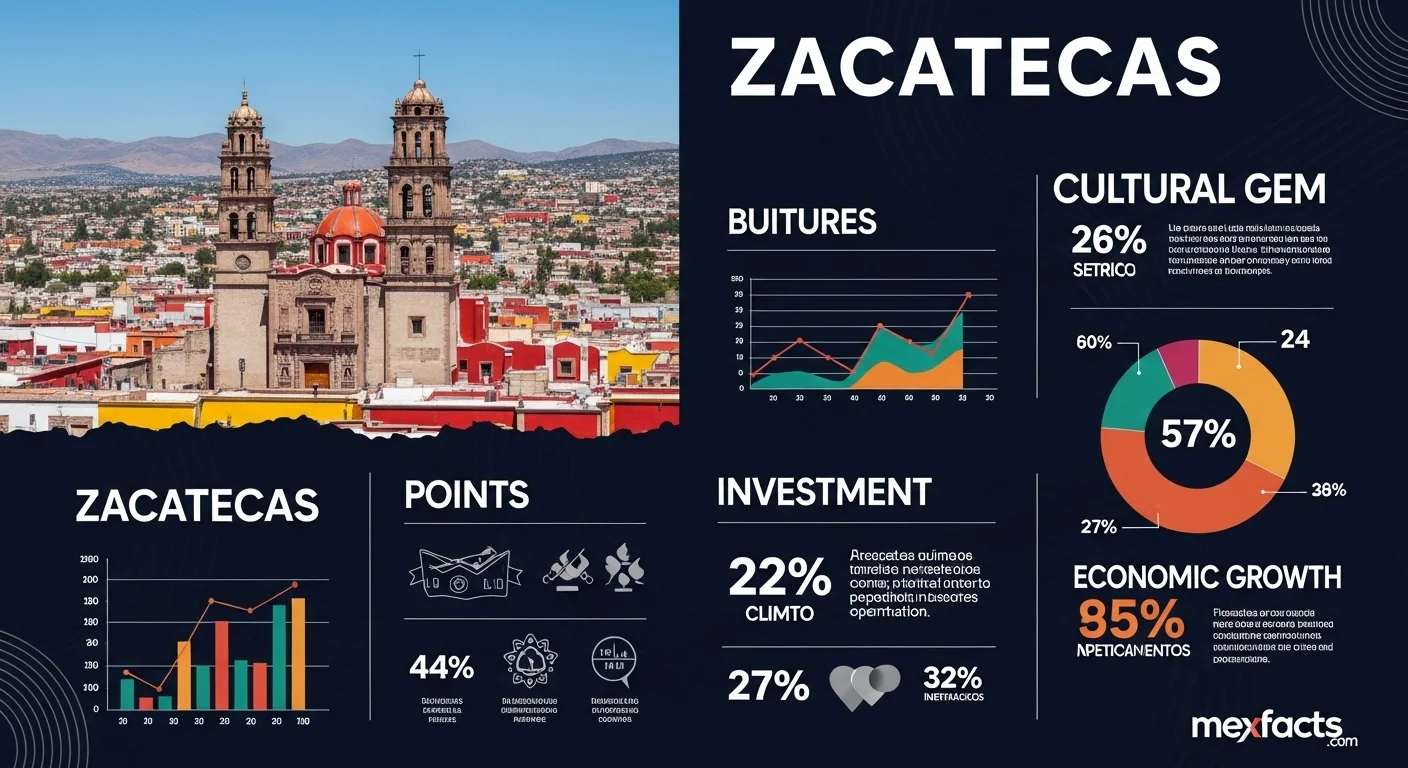
The city's historic center contains a dense concentration of civic, religious, and museum treasures. Foremost among them is the Catedral Basílica de Zacatecas, completed in the mid-18th century. Its southern and principal facades represent one of the pinnacles of the ultrabarroco (Churrigueresque) style in the Americas, featuring intricate stone carvings of vine motifs, apostles, and indigenous-influenced decorative work executed in native pink quarry stone.
Key attractions that showcase the city's unique identity include:
- Mina El Edén: First opened in 1586, this historic silver mine operated for more than three centuries before being converted into an underground museum. Visitors access deep subterranean galleries aboard a dedicated mining train to examine original shafts, mineral veins, and historical extraction machinery.
- Cerro de la Bufa and the Teleférico: Overlooking the city at 2,614 meters above sea level, Cerro de la Bufa features an observatory, the Sanctuary of Our Lady of the Patronage, and monuments commemorating the 1914 revolutionary battle. The historic cable car (teleférico), originally opened in 1979 and fully modernized in recent years, connects the peak across the canyon to Cerro del Grillo, offering expansive views of the colonial rooftops.
- World-Class Museums: Zacatecas houses exceptional cultural institutions, such as the Museo Rafael Coronel, located in the evocative ruins of the 16th-century San Francisco Convent and featuring more than 10,000 traditional Mexican ethnographic masks; the Museo Pedro Coronel, featuring modern international art and ancient artifacts; and the Museo de Arte Abstracto Manuel Felguérez, dedicated to contemporary abstract work.
- Cultural Festivals: The city hosts the annual Festival Cultural Zacatecas each spring during Holy Week, drawing international performing artists across classical music, theater, and literature, as well as the summer Festival Zacatecas del Folclor Internacional, which celebrates regional Mexican dance and global folk arts.
Understanding Safety and Travel Advisories
Security is an essential consideration for anyone evaluating travel, study, or relocation in north-central Mexico. When assessing is Mexico safe across various jurisdictions, it is vital to distinguish between the state of Zacatecas as a whole and the municipal urban core of Zacatecas City.
The state has faced sustained security challenges driven by organized crime syndicates contesting control of strategic transit corridors, notably Federal Highway 45 and rural agricultural junctions. Because of violent crime and cartel disputes in outlying municipalities, the U.S. Department of State classifies the state of Zacatecas under a "Level 4: Do Not Travel" advisory. Official guidance instructs U.S. government personnel to remain within Zacatecas City when present, to arrive strictly via commercial air travel, and to avoid all intercity vehicular travel across the state, especially after dark.
Within the historic downtown core of Zacatecas City, municipal and tourist police forces maintain an active, visible presence around central plazas, museums, and hotels. Visitors who fly directly into the local airport and confine their itineraries to the historic city center, certified tour groups, and daylight hours generally experience an orderly cultural environment. However, strict vigilance is required: travelers should avoid non-essential road trips through rural municipalities, refrain from driving at night, use verified airport taxis or private transport, and monitor current consular advisories before departing.
Practical Travel Logistics: Altitude, Climate, and Getting There
Planning a trip to Zacatecas requires attention to physical geography. Because the city sits around 2,450 meters (8,038 feet) above sea level, visitors unaccustomed to high altitudes should plan for acclimatization during their first 24 to 48 hours. Staying hydrated, limiting alcohol consumption, and pacing uphill walking along the city's steep callejones will mitigate altitude sickness symptoms.
The local climate is semi-arid and temperate, characterized by substantial diurnal temperature swings. Daytime temperatures are generally pleasant and mild throughout the year (typically between 18°C and 25°C / 64°F to 77°F), but winter nights from November through March can dip near or below freezing. Summers bring the rainy season, which runs from late June through September and is marked by afternoon mountain showers that refresh the high plateau.
Arrival and Transit: Zacatecas International Airport (Aeropuerto Internacional General Leobardo C. Ruiz, code ZCL) is located roughly 25 kilometers north of the capital in Calera. It provides domestic non-stop routes to major hubs such as Mexico City and Tijuana, alongside direct scheduled international flights to select U.S. cities with strong diasporic links, including Dallas/Fort Worth and Chicago. For security and convenience, arriving by air and hiring licensed airport transportation directly to city hotels is the recommended transit approach.
Economic Landscape and Living Considerations
Zacatecas remains the primary silver-producing state in Mexico—which itself ranks as the world's leading silver producer—alongside substantial yields in lead, zinc, and copper centered around mining hubs like Fresnillo. Agriculture and animal husbandry form the second pillar of the regional economy, supported by historical rancho traditions that yield dry beans, chili peppers, garlic, and stone fruit.
The cost of living in Zacatecas City is notably lower than in Mexico City, Guadalajara, Monterrey, or major coastal resorts. Daily expenses—ranging from dining at local fondas to museum admissions and long-term rentals—remain modest. This affordability has generated periodic interest from prospective expatriates and heritage renovators exploring colonial real estate in Mexico. However, property purchases in the historic core require careful legal due diligence, including compliance with strict architectural preservation standards enforced by the National Institute of Anthropology and History (INAH), alongside clear-eyed assessment of regional security constraints.
Frequently Asked Questions About Zacatecas
- Why is Zacatecas known as the Silver City?
- Rich silver veins were discovered in 1546 at the foot of Cerro de la Bufa. During the colonial era, the mines of Zacatecas produced up to one-fifth of the entire world's silver, funding the Spanish Empire and financing the city's magnificent Baroque churches and civic mansions.
- How high is Zacatecas above sea level?
- The city rests in a mountain canyon at an average altitude of approximately 2,450 meters (over 8,000 feet) above sea level, giving it a cool, semi-arid mountain climate with crisp nights.
- Is it safe to visit the historic center of Zacatecas?
- While the state of Zacatecas is subject to a U.S. State Department "Do Not Travel" advisory due to criminal activity along rural highway corridors, the historic downtown district is well-policed. Travelers who choose to visit are advised to arrive by air at Zacatecas International Airport (ZCL), avoid intercity highways at night, and remain within urban cultural zones.
- What is the best time of year to visit Zacatecas?
- Spring (March through May) and autumn (October through November) offer pleasant daytime temperatures and clear skies. Visiting during Holy Week coincides with the world-renowned Festival Cultural Zacatecas, which brings vibrant performing arts to the city's historic courtyards and plazas.
Expert Reviews
Brenda P., Potential Retiree ⭐⭐⭐⭐
My husband and I are considering retiring in Mexico and this article was a godsend. It didn't sugarcoat the safety issues in Zacatecas, which we appreciated. The breakdown of living costs and the passionate description of the city's beauty gave us a truly balanced picture. It felt like getting advice from a knowledgeable friend.
Carlos V., Cultural Traveler ⭐⭐⭐⭐⭐
I visited Zacatecas after reading this. The description of the 'living museum' is spot on. I felt like I was walking through history, and the article prepared me well—I knew to be cautious but also to soak in the incredible culture. The passion for the city really comes through in the writing.
Samantha L., Investor ⭐⭐⭐⭐
As an investor looking at emerging markets in Mexico, this was incredibly useful. The article connected the dots between the state's silver history, its current economic data, and the challenges it faces. The honest take on security versus the potential of nearshoring is exactly the kind of nuanced analysis we need.