
Studying in Mexico: Your Complete 2025 Guide for International Students
Mexico is calling to students worldwide, offering much more than just stunning beaches and incredible food. It's becoming a top-tier destination for international education, blending academic excellence with a cultural immersion that I can tell you from experience, changes your life. This guide is your trusted companion for the journey. We'll walk you through the Mexican student visa process step-by-step, making sense of the requirements. I'll share insights on life at Mexico's best universities and demystify the unique relationship with the U.S., including how F1 students can easily visit and how Mexican students can pursue studies up north. Think of this as a conversation with someone who's been there, designed to help you, your parents, and your advisors navigate the vibrant and exciting academic opportunities waiting for you in Mexico.
Table of Contents
What is it Really Like to Study in Mexico?
Becoming a student in Mexico is more than an academic choice; it's a dive into a world brimming with color, history, and warmth. I remember my first days as a student here—the smell of street tacos, the sound of music everywhere, and the incredible kindness of the people. Mexico is a place that engages all your senses. Its growing reputation as a hub for higher education is built on this unique mix: world-class academic programs at an affordable cost and the priceless opportunity to become fluent in Spanish, a skill that opens doors across the globe. Studying here gives you a perspective you can't find anywhere else, placing you at a cultural crossroads between North and Latin America.
Mexico's universities are impressive and diverse. You have giants like the Universidad Nacional Autónoma de México (UNAM), a city within a city and a titan in research, and the Tecnológico de Monterrey (ITESM), renowned for its cutting-edge business and engineering programs. These institutions, and many others, are increasingly offering programs in English, but the real magic happens when you start living and breathing the language. It's no wonder over 30,000 international students choose Mexico. The cost is a huge factor; public university tuition can be a few hundred dollars a year, which frees up your budget to actually live and travel, not just study.
Your Step-by-Step Guide to the Mexican Student Visa
Let's tackle the paperwork. It might seem daunting, but I've helped countless students through it. The main document you'll need is the Temporary Resident Student Visa, which is for any program lasting more than 180 days. For shorter courses, if you're from a country like the US, Canada, the UK, or the Schengen Area, you can often study on a simple tourist permit. But for the full experience, the student visa is a must.
You have to apply in person at a Mexican consulate in your home country—you can't do this from within Mexico. Getting your documents in order is the key. Here's what you'll need, explained simply:
- Valid Passport: Make sure it's valid for your entire stay. A simple but crucial first step.
- Visa Application Form: You'll find this on your local consulate's website. Fill it out carefully; every detail matters.
- Passport-Sized Photo: A specific size, color, on a white background. Don't just use any photo!
- Letter of Acceptance: This is your golden ticket. It must be the original letter from your Mexican school, detailing your program, its duration, cost, and the school's contact info. It proves you have a legitimate reason to be there.
- Proof of Economic Solvency: This is where people get nervous, but it's just to show you can support yourself. You can prove this with:
- Bank Statements: Original statements from the last few months showing a consistent minimum balance. The amount varies, so check with your specific consulate, but think in the ballpark of ~$1,500-2,000 USD in monthly income or a savings balance of around $20,000-$25,000 USD.
- Scholarship or Job: A letter confirming a full scholarship or proof of a steady income that meets the minimum threshold.
- Help from Parents: If you're under 25, your parents can provide their financial documents along with a letter saying they'll support you. I've seen this work for many young students.
- Visa Fee Payment: A fee of around $50 USD. It's one of the most affordable student visa fees out there.
After you have everything, book an appointment. The interview is usually a friendly chat to confirm your plans. Apply well in advance, as processing times can vary from a few days to a few weeks.
You've Arrived! The All-Important 'Canje' Process
Once you get that visa sticker in your passport, you're not quite done. Think of the visa as your ticket to enter the country for the purpose of studying. Within your first 30 days in Mexico, you MUST go to a local office of the National Migration Institute (INM) to exchange your visa for a Temporary Resident Card (Tarjeta de Residente Temporal). This process is called 'canje' (exchange). This card is your official ID in Mexico, proving your legal status. It's good for one year and you'll renew it annually. Please, don't forget this step! It's a common mistake that can cause major headaches. It's a rite of passage for every foreign resident, and once you have that card, you'll feel truly settled in.
The US-Mexico Connection: A Unique Student Advantage
Mexico's location next to the U.S. creates some fantastic opportunities. This is especially true for F-1 visa holders studying in the U.S. and for Mexican students wanting to study north of the border.
A common question I hear is, 'can I travel to Mexico as an F-1 student?' Yes, and it's easier than you think! For a short trip, it's a breeze. But the real game-changer is a U.S. policy called Automatic Visa Revalidation. This incredible rule allows an F-1 student with an expired U.S. visa stamp to travel to Mexico for under 30 days and come back to the U.S. without needing a new visa. It saves so much time and money. I've seen students use this for a quick cultural getaway to Tijuana or a spring break in Cancun. Just make sure you have your valid passport and a recently signed I-20 form.
For those in Mexico looking to study in the U.S., the path is well-worn. It involves getting accepted to a U.S. school, getting your I-20 form, and then applying for an F-1 visa at a U.S. Embassy in Mexico. The key is proving you have strong ties to Mexico and plan to return after your studies. This two-way flow of students is what makes the educational bond between our countries so strong and dynamic.
A Look at the Numbers: International Students in Mexico
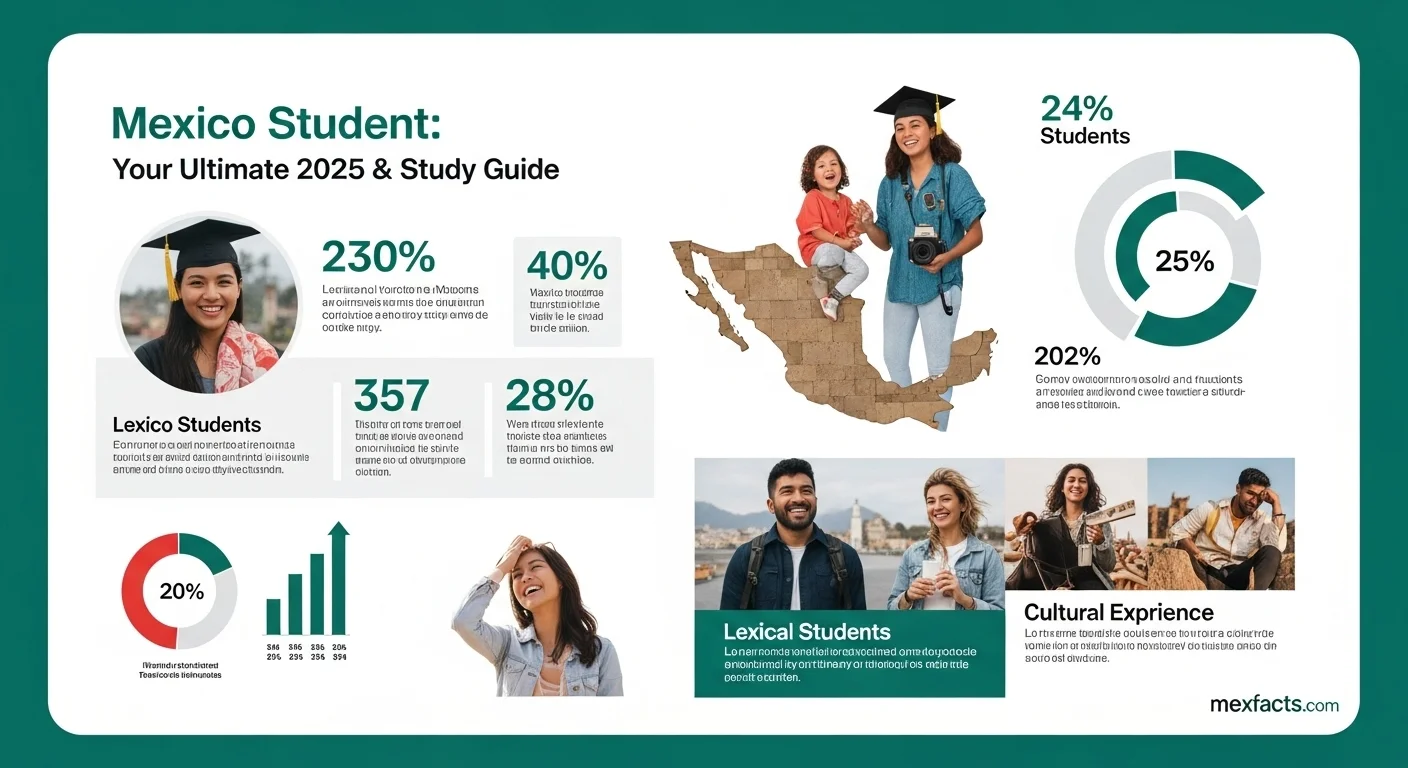
The story of international education in Mexico is one of exciting growth. We're talking about tens of thousands of students from all over the world choosing to build a chapter of their lives here. While the official numbers are always in motion, data from sources like UNESCO and Mexico's own Ministry of Public Education (SEP) paints a clear picture: more and more students are coming. Traditionally, many come from the U.S. and Latin American neighbors like Colombia, but I'm seeing a wonderful increase from Europe—Spain, France, Germany—and even from Asia. They're not just coming for Spanish class anymore; they're enrolling in top-tier programs for business, engineering, and medicine.
The heart of this international scene beats strongest in Mexico City, Guadalajara, and Monterrey. This is where you'll find the big-name universities like UNAM, Tec de Monterrey (ITESM), and the Instituto Politécnico Nacional (IPN), which host the lion's share of foreign students. The numbers that really matter to a student, though, are the costs. I can't stress this enough: the affordability is a game-changer. Living comfortably—including your apartment, food, and transportation—can cost between $600 to $1,200 a month. And tuition at a great public university can be less than $1,000 for the whole year. This isn't just about saving money; it's about affording a richer experience, being able to travel on weekends to see pyramids or colonial cities.
Deep Dive: The Cross-Border Student Experience
The connection between Mexico and the U.S. is a living, breathing thing for students. Let's break down how it really works, because understanding these rules can open up amazing possibilities.
The F-1 Student's Gateway: Easy Travel to Mexico
For the international student community in the U.S., Mexico is the perfect backyard for exploration. The most helpful tool for this is Automatic Visa Revalidation. It sounds technical, but it’s quite simple: if your F-1 visa stamp in your passport has expired but your student status is still valid, you can visit Mexico for less than 30 days and re-enter the U.S. without a problem. I always advise students to think of it as a 'hall pass'.
Here's your checklist to use this amazing perk:
- A passport that's valid for at least six more months.
- Your I-20 form, with a fresh travel signature from your school's advisor (less than a year old).
- Your valid I-94 record (it's electronic now).
- It's smart to carry proof of your current enrollment, like a recent transcript.
- Here's the crucial part: DO NOT apply for a new U.S. visa while in Mexico. If you do and it gets denied, you can't use automatic revalidation to get back in.
This policy makes Mexico incredibly accessible, turning a weekend trip into a simple and stress-free adventure that adds a whole new dimension to your study abroad experience in the States.
From South to North: Getting a U.S. Student Visa in Mexico
For my students here in Mexico dreaming of graduate school or specialized programs in the U.S., the F-1 visa process is a clear and achievable goal. It’s a journey many thousands take each year.
Here are the steps from my experience:
- Get Accepted & Get Your I-20: First, a U.S. school approved by the Student and Exchange Visitor Program (SEVP) has to accept you. Once you show them you can pay, they'll send you the Form I-20, which is the foundation of your entire application.
- Pay the SEVIS Fee: This I-901 SEVIS fee supports the tracking system for international students. You have to pay it before your interview.
- Fill Out the DS-160 Form: This is the online visa application. It's detailed, so take your time. When you're done, you'll get a confirmation page with a barcode—guard it with your life, you need it for the interview.
- Schedule and Ace Your Interview: You'll have an interview at a U.S. Embassy or Consulate in Mexico. The main thing the officer wants to see is 'non-immigrant intent'. In simple terms, you need to convince them you plan to return to Mexico after your studies. You do this by talking about your family, job prospects, and life back home.
- Bring Your Documents: At the interview, you'll need your passport, the DS-160 confirmation, SEVIS fee receipt, original I-20, and solid proof you have the funds to cover your education and living costs.
Being well-prepared is everything. The U.S. actually wants talented students, and programs like EducationUSA are there to help guide you.
The Future is Bright: Opportunities for Students in Mexico
The journey of a student in Mexico is on an exciting upward curve. As the world looks for more affordable, culturally rich educational experiences, Mexico is perfectly placed to meet that demand. I see a future with more streamlined visa processes, more scholarships, and more universities actively recruiting brilliant minds from around the world. The Mexican government and schools are realizing that international students are one of our greatest assets.
One of the most promising developments I'm watching is the creation of clearer pathways from student to professional. Right now, a student visa doesn't let you work. You need a company to sponsor a work permit after you graduate. But there's a growing conversation, especially in booming sectors like tech in Guadalajara or fintech in Mexico City, about making it easier for talented graduates to stay and work. Imagine finishing your degree and launching your career in one of the world's most dynamic economies. This would make Mexico an even more powerful magnet for global talent.
Navigating Your Path: What to Expect in the Coming Years
The core visa requirements—proof of acceptance and funds—will likely stay the same. But I expect the process to get easier. Look for more consulates to offer fully online application forms and better appointment systems. A big step forward would be to standardize the rules across all Mexican consulates, as they can sometimes vary, which can be confusing for applicants.
For those of you traveling back and forth, the **F-1 student travel to Mexico** will continue to be a fantastic perk, all thanks to Automatic Visa Revalidation. It’s a stable policy that is a cornerstone of the U.S.-Mexico student relationship.
For those heading from **Mexico to the USA for studies**, the key will always be the interview. My advice for the future is to look for joint programs or research partnerships between U.S. and Mexican universities. These kinds of connections make your application stronger by showing a clear, supported academic plan. And as Mexico's own job market gets stronger, it actually becomes easier to prove you have compelling reasons to return home, which is a key part of the U.S. visa interview.
A World of Opportunity Awaits
Choosing to be a student in Mexico is an investment in a future that is global, multilingual, and culturally aware. The thousands of students who come here every year don't just spend money on tuition; they become part of our communities, contributing to the local economy and our cultural fabric. For companies, the growing pool of graduates from Mexican universities is a goldmine of talent—people who understand both local and global perspectives.
Of course, there are challenges. We're working on improving safety perceptions and cutting through bureaucratic red tape. But the story of studying in Mexico is overwhelmingly one of immense opportunity. You get a top-notch education at a price that makes sense, in a country with a soul-stirring depth of culture and history. As someone who has dedicated my career to this field, I can tell you that the journey of a 'Mexico Student' is a powerful launchpad for a life without borders.
To get started with the most accurate, official information, your best resource is the website of the Mexican Ministry of Foreign Affairs (Secretaría de Relaciones Exteriores - SRE). It has a directory of all its consulates and the latest visa rules. It's the perfect first stop on your amazing journey.
Expert Reviews
Anja Schmidt, Student from Germany ⭐⭐⭐⭐⭐
This guide was a lifesaver! I was so nervous about the visa process, especially the 'proof of economic solvency' part. The way it was broken down here made perfect sense. And the tip about the 'canje' process within 30 days saved me from a huge mistake. I've been studying in Puebla for six months now and it's the best decision I've ever made. ¡Muchas gracias!
David Chen, F-1 Student in the USA ⭐⭐⭐⭐⭐
I'm an F-1 student in California and always wanted to visit Mexico City, but was worried about my expired visa stamp. I had no idea about Automatic Visa Revalidation until I read this article. It explained it so clearly. I went for a weekend last month with no issues at all. This is essential info for any international student in the US!
Brian O'Malley, Parent from Ireland ⭐⭐⭐⭐
My daughter is planning to attend university in Guadalajara next year, and I was quite anxious about the whole process. This article provided a clear, reassuring roadmap. It felt like getting advice from a real person, not just a government website. My only wish is that it had a bit more detail on specific student housing options, but for the visa and arrival process, it's fantastic.