
The Ritz-Carlton Cancun: Legacy, Kempinski Rebranding, and Future Outlook

The Ritz-Carlton, Cancun stood for nearly thirty years as the benchmark of traditional five-star luxury in Quintana Roo before officially rebranding as the Kempinski Hotel Cancún in late 2022. Operating as a strict European Plan (EP) resort rather than an all-inclusive property, the beachfront landmark introduced world-class fine dining, AAA Five Diamond standards, and bespoke hospitality to Cancun's Hotel Zone. This comprehensive profile examines the history of the original resort, why it maintained an à la carte model, its transition to Kempinski, and Marriott's planned return with The Ritz-Carlton, Cancun, Punta Nizuc.
Table of Contents
- What Happened to the Ritz-Carlton Cancun?
- A Historic Milestone: Luxury Pioneer of 1993
- The European Plan Choice: Why It Was Never All-Inclusive
- Tourism Growth and Competitive Pressures in Quintana Roo
- The Transition to Kempinski Hotel Cancún
- The Future: The Ritz-Carlton, Cancun, Punta Nizuc
- Frequently Asked Questions
What Happened to the Ritz-Carlton Cancun?
Travelers searching for the Ritz-Carlton Cancun today will find that the physical landmark at Km 14.5 of Kukulcan Boulevard no longer operates under the Marriott portfolio. After nearly three decades of defining ultra-luxury hospitality in the Mexican Caribbean, the resort concluded operations as a Ritz-Carlton in late 2022. The property was acquired by Europe's oldest luxury hospitality group and reopened as the Kempinski Hotel Cancún.
While the architectural silhouette and premier beachfront location remain identical, the emblem of the lion and crown has moved on. For visitors planning a stay, understanding this transition clarifies why historical Ritz-Carlton bookings now route through Kempinski, and how the property's foundational legacy continues to influence true luxury in the Mexican Caribbean.
A Historic Milestone: Luxury Pioneer of 1993
When The Ritz-Carlton, Cancun opened its doors in 1993, it marked a historic milestone for both the brand and Mexican hospitality. It was the very first Ritz-Carlton property established outside the United States. During that era, Cancun was widely recognized as a sun-and-sand vacation center created by Mexico's tourism agency (FONATUR), but it had yet to establish a global reputation for formal fine dining and white-glove service.
The opening of the hotel reshaped international perceptions. Introducing the brand's renowned service standards, the resort quickly earned the coveted AAA Five Diamond Award. Notably, it achieved rare industry acclaim when both of its signature fine-dining venues—Fantino (offering Mediterranean cuisine) and The Club Grill (specializing in elevated continental fare)—secured independent Five Diamond ratings. This level of culinary prestige demonstrated that Cancun could deliver a world-class gastronomic and cultural experience on par with major international capitals.
The European Plan Choice: Why It Was Never All-Inclusive
A frequent inquiry among prospective travelers is whether the hotel offered an all-inclusive rate package. Throughout its 29-year tenure, the Ritz-Carlton Cancun operated strictly as a European Plan (EP) hotel, meaning room rates covered accommodation only, with all dining, beverage, and spa services billed à la carte.
This choice was deliberate. In a destination that evolved into an international hub for all-inclusive travel, the property deliberately cultivated an environment of exclusivity, culinary innovation, and unhurried intimacy. Rather than catering to volume dining, the resort focused on individualized service, vintage wine pairings, and bespoke beachside cabanas. While high-end all-inclusive concepts gradually gained traction across Mexico, the Ritz-Carlton's steadfast commitment to the EP format made it a standout retreat for purists who prioritized tailored culinary artistry over packaged convenience.
Tourism Growth and Competitive Pressures in Quintana Roo
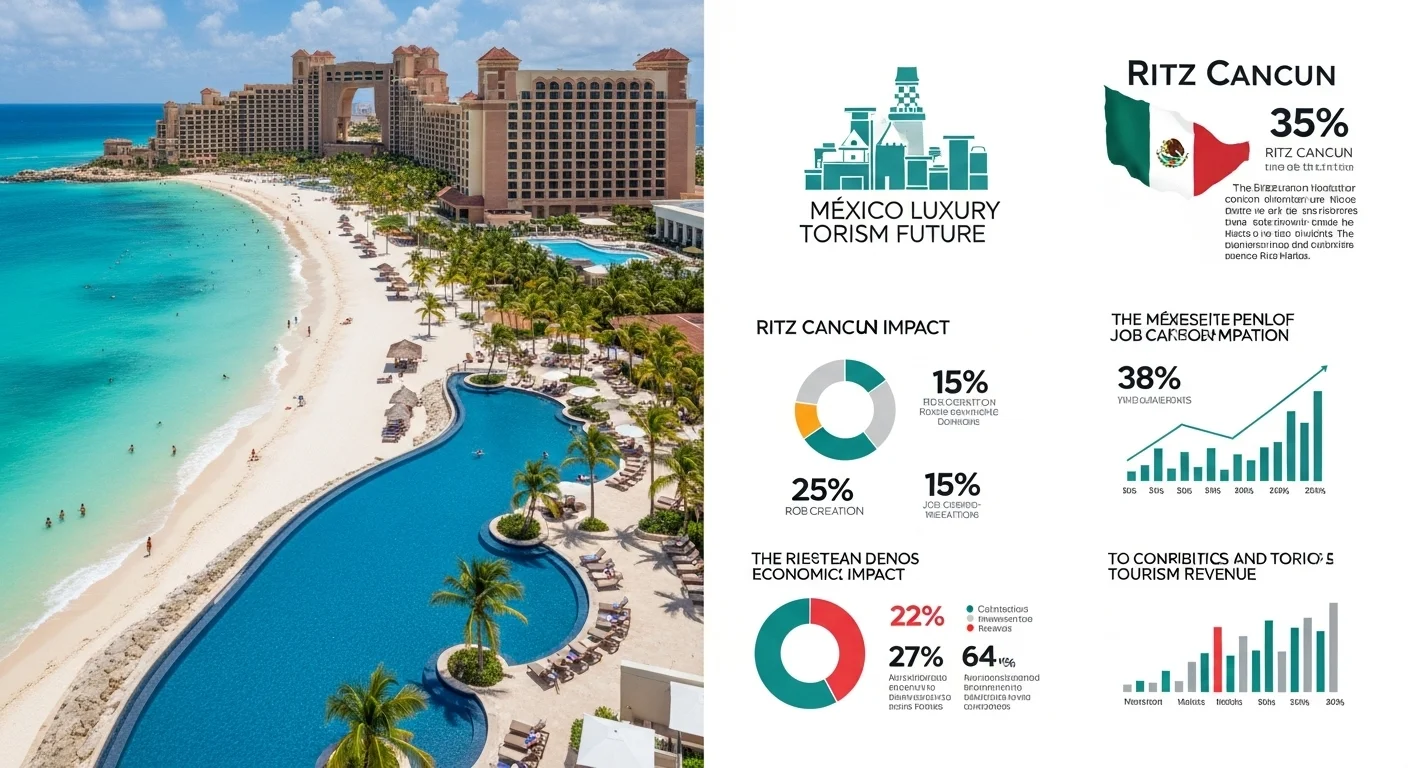
To evaluate why a landmark property like the Ritz-Carlton transformed into a new venture, one must look at the broader evolution of Quintana Roo's hospitality economy. Over the past three decades, the Mexican Caribbean transitioned from a burgeoning coastline into one of the most resilient tourism engines in the Western Hemisphere.
Federal tourism statistics highlight this trajectory: in 2023, Mexico welcomed over 42 million international visitors, with Cancun International Airport serving as the primary arrival corridor for overseas travelers. Across Quintana Roo, hotel room capacity expanded past 100,000 keys, supported by sustained average annual occupancy rates exceeding 75 to 80 percent in prime tourist sectors.
However, heightened demand attracted intense international competition. In 1993, the Ritz-Carlton was virtually unmatched in its tier. Over time, luxury hospitality broadened dramatically. Early resort models like Club Med Cancun were joined by refined developments along the corridor connecting Cancun and Tulum, where brands such as Waldorf Astoria, Rosewood Mayakoba, and St. Regis raised design benchmarks. Additionally, the emergence of ultra-luxury all-inclusive resorts challenged the conventional dominance of European Plan establishments, placing immense pressure on mature properties to undergo capital-intensive modernizations.
The Transition to Kempinski Hotel Cancún
The announcement in mid-2022 that the hotel would end its nearly thirty-year relationship with Marriott marked the conclusion of an era. Swiss-based luxury hotel group Kempinski Hotels stepped in to assume operations, selecting the iconic property for its marquee entry into the North American beach resort market.
Following the rebrand to Kempinski Hotel Cancún, the new operator committed substantial investments into updating guestrooms, revitalizing beachfront amenities, and refreshing public spaces while preserving the beloved architecture and legacy staff. Kempinski also preserved the resort's commitment to the European Plan model, pairing European culinary refinement with the renowned warmth of Mexican hospitality.
The Future: The Ritz-Carlton, Cancun, Punta Nizuc
The conclusion of the original hotel's run did not signal the end of the Ritz-Carlton brand in Cancun. Demonstrating ongoing confidence in Quintana Roo's high-end travel market, Marriott International entered into an agreement with Fibra Danhos and Beyond Capital to launch an entirely new property: The Ritz-Carlton, Cancun, Punta Nizuc, slated to open in 2027.
Located at the southern tip of Cancun's Hotel Zone near Punta Nizuc, this upcoming resort is designed from the ground up to reflect modern architectural elegance, oceanfront wellness suites, and state-of-the-art environmental sustainability. Rather than competing directly for historical nostalgia, this next-generation development will restore the brand's footprint in a quieter, ecologically distinctive setting.
Frequently Asked Questions
- Is the Ritz-Carlton Cancun still open?
- No. The original Ritz-Carlton Cancun closed in 2022 and transitioned to Kempinski Hotels. The property currently operates as the Kempinski Hotel Cancún.
- Where is the former Ritz-Carlton Cancun located?
- The resort is situated at Retorno del Rey 36, Km 14.5 in Cancun's Hotel Zone, overlooking the white sands of the Caribbean Sea.
- Was the Ritz-Carlton Cancun all-inclusive?
- No. The property operated exclusively on the European Plan (EP), where meals and beverages were purchased à la carte.
- When will the new Ritz-Carlton in Cancun open?
- Marriott International has scheduled the opening of The Ritz-Carlton, Cancun, Punta Nizuc for 2027.
- What made the dining at the original Ritz-Carlton famous?
- It was one of the few resorts in the world whose two signature restaurants, Fantino and The Club Grill, each held prestigious AAA Five Diamond ratings simultaneously.
Final Editorial Assessment
The Ritz-Carlton Cancun fundamentally altered the trajectory of Mexican Caribbean tourism by demonstrating that Cancun was capable of world-tier five-star hospitality. While the address now thrives under Kempinski's stewardship and Marriott prepares its next chapter at Punta Nizuc, the original resort's standards remain the foundation upon which Cancun's modern luxury sector was constructed.
Expert Reviews
Robert Chen, Long-time visitor ⭐⭐⭐⭐⭐
My wife and I celebrated our 20th anniversary at the Ritz-Carlton Cancun years ago. It was pure magic. This article really captures the 'why' it was so special. It's sad that it changed, but this piece gave me a great understanding of the business reasons and made me feel optimistic about what's next for Cancun. Beautifully written.
Sofia Marquez, Hospitality Student ⭐⭐⭐⭐⭐
I used this article for a research paper on brand evolution in tourism. The blend of history, personal perspective, and hard data was perfect. It explained the complex market pressures in Cancun in a way that was easy to understand. Thank you for not just listing facts, but telling a story!
Emily and Tom, First-time travelers to Cancun ⭐⭐⭐⭐
We were trying to decide between all the luxury hotels in Cancun and this article was a huge help. We didn't understand the difference between the 'old' Ritz and the new Kempinski, or why some places were all-inclusive and others weren't. This cleared everything up and helped us understand the vibe of each place. Really useful!