
Indigenous Cultures in Mexico: History, Languages, and Communities

Mexico's Indigenous peoples represent a foundational and dynamic pillar of the country's identity, comprising 23.2 million individuals who self-identify as Indigenous and more than 7.3 million who speak one of 68 recognized native languages. Rooted in millennia of Mesoamerican civilization and shaped by centuries of cultural resilience, these diverse communities sustain vibrant artistic, agricultural, and governance traditions. This guide examines official demographic data from INEGI, socioeconomic benchmarks from CONEVAL, regional textile and craft heritage, and critical legal developments—including the September 2024 constitutional reform recognizing Indigenous communities as subjects of public law.
Table of Contents
- Origins, Civilizational Legacy, and Historical Evolution
- Colonial Resilience, Syncretism, and Constitutional Rights
- Artistic Traditions, Traditional Clothing, and Heritage Protection
- Demographics and Linguistic Tapestry (INEGI Data)
- Socioeconomic Disparities and Economic Resilience
- Legal Autonomy, Ethical Tourism, and Future Outlook
- Frequently Asked Questions
Origins, Civilizational Legacy, and Historical Evolution
To understand modern Mexico, one must engage with the history and ongoing presence of its pueblos originarios (original peoples). Far from representing a vanished past, the term "Indigenous" identifies the contemporary descendants of the Mesoamerican, Aridoamerican, and Oasisamerican civilizations that inhabited this territory millennia before Spanish contact in the sixteenth century. These distinct nations maintain sovereign social practices, ancestral territories, communal worldviews, and vibrant languages that continue to define Mexican history and culture.
Before the arrival of European explorers, the territory of present-day Mexico was a complex mosaic of advanced civilizations. The Olmecs laid foundational religious and artistic concepts in the Gulf lowlands; the Maya engineered advanced mathematics, astronomy, and architectural marvels across the Yucatán Peninsula and Chiapas; the Zapotecs and Mixtecs constructed regional administrative centers like Monte Albán in Oaxaca; and the Purépecha developed sophisticated metallurgy in Michoacán. In the Valley of Mexico, the Triple Alliance, centered on the Mexica island metropolis of Tenochtitlán, commanded trade networks stretching across thousands of miles. Their stone monuments, painted screenfold codices, and urban designs formed a complex philosophical and scientific heritage that survives in community memories and contemporary practices.
Colonial Resilience, Syncretism, and Constitutional Rights
The Spanish conquest of 1521 inaugurated centuries of profound demographic, political, and cultural disruption. European warfare, forced labor, and epidemic diseases such as smallpox caused catastrophic population collapses. Spanish authorities implemented the casta system, legally subordinating Indigenous communities and dispossessing them of ancestral territories. However, Indigenous peoples resisted total assimilation. Rather than vanishing, communities adapted by adopting and reinterpreting European institutions, creating enduring syncretic cultural traditions.
This cultural resilience is visible today across Mexican civic and spiritual life. Major observances like the Day of the Dead (Día de los Muertos) and patron saint festivities blend Catholic iconography with pre-Hispanic agricultural and mortuary rites. Community structures, including the communal cargo system (sistema de cargos) and assembly governance, preserved local autonomy within colonial and republican frameworks.
Following national independence and the 1910 Mexican Revolution, the federal government promoted mestizaje—a national identity celebrating mixed ancestry. While aimed at fostering civic unity, state indigenismo policies frequently treated native languages and autonomous customs as obstacles to modern development. The struggle for self-determination gained renewed momentum in the late twentieth century, leading to a 1992 constitutional reform that officially recognized Mexico as a "pluricultural" nation. In 2001, following negotiations surrounding the San Andrés Accords, Article 2 of the Constitution was amended to establish the right to cultural autonomy and internal dispute resolution through traditional legal norms (usos y costumbres).
A historic milestone occurred in September 2024, when the Mexican Congress approved a sweeping constitutional reform to Article 2. This legislation recognized Indigenous and Afro-Mexican communities as "subjects of public law" (sujetos de derecho público) with collective legal personality and their own patrimony. This reform formally empowers communities to manage public budgets directly, defend collective territorial rights in court, and conduct binding consultations prior to infrastructure projects on their lands.
Artistic Traditions, Traditional Clothing, and Heritage Protection
The material culture of Indigenous Mexico demonstrates unmatched mastery of ancient craftsmanship, regional raw materials, and symbolic narratives. Indigenous art is not a monolithic genre; it encompasses regional traditions honed across generations. Prominent examples include:
- Ceramics: The polished barro negro (black clay) of San Bartolo Coyotepec, Oaxaca, achieved through specialized burnishing and reduction firing, and the low-temperature glazed pottery of Purépecha communities around Lake Pátzcuaro.
- Woodcarving: The intricately painted copal-wood alebrijes carved in San Martín Tilcajete and San Antonio Arrazola in Oaxaca, reflecting both traditional animal symbology and modern creative expressions.
- Sacred Yarn Art and Beadwork: The nierikas (yarn paintings) and glass beadwork of the Wixárika (Huichol) people of Jalisco and Nayarit, which serve as visual prayers depicting sacred deer, peyote, and ancestral creator deities.
Traditional clothing represents a sophisticated system of cultural communication. Far from mere decorative dress, traditional Mexican clothing indicates the wearer's community, geographic origin, marital status, and ceremonial role. Master weavers continue to produce textiles using the ancient backstrap loom (telar de cintura) with natural fibers like hand-spun cotton and wool, tinted with organic dyes including cochineal (an insect dye yielding brilliant crimson), wild indigo, and snail purpura patula.
The signature garment is the huipil, a sleeveless woven tunic worn by women across Mesoamerica. The geometric motifs of the Triqui huipil in Oaxaca, the brocaded natural imagery of Chiapas highland huipiles, and the floral-embroidered velvet of the Zapotec Tehuana attire demonstrate distinct regional identities. Other enduring garments include the quexquémitl, a diamond-shaped shoulder cape worn by Otomí, Nahua, and Huastec women, and the rebozo, a versatile woven shawl that evolved during the colonial era.
Because these ancestral designs hold substantial commercial value, international fashion houses have repeatedly copied motifs without permission or compensation. In response, Mexico enacted the 2022 Federal Law for the Protection of the Cultural Heritage of Indigenous and Afro-Mexican Peoples and Communities. This legal framework establishes collective intellectual property rights, requiring mandatory consent and fair economic agreements before third parties can reproduce or commercialize community designs.
Demographics and Linguistic Tapestry (INEGI Data)
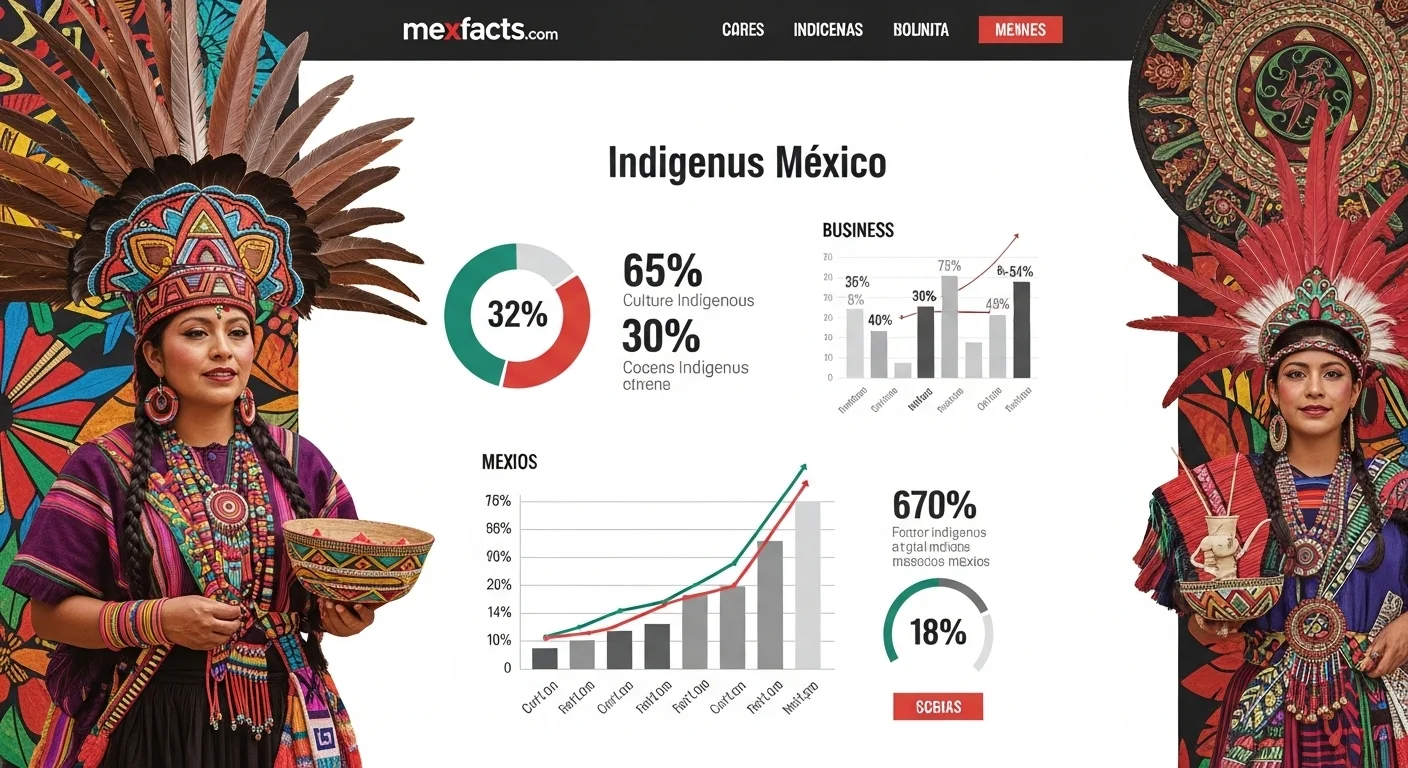
Official demographic measurements conducted by the National Institute of Statistics and Geography (INEGI) in the 2020 Population and Housing Census provide clear insights into Mexico's Indigenous population. The state evaluates Indigenous presence through two primary standards: cultural self-identification and linguistic criteria.
Under the self-identification standard, 23.2 million people aged three and older identify as Indigenous, representing approximately 19.4% of Mexico's total population. Of this population, 11.9 million are women and 11.3 million are men. Notably, approximately 16.1 million self-identified Indigenous people do not speak an Indigenous language, illustrating that cultural belonging, familial lineage, and communal participation extend beyond linguistic fluency.
Under the linguistic standard, 7.36 million people speak an Indigenous language, representing roughly 6.1% of the national population. Of these speakers, 87.2% are bilingual, speaking both an Indigenous language and Spanish, while approximately 866,000 individuals (11.8%) are monolingual in their native language.
Linguistic Diversity
According to the National Institute of Indigenous Languages (INALI), Mexico is home to 11 linguistic families, 68 distinct linguistic groupings (agrupaciones lingüísticas), and 364 linguistic variants (variantes lingüísticas). The most widely spoken Indigenous languages include:
- Nahuatl: Approximately 1.65 million speakers, concentrated in Puebla, Veracruz, Hidalgo, San Luis Potosí, and Guerrero.
- Maya (Maaya t'aan): Approximately 774,000 speakers, primarily in Yucatán, Quintana Roo, and Campeche.
- Tseltal: Approximately 589,000 speakers, located predominantly in the highlands and jungle regions of Chiapas.
- Tsotsil: Approximately 550,000 speakers, concentrated in Chiapas.
- Mixteco: Approximately 526,000 speakers, historically centered in Oaxaca, Guerrero, and Puebla, with significant migrant communities in Baja California and Mexico City.
- Zapoteco: Approximately 490,000 speakers, concentrated in the Central Valleys, Sierra Norte, and Isthmus of Tehuantepec in Oaxaca.
- Otomí (Hñähñu): Approximately 298,000 speakers, located across Hidalgo, México State, Querétaro, and Puebla.
- Totonaco: Approximately 256,000 speakers, concentrated in Veracruz and northern Puebla.
Geographic Distribution
Mexico's Indigenous population is concentrated primarily in the central and southern states, where Mesoamerican settlements were historically dense:
- Oaxaca: Contains the highest proportion of Indigenous language speakers, with over 31% of the state's population speaking a native tongue across 16 recognized ethnolinguistic groups.
- Chiapas: Home to roughly 28% Indigenous language speakers, dominated by Maya-family languages such as Tseltal, Tsotsil, Ch'ol, and Tojolabal.
- Yucatán: Approximately 23% of the state's population speaks Yucatec Maya.
- Guerrero: Roughly 15% of residents speak native languages, primarily Náhuatl, Mixteco, Me'phaa (Tlapaneco), and Amuzgo.
- Urban Centers: Increased internal migration has concentrated large Indigenous populations in urban areas, particularly the Mexico City Metropolitan Area, Monterrey, and agricultural corridors in northern Mexico.
Socioeconomic Disparities and Economic Resilience
Despite their cultural wealth, Indigenous communities confront deep-seated structural inequalities resulting from centuries of social and geographic marginalization. Data published by the National Council for the Evaluation of Social Development Policy (CONEVAL) highlights substantial disparities between Indigenous and non-Indigenous populations:
- Poverty Rates: CONEVAL multidimensional poverty evaluations report that approximately 73% to 75% of Indigenous language speakers live in poverty, compared to roughly 39% of the non-Indigenous population. Furthermore, extreme poverty affects approximately 34% to 35% of Indigenous language speakers, compared to less than 6% among non-Indigenous Mexicans.
- Social Security Access: Over 78% of Indigenous workers lack access to formal social security, primarily due to their concentration in smallholder agriculture, domestic work, and informal trade.
- Educational Attainment: In 2020, the illiteracy rate among Indigenous language speakers stood at approximately 20.9%, roughly four times the national average of 4.7%. Limited access to fully bilingual and culturally relevant schools remains an ongoing challenge in rural regions.
- Basic Infrastructure: A significant share of Indigenous households, particularly in mountainous and isolated municipalities, experience deficits in potable piped water, drainage systems, and high-speed internet connectivity.
Faced with these challenges, Indigenous communities have established robust models of economic resilience. Community forestry enterprises, such as the Pueblos Mancomunados in Oaxaca's Sierra Norte, manage communal forests sustainably, running sawmills, water-bottling plants, and ecotourism ventures that return all profits directly to communal development funds. Similarly, Indigenous smallholder coffee cooperatives in Chiapas and Oaxaca produce certified organic, fair-trade shade-grown coffee for international markets, demonstrating how ancestral ecological stewardship can thrive within modern global commerce.
Legal Autonomy, Ethical Tourism, and Future Outlook
The contemporary landscape for Mexico's Indigenous peoples is marked by active political organization, legal advances, and ecological defense. As collective entities recognized by the constitution, Indigenous communities are asserting authority over their ancestral lands and local resources.
Key Arenas of Ongoing Engagement
- Territorial and Environmental Defense: Indigenous lands harbor an estimated 70% of Mexico's priority biodiversity areas. Communities increasingly challenge unauthorized concessions for open-pit mining, mega-infrastructure, and commercial logging by exercising their legal right to Free, Prior, and Informed Consent (FPIC) under International Labour Organization (ILO) Convention 169 and reformed Mexican constitutional law.
- Biocultural Agriculture: The defense of native maize varieties and the traditional milpa agricultural system remains vital for food sovereignty. Indigenous seed-saver networks actively oppose genetically modified crops to preserve culinary biodiversity, soil health, and cultural ceremonies tied to agricultural cycles.
- Language Revitalization: With many linguistic variants classified by INALI as endangered, young Indigenous scholars, educators, and artists are developing mobile language apps, digital dictionaries, multilingual radio stations, and bilingual literature to ensure linguistic continuity.
- Community-Based Tourism (Turismo Comunitario): Moving away from extractive mass tourism models, community-managed ecotourism cooperatives invite visitors into Indigenous territories under locally established guidelines. Travelers experience guided hikes, traditional culinary workshops, and environmental conservation projects where 100% of revenue directly supports community infrastructure and conservation initiatives.
Principles for Ethical Engagement
For travelers, academic researchers, and commercial enterprises seeking to engage respectfully with Indigenous communities in Mexico, core guidelines ensure mutual benefit and cultural integrity:
- Support Certified Cooperatives and Direct Artisans: Purchase textiles, pottery, and agricultural goods directly from artisans or organized community cooperatives. Avoid haggling aggressively over handcrafted works that represent weeks or months of specialized labor.
- Respect Local Governance Protocols: When visiting autonomous municipalities that govern through usos y costumbres, adhere to local community rules regarding photography, drone usage, and access to sacred natural sites.
- Uphold Intellectual Property Rights: Commercial entities utilizing Indigenous design motifs, patterns, or agricultural knowledge must enter into formal, transparent benefit-sharing agreements in accordance with the 2022 Federal Law on Indigenous Cultural Heritage.
Frequently Asked Questions
- How many Indigenous languages are officially recognized in Mexico?
- The Mexican federal government, through the National Institute of Indigenous Languages (INALI), recognizes 68 distinct Indigenous linguistic groupings, comprising 364 spoken linguistic variants across 11 linguistic families. Under the General Law on Linguistic Rights, all recognized Indigenous languages have equal validity with Spanish as national languages.
- What is the difference between Indigenous self-identification and language speakers in Mexico?
- Self-identification reflects an individual's personal recognition of their Indigenous ancestry, cultural heritage, and communal belonging, totaling 23.2 million people in the 2020 INEGI Census. Language speakers represent the subset of 7.36 million people who actively speak an Indigenous tongue. Historical assimilation policies and urban migration mean that many individuals identify culturally as Indigenous without speaking their ancestral language.
- Which Mexican state has the largest Indigenous population?
- By absolute number of self-identified Indigenous residents and speakers, Oaxaca, Chiapas, and Veracruz rank highest. Proportionally, Oaxaca has the highest percentage of Indigenous language speakers, with over 31% of its population speaking a native tongue across 16 distinct ethnolinguistic groups.
- What did the September 2024 Mexican constitutional reform change for Indigenous peoples?
- The September 2024 reform to Article 2 of the Mexican Constitution recognized Indigenous and Afro-Mexican communities as "subjects of public law" with legal personality and collective patrimony. This grants them legal standing to manage public funds directly without municipal intermediaries, exercise autonomous decision-making through traditional governance systems, and participate in binding prior consultations.
Expert Reviews
Sarah K., Traveler ⭐⭐⭐⭐⭐
I read this before my trip to Oaxaca and it completely changed my perspective. I sought out a community-run tour instead of a big bus company, and it was the highlight of my visit. Understanding the history behind the crafts I was buying made it so much more meaningful. Thank you!
David Chen, Entrepreneur ⭐⭐⭐⭐⭐
As someone looking to source textiles from Mexico, this article was invaluable. The sections on fair trade and the new legal landscape gave me the context I needed to approach potential partners with respect and understanding. It's about more than just business; it's about building relationships.
Maria G., University Student ⭐⭐⭐⭐
This was so much more engaging than my textbook! The personal stories and the way the statistics were explained really helped me grasp the modern-day realities for Indigenous peoples in Mexico. I feel like I have a much deeper appreciation now.