
Riu Palace Las Américas: Inside Cancún's Iconic Resort and Its Economic Impact

Standing along the white sands of Punta Cancún on Boulevard Kukulcán, the Hotel Riu Palace Las Américas is one of the most recognizable landmarks in Cancún's Hotel Zone. Renowned for its distinctive neoclassical architecture and beachfront position, the property operates as an adults-only, 24-hour all-inclusive resort under Spain's RIU Hotels & Resorts. Beyond welcoming international travelers, the resort serves as a vital case study in Mexico's modern hospitality development, reflecting how master-planned destinations generate local employment, foster complex supplier ecosystems, and contribute billions of dollars to Quintana Roo's regional economy. This profile examines the history, operational scale, economic contributions, and environmental initiatives defining Riu Palace Las Américas today.
What is Hotel Riu Palace Las Américas?
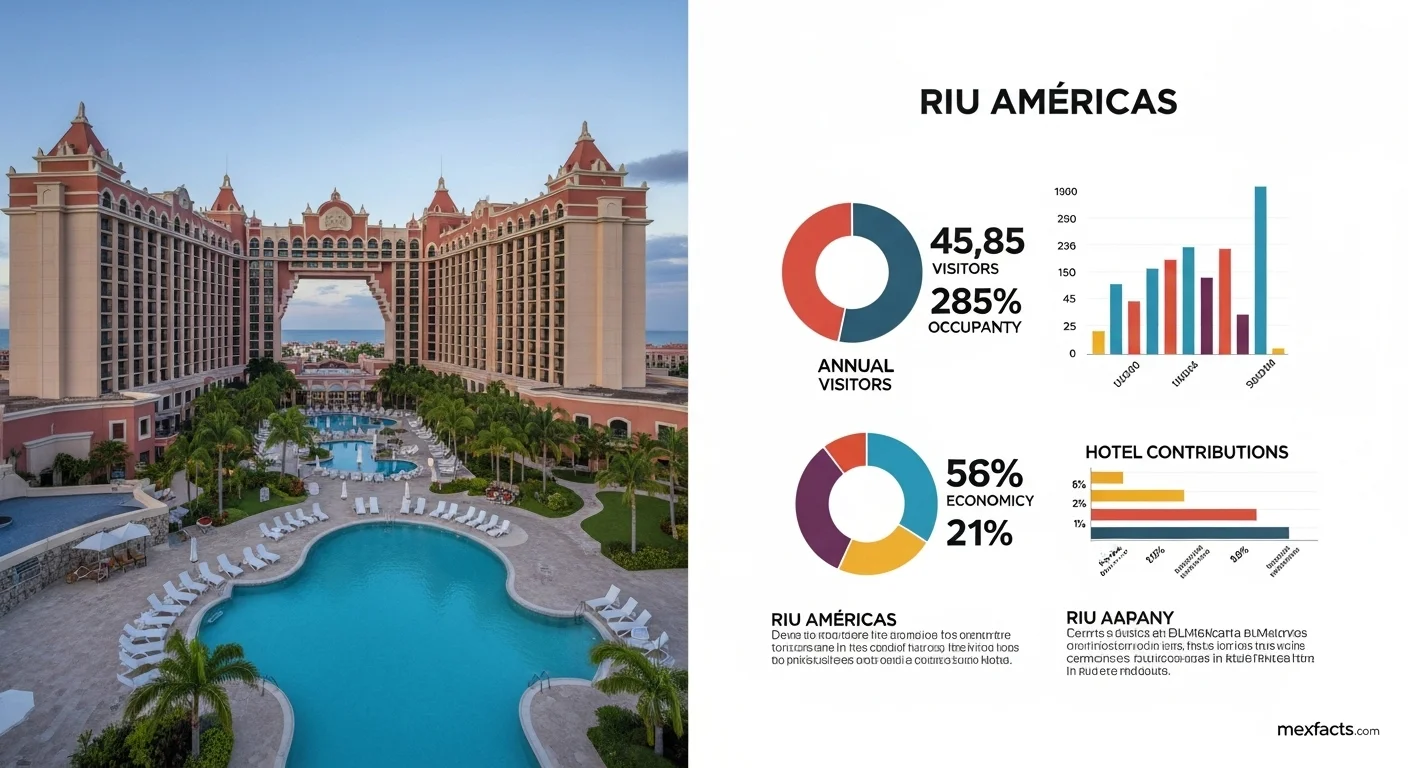
Located at Kilometer 8.5 of Boulevard Kukulcán in Cancún's Hotel Zone, Hotel Riu Palace Las Américas occupies a prime oceanfront position near Punta Cancún. The resort features 372 suites, multiple swimming pools, a dedicated wellness spa, and five specialty restaurants alongside its central buffet. Converted to an exclusive adults-only (18+) format following a major renovation in 2016, the property delivers RIU's signature 24-hour all-inclusive service, encompassing à la carte dining, premium beverages, and round-the-clock room service.
Its prime location places guests within walking distance of Cancún's commercial center, nightspots, and calm, swimmable Caribbean beaches sheltered by the northern curve of Punta Cancún. As part of RIU's Cancun complex, guests at the Palace property also enjoy reciprocal access to select amenities, entertainment, and daytime facilities at neighboring RIU properties, providing flexibility while maintaining an elevated, adult-oriented environment on-site.
Cancún's Transformation and RIU's Expansion in Mexico
The emergence of Riu Palace Las Américas reflects the broader trajectory of Cancún itself. Initiated in the early 1970s by the Mexican federal government through the National Fund for Tourism Development (FONATUR), Cancún was transformed from an isolated coastal sandbar into a global tourism powerhouse. The strategy focused on attracting high-caliber foreign direct investment and building modern infrastructure capable of supporting large-scale international arrivals.
Spanish hospitality group RIU Hotels & Resorts entered Mexico in 1997 with the opening of Riu Yucatan in Playa del Carmen. Mexico quickly grew into the company's most important international destination outside Spain. Today, RIU operates more than 20 resorts across key Mexican corridors—including Cancún, Riviera Maya, Los Cabos, Riviera Nayarit, Mazatlán, and Guadalajara. Demonstrating the depth of this economic relationship, Mexican professionals constitute approximately 40 percent of RIU's total global workforce, making the company a major private-sector employer in the country.
The All-Inclusive Model and Guest Demographics
The all-inclusive format represents the dominant operating model in the Mexican Caribbean, offering predictable vacation pricing that appeals strongly to international visitors from the United States, Canada, and Europe. By bundling accommodations, gourmet dining, leisure activities, and services into a single package, Riu Palace Las Américas attracts high-intent leisure travelers seeking seamless convenience without sacrificing luxury standards.
The adult-only policy shapes the property's operational focus, prioritizing elevated culinary concepts, tranquil pool settings, and premium beverage offerings over family-oriented entertainment. This targeted positioning captures high-value international tourist spending, which directly circulates through the regional economy via hotel wages, municipal resort fees, and regional supply chain procurement.
Key Tourism Metrics and Regional Economic Impact
Understanding the scale of Riu Palace Las Américas requires looking at the macroeconomic figures that power Quintana Roo's hospitality sector. Cancún International Airport (CUN) serves as the primary international gateway to the Mexican Caribbean, handling over 30 million domestic and foreign passengers annually and consistently ranking among Latin America's busiest airports for international traffic. North American travelers—primarily from the United States and Canada—make up the overwhelming majority of international arrivals, sustaining resort occupancy throughout the year.
Hotel occupancy rates across Cancún's Hotel Zone routinely average between 75 and 85 percent, with luxury beachfront properties like Riu Palace Las Américas frequently reaching peak capacity during the winter high season and summer vacation periods. In 2023, tourism in Quintana Roo generated more than $20 billion USD in economic revenue (derrama económica), reinforcing the state's status as Mexico's primary generator of foreign tourism receipts.
Employment and the Local Supply Chain Ecosystem
Resorts of this magnitude operate essentially as self-contained commercial hubs. A large-scale luxury resort directly employs hundreds of individuals across diverse operational departments, including culinary staff, food and beverage service, housekeeping, facilities maintenance, guest relations, security, and administrative management. Beyond direct payroll, the property drives an extensive indirect economic network.
Nationally, Mexico's tourism sector sustains roughly 4.8 million direct jobs according to data from the Mexican Secretariat of Tourism (SECTUR), representing nearly 9 percent of national employment. At the regional level, Riu Palace Las Américas relies on a vast domestic supply network: agricultural producers supplying fresh produce, regional poultry and seafood purveyors, Mexican beverage distributors, logistics providers, and local transport operators. This multiplier effect ensures that international tourist expenditure extends well beyond the resort perimeter into communities across Quintana Roo and the Yucatán Peninsula.
Visitor Spending Patterns in the Luxury Segment
Data from Mexico's National Institute of Statistics and Geography (INEGI) indicates that international tourists arriving by air spend an average of over $1,100 USD per stay in Mexico. High-end all-inclusive resorts capture substantial shares of this expenditure by providing upscale dining, premium amenities, and wellness services. Because international guests perceive the luxury all-inclusive offering as exceptional value compared to competing Caribbean and Mediterranean destinations, Quintana Roo maintains strong competitive advantages in attracting long-haul and repeat travelers.
Environmental Responsibilities and Sustainability Initiatives
The long-term viability of Cancún's resort corridor relies directly on safeguarding the natural ecosystems that attract millions of visitors. Coastal Quintana Roo faces significant environmental considerations, including the management of pelagic sargassum seaweed, coastal erosion, and the conservation of the nearby Mesoamerican Barrier Reef—the second-largest barrier reef system in the world.
To mitigate these pressures, RIU Hotels & Resorts has implemented its group-wide 'Proudly Committed' sustainability strategy. The initiative focuses on measurable targets in energy efficiency, waste management, single-use plastic elimination, and water conservation through modern on-site reverse osmosis and treatment systems. Riu Palace Las Américas holds certification through Travelife Gold, an internationally recognized standard for sustainable tourism management. Additionally, municipal and private containment protocols, including offshore barriers and dedicated beach cleanup operations, work continuously to protect beachfront conditions during peak sargassum seasons.
Infrastructure Connectivity and the Tren Maya
Major federal infrastructure projects are reshaping accessibility throughout southeastern Mexico. The Tren Maya (Maya Train), which connects Cancún International Airport to major archaeological sites and regional centers across Quintana Roo, Yucatán, Campeche, Tabasco, and Chiapas, expands regional mobility for resort guests. Visitors staying at Riu Palace Las Américas can easily combine all-inclusive beachfront stays with day excursions to cultural landmarks such as Chichén Itzá, Valladolid, and Tulum, distributing economic benefits more evenly across southern Mexico.
Frequently Asked Questions About Riu Palace Las Américas
- Where is Riu Palace Las Américas located?
- The resort is situated at Boulevard Kukulcán, Kilometer 8.5, in the Hotel Zone of Cancún, Quintana Roo, Mexico, positioned directly on the beachfront near Punta Cancún.
- Is Riu Palace Las Américas an adults-only resort?
- Yes. Following its comprehensive 2016 renovation, Riu Palace Las Américas operates exclusively as an adults-only (18+) property.
- What is included in the all-inclusive service?
- The 24-hour all-inclusive plan includes buffet and à la carte specialty dining, 24-hour room service, premium beverages, in-suite minibars and liquor dispensers, daily activities, and daytime access to select facilities at neighboring RIU properties.
- How does the resort support environmental sustainability?
- The property maintains Travelife Gold certification and participates in RIU's 'Proudly Committed' strategy, implementing water conservation, energy efficiency, waste recycling, and coastal management programs.
For official travel regulations, regional statistics, and destination guidelines, travelers and researchers can consult the Mexican Secretariat of Tourism (SECTUR at gob.mx/sectur).
Expert Reviews
Carlos M., San Antonio, TX ⭐⭐⭐⭐⭐
My wife and I stayed at the Riu Palace Las Américas for our anniversary. Beyond the beautiful beaches, what struck me was the staff. Talking to them, you realize how much this hotel means to the community. It's not just a resort; it's a lifeline. This article really captures that bigger picture.
Elena V., Cancún, Mexico ⭐⭐⭐⭐⭐
I run a small tour company in Cancún. This article is spot on. Hotels like the Riu are the heart of our economy. When they do well, we all do well. It's great to see an analysis that respects the connection between international tourism and local livelihoods.
Jessica Albright, Travel Blogger ⭐⭐⭐⭐⭐
As someone who writes about travel, I found this piece incredibly insightful. It goes beyond the typical resort review to explain the 'why' behind Cancún's success. Understanding the Riu's role in the larger ecosystem gives me a much deeper appreciation for the destination.