
Is Mexicali Safe? An Insider's 2025 Guide for Travelers & Business

People often ask me, with a hint of concern, 'Is Mexicali actually safe?' As the capital of Baja California, a bustling industrial center sharing a border with the U.S., Mexicali has two stories. One is of thriving business and opportunity, the other is of border-town headlines. My goal here is to give you the real picture. I've spent years exploring and understanding the nuances of Mexican border cities, and the truth is rarely black and white. This guide dives deep into the safety situation for 2025, whether you're a tourist, an investor, or thinking of moving. We'll look at official advisories, but more importantly, we'll put them in context. We’ll discuss what crime statistics really mean for a visitor and break down the popular drive to Puerto Peñasco. This isn't about fear, it's about knowledge. I want to give you the information you need to make smart, informed decisions about experiencing this dynamic and important Mexican city.
Table of Contents
- Why Mexicali Matters: A City of Contrasts
- The Official Stance: What U.S. Travel Advisories Really Mean
- Putting Crime in Context: Beyond the Headlines
- The Journey South: Is the Drive to Puerto Peñasco Safe?
Why Mexicali Matters: A City of Contrasts
When you ask 'Is Mexicali safe?,' you're asking about a city of immense importance, a place that's much more than just a line on a map. I've always seen Mexicali as a place of powerful contrasts. It's the sprawling capital of Baja California, sitting right up against Calexico, California, but it feels like its own universe. Its safety isn't just a local issue; it's a question that matters to global companies, investors, and anyone who enjoys the fruits of our deeply connected economies.
At its heart, Mexicali is an economic engine. It’s a giant in agriculture and home to a massive maquiladora (manufacturing) industry, particularly in aerospace and electronics. I've seen firsthand how companies from the U.S., Korea, and Germany have poured billions into this city, drawn by its skilled people and its incredible location, just a stone's throw from U.S. markets. This constant flow of business brings engineers, consultants, and executives from around the world. For them, the question 'is it safe to travel to Mexicali' isn't just casual curiosity—it shapes corporate decisions and investments. A city that feels safe is a city that attracts talent and money. From my experience, the local workforce's stability and loyalty are huge selling points that investors see as a sign of underlying community strength.
The Official Stance: What U.S. Travel Advisories Really Mean
To get a clear picture, we have to start with the official advice. The U.S. Department of State issues travel advisories, and for Baja California, they've issued a 'Reconsider Travel' warning, citing crime and kidnapping. Now, that sounds scary, and it's something to take seriously. The advisory mentions that criminal organizations are active, and violent crime does happen. But here’s where reading the details is crucial. Most of the severe violence, like homicides, is targeted—it's typically disputes between rival criminal groups, not random attacks on the public. While there's always a risk of being in the wrong place at the wrong time, this context is key. Tourists and business travelers are not the primary targets.
Even more specifically, the advisory points out a critical distinction for Mexicali. It warns U.S. government employees to stay out of the Mexicali Valley, which is the rural area *outside* the city, due to potential cartel violence. This tells you a lot. The restriction isn't for the city center, the business districts, or the main industrial parks. In fact, the advisory explicitly allows U.S. government staff to drive through Mexicali on major highways and use the airport. So, when people ask, 'is it safe to go to Mexicali', the official answer isn't a simple 'no.' It’s a 'yes, if you're smart about it'—sticking to the main urban areas and using common sense.
Putting Crime in Context: Beyond the Headlines
Let's be honest: you can't talk about a Mexican border city without addressing organized crime. These groups fight over trafficking routes, and that fight can be violent. It’s true that Mexicali saw an increase in homicides in 2024. These are sobering facts that point to real security challenges. However, the story of crime in border regions is always more complex than the headlines suggest. For the average visitor, the risk isn't usually from these high-level conflicts. The more common concern is petty crime, like pickpocketing or scams in crowded places, which can happen in any large city in the world. Violent crime is often concentrated in specific neighborhoods, far from where a tourist or business traveler would typically be. The most important lesson I’ve learned about navigating Mexico is this: your biggest asset is awareness. Understanding that the most severe risks are often not aimed at you allows you to focus on practical safety—like watching your belongings, using trusted Ubers or taxis, and not flashing expensive jewelry.
The Journey South: Is the Drive to Puerto Peñasco Safe?
One of the most frequent questions I get from folks in Arizona and California is, 'is it safe to drive from Mexicali to Puerto Peñasco?' This trip to Rocky Point is a classic desert road trip. The route, mainly Mexico's Federal Highway 5, is generally considered safe for daytime travel—so much so that the U.S. government allows its own employees to drive it during the day. That’s a pretty strong vote of confidence. The drive takes about 3-4 hours on a well-kept road. Along the way, you'll see checkpoints with military or federal police. Don't be alarmed; I've always found them to be professional and courteous. They are there for security, and they actually make the route feel safer. Have your passport and car registration handy. The real risks on this drive are usually the mundane ones: a flat tire in a remote area, a sudden sandstorm, or not having the legally required Mexican auto insurance. My advice, echoed by countless travelers, is simple: drive during the day, don't speed, make sure your car is in good shape, and enjoy the journey. Smart travel is your best defense, and it makes the beautiful beaches of Puerto Peñasco a very achievable destination.
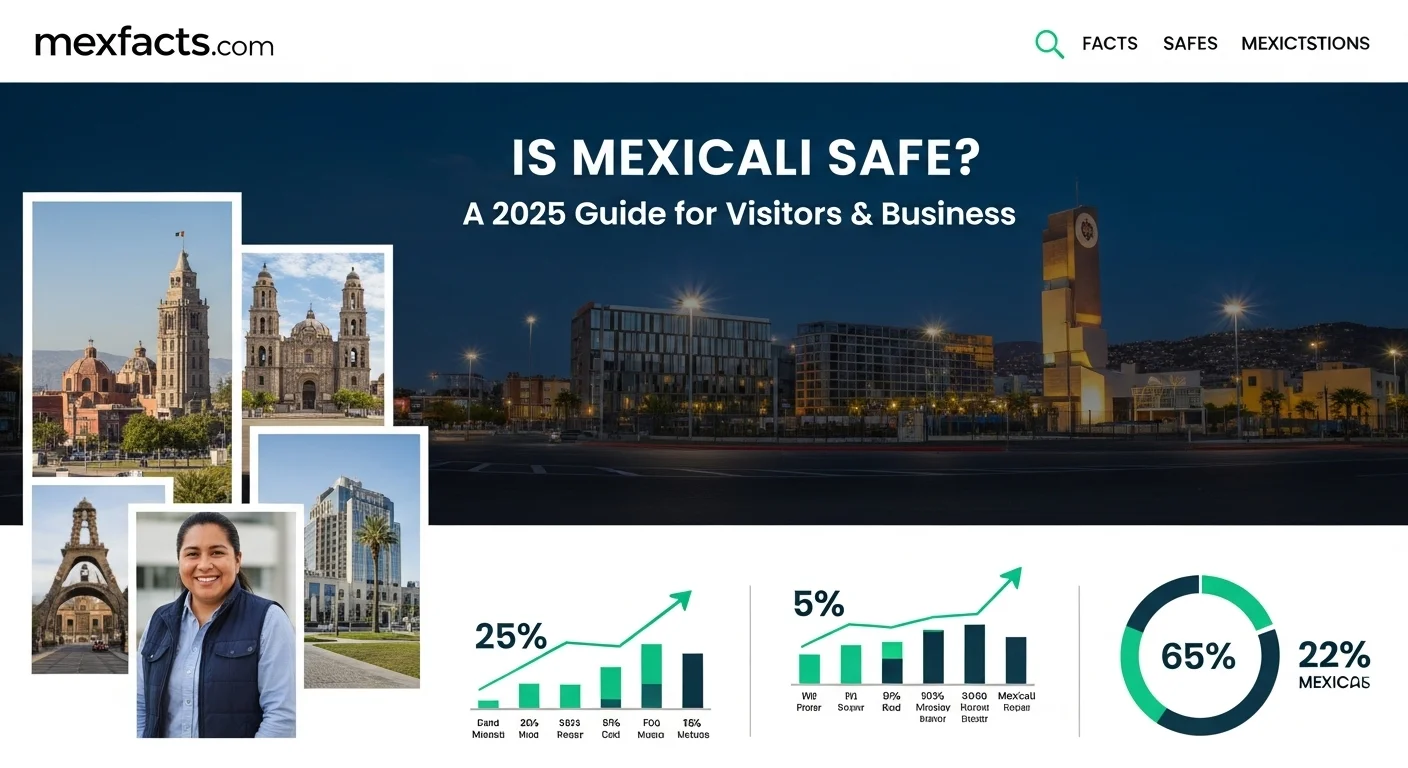
The Real Numbers: A Look at Mexicali's Safety Statistics
To get to the heart of how safe is Mexicali Mexico, we need to look at the data, but with a practical, human perspective. Numbers don't tell the whole story, but they give us a starting point. For any international businessperson or curious traveler, understanding these statistics helps build a realistic picture of the city.
Breaking Down the Crime Data
Let's address the numbers you might have seen in the news. In 2024, Mexicali recorded 228 homicides, which was an increase from the year before. That's a serious number, and it reflects the real security challenges the city faces. But to understand if is it safe to go to Mexicali, we have to ask: who is most at risk? As both local authorities and U.S. advisories point out, this violence is overwhelmingly targeted, often the result of conflicts between criminal groups. It’s not random violence aimed at the general public or tourists.
For the average visitor, the concerns are usually different. Travel safety guides often classify Mexicali's risk as 'Medium.' This is because the more common issues are petty crimes like pickpocketing, especially in busy markets or public areas. While more serious crimes like armed robbery can happen, they are less frequent for visitors who practice basic situational awareness. In fact, in some crime categories, Mexicali has historically been considered safer than its more famous neighbor, Tijuana. The key is to understand that your personal safety depends heavily on where you go, what you do, and the precautions you take—just like in any major city around the globe.
The Security You Can See
When you evaluate how safe is Mexicali, you also have to look at the response to crime. I've always been struck by the visible security presence in the city. You'll see municipal and state police, as well as the National Guard, particularly on major roads and at checkpoints. This visibility is a deliberate strategy to deter crime and project a sense of order.
For the international business community, there's another layer of security. Mexicali is home to over 150 manufacturing plants, most of them located within 27 secure industrial parks. I've visited some of these parks, and they are like self-contained, secure zones. They have their own private security, gated access, 24/7 surveillance, and patrols. This 'bubble' of security is precisely why huge multinational companies feel confident enough to operate and expand here, despite the regional security headlines. It’s a powerful example of how the private sector creates a safe environment to protect its people and investments.
How Mexicali Compares: A Broader View
Context is everything. Is Mexicali more dangerous than other cities? Compared to its neighbor, Tijuana, many people perceive Mexicali as calmer and safer, especially regarding the type of crime a tourist might encounter. However, the state of Baja California as a whole does struggle with high rates of organized crime. It's a complex picture.
Interestingly, if you look just across the border, U.S. cities like El Paso, Texas, are consistently ranked among the safest in the United States, with violent crime rates far below the national average. This challenges the myth that the entire border region is inherently dangerous. While the dynamics on the Mexican side are certainly different, the deep economic and cultural ties create a shared interest in safety and stability across the border.
Revisiting the Drive to Puerto Peñasco: The Data Points
For the thousands who make the trip every year, the question of whether is it safe to drive from Mexicali to Puerto Peñasco is very real. The most important 'data point' is the U.S. government's green light for its own staff to use Highway 5 during the day. That's not a casual recommendation. While official statistics for tourist incidents on that specific route aren't widely published, the anecdotal evidence is overwhelming. Thousands of Americans make this drive safely every year, especially during spring break and holidays. Experienced travelers all say the same thing: drive in daylight, don't speed (especially through the town of Sonoyta), have Mexican insurance, and treat checkpoints with respect. The risks are less about crime and more about road safety and being prepared. The data, both official and anecdotal, gives a clear answer: yes, the drive is reasonably safe if you are a prudent and prepared driver.
The Future of Mexicali: How Opportunity is Building a Safer Tomorrow
The story of safety in Mexicali isn't just about today; it's about where the city is headed. When I look at the future, I see a landscape where economic opportunity is the most powerful force for positive change. For anyone looking to invest, do business, or travel here, understanding these trends is key to seeing the city's true potential.
Nearshoring: The Economic Wave Creating Security
The biggest story in Mexicali right now is 'nearshoring.' It's a simple idea: companies are moving their manufacturing plants from overseas to be closer to their customers in North America. Mexico is the perfect place for this, and Mexicali is at the heart of the boom. In recent years, billions of dollars have flowed into the city to build new factories and expand existing ones, from high-tech car battery plants to aerospace components. I've seen entire industrial parks spring up, buzzing with activity.
This has a direct and powerful effect on safety. This wave of investment is creating tens of thousands of good, stable jobs, which is the best way to build a strong community and reduce the appeal of crime. When global companies invest billions, they demand a secure environment. This creates a powerful incentive for the city to improve security, not just in the industrial parks, but everywhere. The future of whether is it safe to travel to Mexicali for business looks very promising, because a safe city is a profitable city.
Stronger Governance and a Cross-Border Partnership
The future of safety will also be shaped by smart government action. Local leaders know that security is a top priority, and they are working with business councils and community groups to make Mexicali a hub of innovation and value. As investment grows, so does the pressure on the government to strengthen the rule of law and ensure the justice system is reliable and effective.
Furthermore, security here has always been a team effort with the United States. The challenges of cross-border trafficking are shared, and so are the solutions. The future of safety in Mexicali depends on this continued cooperation—sharing intelligence, running joint operations, and tackling the root causes of crime on both sides of the border. When travelers ask, 'is it safe to go to Mexicali,' the answer is tied to the success of this vital international partnership.
A Brighter Future for Tourism and Travel
While Mexicali is known for industry, it has a unique charm that's ripe for discovery. I always tell people, you haven't lived until you've tried the authentic Chinese food in Mexicali, a delicious legacy of the Chinese immigrants who helped build the irrigation canals a century ago. It's a culinary experience you won't find anywhere else in Mexico. For tourism to grow, safety is everything. I believe the future will see more effort to create and promote secure tourist zones, showcasing the city's unique culture.
For those planning a road trip, the outlook for the drive to the coast remains positive. The answer to 'is it safe to drive from Mexicali to Puerto Peñasco' will continue to be 'yes, with common sense.' As the route becomes even more popular, we can expect better infrastructure and services. The key, as always, will be to stay informed through reliable sources like the U.S. State Department and traveler forums.
A Final Thought: Cautious Optimism
In conclusion, my outlook on Mexicali's safety is one of cautious optimism. The powerful economic tide of nearshoring is creating a future where prosperity and security go hand in hand. The challenges are real, but the forces of development, job creation, and international investment are a powerful counterbalance. For anyone engaging with Mexicali, the strategy should be one of informed awareness. Understand the risks, but also see the reality on the ground in the city's secure business and commercial areas. So, how safe is Mexicali? It’s a city where the future is being built every day, and that future is looking safer, more prosperous, and full of opportunity. For a deeper dive into Mexico's business climate, the International Trade Administration's commercial guide for Mexico is an excellent resource.
Expert Reviews
Mark T., Aerospace Engineer ⭐⭐⭐⭐⭐
As someone who travels to Mexicali for work, this article is spot on. It correctly separates the reality of business inside the secure industrial parks from the sensational headlines. A much-needed, balanced perspective.
Jessica L., California ⭐⭐⭐⭐⭐
My family was nervous about driving from Calexico to Puerto Peñasco. This guide gave us the confidence to do it. We followed the advice—drove during the day, stayed on the main highway—and had an amazing, trouble-free trip. The checkpoints actually made us feel safer!
Dr. Alejandro Flores, Sociologist ⭐⭐⭐⭐⭐
Incredible detail. I'm studying border economies, and the article's nuanced take on crime statistics versus economic investment is something you don't find in news reports. It truly understands the city's complex dynamics.