
The Cancún Effect: Mexico's Crown Jewel of Tourism and Business

Cancún stands as Mexico's undisputed crown jewel of international tourism and master-planned economic development. Conceived from scratch by the Bank of Mexico and developed through FONATUR, the barrier island evolved from an isolated sandbar into a multibillion-dollar hospitality powerhouse. This comprehensive analysis examines the origins, economic framework, and operational mechanics behind Cancún's global standing. It explores how pioneering master planning, the rise of the all-inclusive resort model, and record-setting visitor volumes transformed Quintana Roo's economy—where tertiary activities and hospitality account for roughly 87% of state GDP. Finally, this guide evaluates the strategic landscape ahead, analyzing major regional infrastructure like the Tren Maya, environmental stewardship for the Mesoamerican Barrier Reef, and the future of sustainable investment across the Mexican Caribbean.
Table of Contents
- What is the 'Cancún Crown' and Why Does It Matter Globally?
- A Bold Gamble: The Birth of a Tourism Mecca
- The All-Inclusive Revolution: A Game-Changing Strategy
- From Sand Dunes to an Economic Superpower
- What the Numbers Say: A Statistical Look at Cancún's Economic Impact
- Visitor Inflows, Airport Traffic, and Hotel Occupancy
- An Engine for Mexico's Economy: GDP and Employment
- The All-Inclusive Model: Operational Efficiencies and Local Integration
- The Future of Cancún: Opportunities, Infrastructure, and Sustainability
- New Horizons: Infrastructure, Tren Maya, and Cultural Tourism
- Environmental Stewardship: Sargassum, Reefs, and Climate Resilience
- Smart Destinations: Technology, Modernization, and Investment Outlook
What is the 'Cancún Crown' and Why Does It Matter Globally?
In global tourism and economic analysis, Cancún is widely described as Mexico's 'crown jewel'—the undisputed benchmark for planned resort hospitality in Latin America. While travelers searching for 'Cancún crown' frequently encounter well-known individual properties such as the family-focused Crown Paradise Club Cancún or international corporate hotels like Crowne Plaza, the term truly signifies the master-planned resort ecosystem of the Cancún Hotel Zone (Zona Hotelera). Spanning a narrow, 21-kilometer barrier island between the turquoise Caribbean Sea and the Nichupté Lagoon, this concentrated district represents one of the most successful urban tourism experiments in modern history. Conceived as a state-driven economic engine by Mexico's central bank in the late 1960s, Cancún established a replicable model for high-volume, high-standard hospitality that transformed Quintana Roo into an international economic powerhouse and established a lasting foundation for Mexico's modern identity.
A Bold Gamble: The Birth of a Tourism Mecca
Before 1970, the barrier island of Cancún was an unpopulated strip of sand dunes, coconut groves, and mangrove swamps inhabited by only a few dozen fishermen and caretakers. Its radical transformation was neither accidental nor spontaneous; it was the result of a calculated government initiative. In 1967, Banco de México officials Ernesto Fernández Hurtado and Antonio Enríquez Savignac launched a pioneering data project. Using early computer modeling, their team analyzed climatological data, beach topography, water temperatures, hurricane frequencies, and proximity to major North American air hubs to identify ideal sites for new Master Planned Tourism Centers (Centros Integralmente Planeados, or CIPs).
The mathematical models identified Cancún as the top candidate. In 1969, the federal government authorized INFRATUR (Fondo de Promoción de Infraestructura Turística), which merged with FOGATUR in 1974 to create FONATUR (Fondo Nacional de Fomento al Turismo). Groundbreaking began in 1970 under challenging conditions, requiring engineers to dredge canals, construct causeways connecting the island to the mainland, install potable water lines, and build basic electricity grids. By 1974, Cancún International Airport received its first commercial flights, the initial hotels opened their doors, and the surrounding federal territory officially achieved statehood as the Free and Sovereign State of Quintana Roo.
The All-Inclusive Revolution: A Game-Changing Strategy
Cancún's rapid ascent on the global stage was accelerated by its mastery of the all-inclusive resort model. Pioneered in the Caribbean and perfected along Quintana Roo's coastline, resorts such as Crown Paradise Club Cancún demonstrated how bundling accommodations, dining, beverages, and recreational amenities into an upfront price removed financial friction for international vacationers. This operational structure offered complete peace of mind for traveling families while providing hotel operators with predictable cash flows, high guest retention, and bulk purchasing power.
The model allowed resorts to achieve unprecedented operational scale. Properties could support expansive multi-generational amenities—including water parks, kids' clubs, and supervised activities alongside adult-exclusive pools, wellness spas, and specialty restaurants. For international tour operators in the United States, Canada, and Europe, these standardized packages made Cancún effortless to market and sell, fueling steady charter and commercial flight traffic that anchored Cancún's international success story.
From Sand Dunes to an Economic Superpower
The macroeconomic impact of Cancún's development reached far beyond its beaches. Within three decades, what had been Mexico's least populous and economically isolated territory grew into the country's most lucrative tourism corridor. Major resort complexes not only welcomed millions of leisure travelers but also evolved into premier venues for international conventions, trade summits, and corporate events. This dual capacity as both a leisure paradise and a commercial meeting center mitigated traditional seasonal slumps, ensuring continuous economic activity year-round.
Furthermore, Cancún's international brand recognition served as a global calling card for Mexican hospitality, attracting foreign direct investment and fostering a highly skilled service workforce. By proving that planned infrastructure could generate dependable foreign exchange earnings, Cancún laid the developmental blueprint later expanded south across the Riviera Maya and west into other coastal states.
What the Numbers Say: A Statistical Look at Cancún's Economic Impact
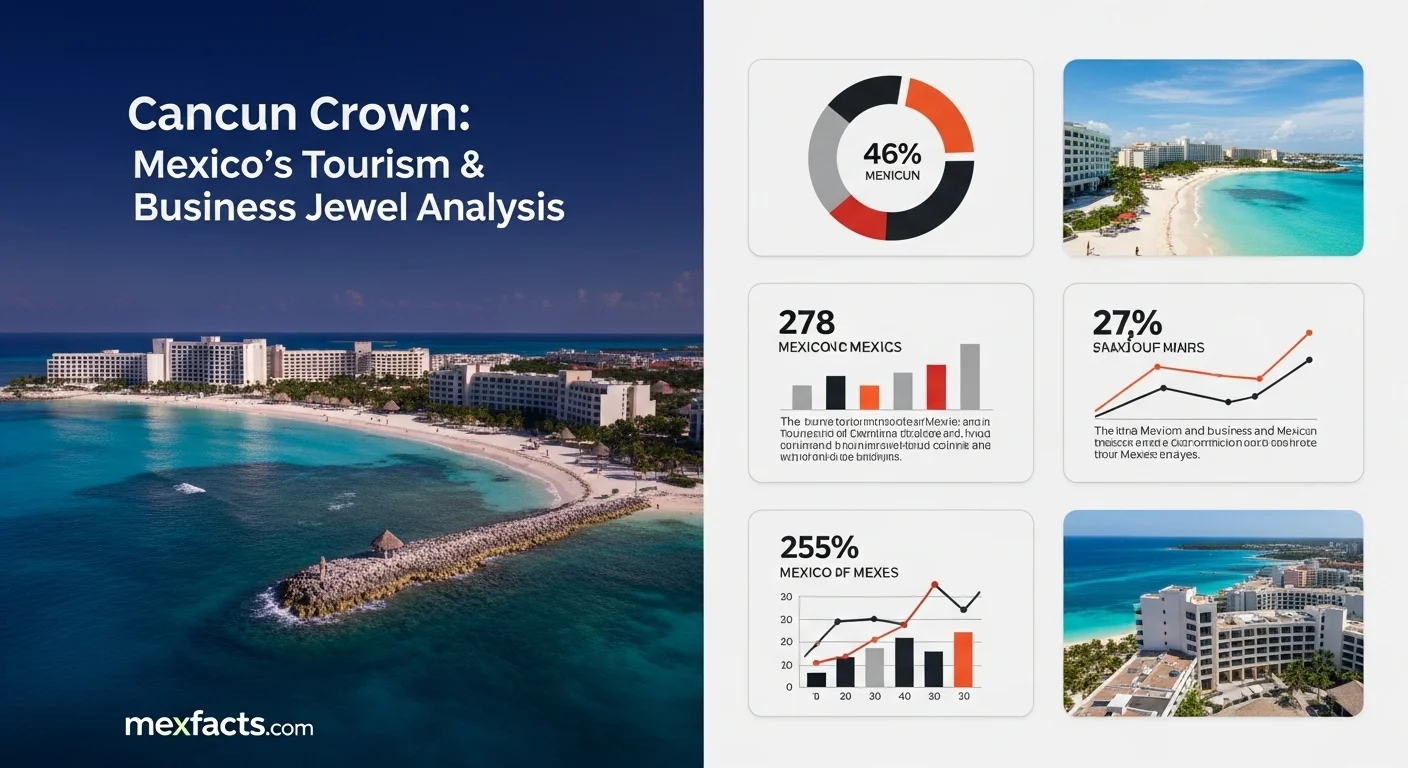
Behind Cancún's reputation as Mexico's crown jewel of tourism lies an impressive statistical foundation. The destination's operational metrics demonstrate how a meticulously designed barrier island supports an extensive commercial ecosystem spanning airlines, logistics suppliers, construction firms, and specialized hospitality services.
Visitor Inflows, Airport Traffic, and Hotel Occupancy
A primary indicator of Cancún's strength is its passenger throughput and lodging density. Cancún International Airport (CUN) consistently ranks as Mexico's busiest hub for international arrivals, handling over 30 million domestic and international passenger movements annually. The airport connects directly to more than 100 cities worldwide, providing unparalleled access for travelers from North America, Latin America, and Europe.
Within the Hotel Zone and immediate municipality, hotel room inventory exceeds 35,000 keys, with the broader northern Quintana Roo corridor providing over 100,000 rooms. Despite this immense capacity, Cancún maintains average annual hotel occupancy rates between 70% and 80%, surging above 85% during peak winter and spring holiday seasons. This resilience stems from market diversification: high-volume family resorts like Crown Paradise Club Cancún capture consistent North American family demand, luxury enclaves attract affluent couples, and full-service business hotels accommodate international corporate delegations.
An Engine for Mexico's Economy: GDP and Employment
The economic contribution of tourism to the state of Quintana Roo is among the highest in the world. According to data from the National Institute of Statistics and Geography (INEGI) and the Quintana Roo Secretariat of Tourism (SEDETUR), tertiary economic activities—comprising hospitality, food and beverage services, passenger transportation, and retail trade—account for approximately 85% to 87% of the state's total Gross Domestic Product (PIBE). Direct tourism activities generate over 40% of state GDP, while linked commercial services represent the balance of the tertiary sector.
This tourism apparatus is Quintana Roo's primary employer. Resorts directly employ tens of thousands of staff across food preparation, housekeeping, facilities engineering, and guest operations. Beyond hotel grounds, the industry sustains hundreds of thousands of indirect livelihoods, including transport drivers, local farmers, food distributors, artisans, and construction workers. This economic dynamism triggered a sustained demographic expansion, drawing skilled workers from across Mexico and establishing Cancún as a thriving multicultural metropolis, as detailed in Mexico: A Guide to Its Economy, Culture & Opportunities.
The All-Inclusive Model: Operational Efficiencies and Local Integration
From a financial standpoint, the all-inclusive formula functions as a finely tuned corporate machine. By capturing guest expenditure on-site, properties achieve economies of scale in culinary operations, energy consumption, and entertainment programming. This efficiency allows operators to manage food costs effectively and maintain stable employment levels even during seasonal shoulder months.
However, the model has prompted valid economic discussions regarding local commercial integration. Because guests have all meals and drinks prepaid, spending at off-resort independent restaurants and neighborhood merchants can be limited. In response, modern tourism strategies in Quintana Roo increasingly emphasize supply-chain linkages—encouraging resorts to procure produce from local agricultural cooperatives in the Zona Maya and partner with licensed local tour operators for excursions beyond hotel gates.
The Future of Cancún: Opportunities, Infrastructure, and Sustainability
As Cancún enters its second half-century of operations, the destination faces evolving traveler preferences, regional competition, and vital ecological responsibilities. Retaining its position as Mexico's crown jewel requires balancing commercial expansion with environmental protection, digital modernization, and cultural depth.
New Horizons: Infrastructure, Tren Maya, and Cultural Tourism
The most transformative development in the Mexican Caribbean is the expansion of regional connectivity through major federal infrastructure projects. Chief among these is the Tren Maya (Mayan Train), which features an intermodal station directly at Cancún International Airport. The rail network connects visitors in the Hotel Zone to renowned archaeological sites across the Yucatán Peninsula—such as Chichén Itzá, Tulum, Calakmul, and Palenque—as well as historic colonial cities including Mérida, Campeche, and Valladolid.
This transit link allows travelers to combine traditional beach vacations with immersive historical and cultural journeys, connecting modern coastal leisure with the ancestral heritage highlighted in The Soul of Mexico: A Journey Through Its History and Culture. Simultaneously, ongoing terminal expansions at Cancún International Airport enhance capacity, ensuring seamless transit for emerging visitor markets in South America and Western Europe.
Environmental Stewardship: Sargassum, Reefs, and Climate Resilience
Sustaining Cancún's appeal hinges on safeguarding the natural ecosystems that established its fame. Two primary ecological challenges demand active management: mitigating recurrent influxes of pelagic sargassum seaweed along the shoreline and protecting the Mesoamerican Barrier Reef System, the world's second-largest barrier reef.
Resort properties and municipal authorities have implemented coordinated containment barriers, mechanized beach-cleaning protocols, and sargassum recycling programs to protect public beaches. In parallel, leading resorts are adopting stringent international sustainability standards, including EarthCheck and Blue Flag certifications. Key operational practices now focus on closed-loop wastewater treatment, elimination of single-use plastics, water desalination efficiency, and support for coastal dune restoration.
Smart Destinations: Technology, Modernization, and Investment Outlook
The technological evolution of Cancún is redefining the guest experience from arrival to departure. Properties throughout the Hotel Zone are implementing contactless mobile check-in, keyless biometric access, smart energy-management systems in guest suites, and artificial intelligence platforms that personalize guest itineraries and optimize resort utility usage.
For institutional investors and international hotel flags, Cancún remains one of Latin America's most compelling markets. The convergence of high-capacity airport infrastructure, established legal frameworks for foreign investment, and strong asset valuation continues to attract hospitality investment trusts (FIBRAs) and international brands. By integrating environmental resilience, cultural depth, and smart technology, Cancún continues to redefine world-class hospitality, ensuring that Mexico's crown jewel of tourism remains vibrant, sustainable, and globally competitive for decades to come.
Expert Reviews
Sarah and Tom Jenkins, First-Time Visitors ⭐⭐⭐⭐⭐
My husband and I just got back from our first trip to Cancún, and this article perfectly captures why we loved it. We stayed at an all-inclusive, and the idea of the 'Cancún Crown' makes so much sense. Everything was seamless, beautiful, and so welcoming. We already feel that pull to come back!
Robert Chen, International Investor ⭐⭐⭐⭐⭐
A fantastic and well-rounded analysis. I've been considering the hospitality market in Mexico, and this piece provided the historical context and forward-looking insights I needed. The discussion on infrastructure like the Tren Maya and the focus on sustainability is particularly valuable for long-term strategy. Very insightful.
Elena Garcia, Repeat Visitor ⭐⭐⭐⭐⭐
I’ve been visiting Cancún with my family for over 15 years, and I've witnessed the evolution this article talks about firsthand. It’s more than just buildings; it’s a living, breathing city. This article does a great job of explaining the 'how' and 'why' behind its success while also touching on the important challenges for the future. ¡Me encantó!