
Park Royal Cancun Resorts: All-Inclusive Guide, Inclusions & History

Cancun's transformation from a secluded Caribbean sandbar into a premier international destination is one of Mexico's most ambitious tourism success stories. Central to this evolution are established hospitality properties like Park Royal Hotels & Resorts, operating both the upscale Grand Park Royal Cancún and the family-focused Park Royal Beach Cancún in the city's iconic Hotel Zone. This comprehensive guide examines both properties, detailing what their all-inclusive packages include and exclude, analyzing Quintana Roo's tourism economics, and exploring how hospitality supply chains connect with the broader regional resort economy.
Table of Contents
- The Birth of a Tourist Paradise: The Cancun Project
- Park Royal Resorts in Cancun: Grand Park Royal vs. Park Royal Beach
- The All-Inclusive Model: Inclusions, Amenities, and Guest Policies
- Cancun and Quintana Roo Tourism Economics
- Beyond the Buffet: Supply Chains and the Local Economic Footprint
- Future Outlook: Infrastructure, Tren Maya, and Regional Connectivity
- Investing in Paradise: Opportunities, Regulations, and Sustainability
The Birth of a Tourist Paradise: The Cancun Project
In the late 1960s, what is now Cancun's 14-mile (22-kilometer) Hotel Zone was a deserted barrier island fringed by mangroves, untouched beaches, and a small fishing community. Recognizing the untapped potential of the Mexican Caribbean, the Mexican federal government and the Bank of Mexico (through Infratur, later reorganized as FONATUR—Fondo Nacional de Fomento al Turismo) conceived an unprecedented initiative in 1969 known as the 'Cancun Project.' Planners evaluated meteorological records, water temperatures, sand composition, and proximity to North American travel markets to designate Cancun as Mexico's first master-planned resort destination, or Centro Integralmente Planeado (CIP).
Groundbreaking began in 1970 under challenging logistics, requiring the construction of access roads from Puerto Juárez, lagoon dredging, and the installation of initial municipal infrastructure. To demonstrate commercial viability to private investors, the federal government financed the earliest hotel developments directly. This master-planned framework laid the groundwork for modern hospitality in the region, showcasing the transformation of the Mexican Caribbean. Established brands such as Park Royal Hotels & Resorts subsequently built properties that epitomize the evolution of Cancun's resort landscape.
Park Royal Resorts in Cancun: Grand Park Royal vs. Park Royal Beach
A frequent point of confusion for travelers researching accommodations in Cancun is distinguishing between the two distinct properties operated under the Park Royal portfolio. Located in prime sections of the Hotel Zone along Boulevard Kukulcán, each property serves a different traveler profile:
Grand Park Royal Cancún (Blvd. Kukulcán Km 10.5): Positioned as an upscale, premium beachfront resort, this property features 346 rooms and suites, including ocean-view villa accommodations. The resort emphasizes relaxation and culinary variety, offering multiple swimming pools (including an adults-only pool with a swim-up bar and an oceanfront main pool), a full-service spa, wellness facilities, and specialty à la carte restaurants such as El Mirador (Italian cuisine) and Frida (traditional Mexican cuisine).
Park Royal Beach Cancún (Blvd. Kukulcán Km 12.5): Designed primarily for families and active travelers, this 288-room beachfront resort is situated directly across from the popular La Isla Shopping Village. A notable feature of the property is its immediate adjacency to the Yamil Lu'um archaeological site—an authentic 13th-century Mayan coastal watchtower ruin located on a promontory directly on hotel grounds. Amenities include a dedicated children's water park with splash areas and slides, family-friendly pools, daily entertainment, and direct beach access.
The All-Inclusive Model: Inclusions, Amenities, and Guest Policies
The rise of the all-inclusive model in the 1990s and 2000s fundamentally reshaped Caribbean tourism. For international vacationers, particularly families and group travelers, the predictability of pre-paid accommodation, dining, and recreation provides budgeting transparency and convenience.
Under the standard all-inclusive packages at Park Royal properties, the following amenities and services are covered under the room rate:
- Dining and Beverages: Unlimited dining across on-site buffet venues and specialty à la carte restaurants, casual snack bars, and domestic alcoholic and non-alcoholic beverages at resort bars and lounges.
- Recreation and Activities: Access to swimming pools, fitness centers, daytime beach games, scheduled sports, and supervised children's club programs.
- In-Room Comforts: Daily housekeeping, air-conditioned guestrooms with balconies or terraces, and mini-bars restocked according to property standards.
- Service Charges: Standard hospitality taxes and basic gratuities are factored into the comprehensive package price.
Understanding service boundaries is equally vital for travelers. Premium amenities typically incur additional charges, including specialized spa and hydrotherapy treatments, imported vintage wines, motorized water sports, laundry services, and off-site transportation. Navigating these details allows international travelers visiting via Cancun International Airport to plan their trips effectively while meeting Mexican entry and border requirements.
Cancun and Quintana Roo Tourism Economics
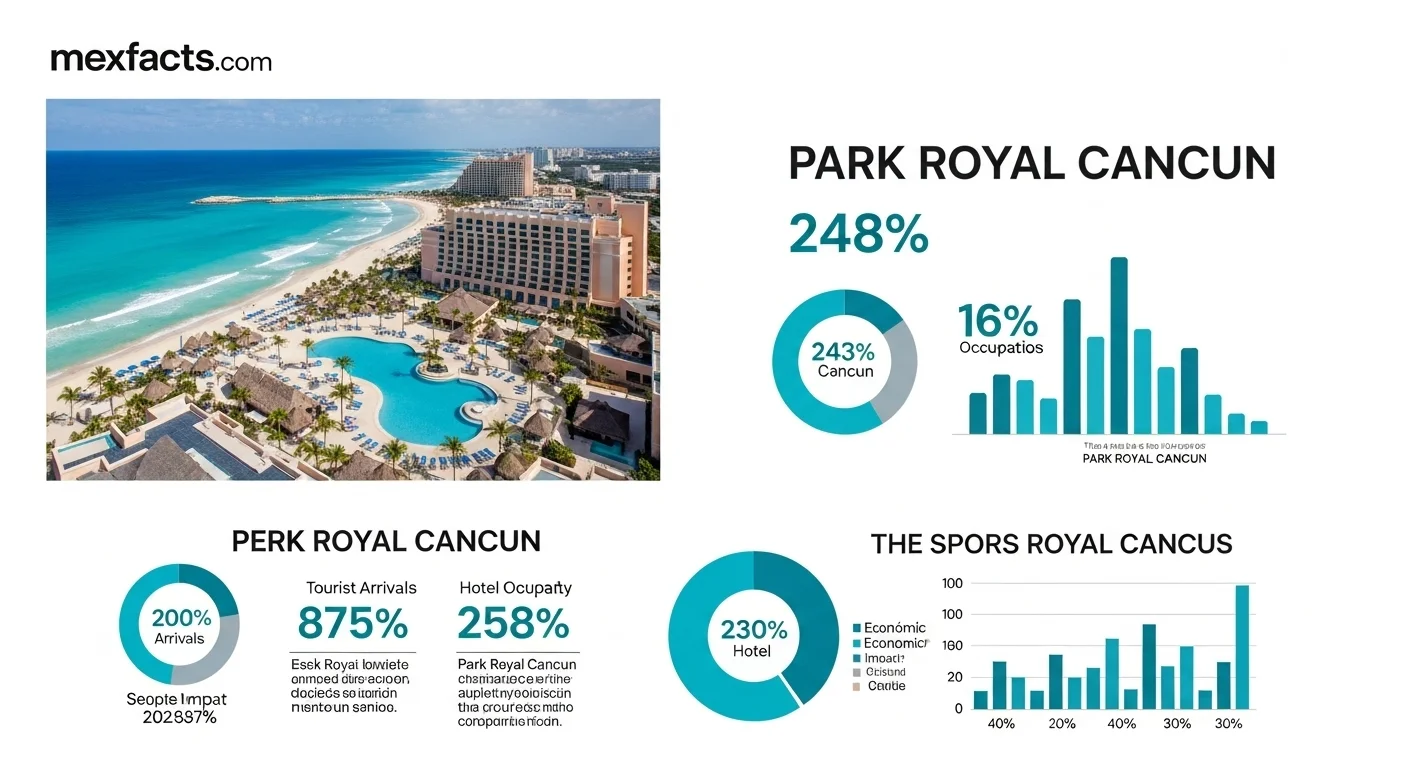
Cancun's lodging performance serves as a primary barometer for the wider hospitality sector across southeastern Mexico. Quintana Roo possesses over 130,000 hotel rooms, with the Cancun Hotel Zone accounting for approximately 35,000 to 40,000 keys. While peak holiday periods such as Easter (Semana Santa), spring break, and the winter festive season frequently see hotel occupancy surge beyond 88% to 92%, annual average occupancy across Cancun typically settles within a resilient 75% to 82% corridor.
At the state level, Quintana Roo welcomes more than 20 to 21 million total visitors annually, generating an estimated economic impact exceeding $20 billion USD. Cancún International Airport (CUN) functions as the country's primary international entry point, handling over 30 million domestic and international passengers each year. Notably, Quintana Roo accounts for more than 40% of all international tourists arriving in Mexico by air, underscoring the macroeconomic prominence of Hotel Zone properties such as Park Royal.
Beyond the Buffet: Supply Chains and the Local Economic Footprint
The economic contribution of large resort complexes extends well beyond room revenues. Tourism generates direct employment for hundreds of hospitality professionals per resort—spanning executive chefs, culinary teams, maintenance engineers, guest service representatives, and housekeeping personnel. In Quintana Roo, tourism represents approximately 85% to 87% of the state Gross Domestic Product (GDP), making resort operations the central pillar of household livelihoods.
Furthermore, resorts maintain deep backward linkages across Mexico's domestic economy. Preparing thousands of meals daily requires robust agricultural supply chains: produce such as avocados from Michoacán, limes and tropical fruits from neighboring Yucatán and Veracruz, and seafood from regional fisheries flow steadily into Hotel Zone storage facilities. Outside resort boundaries, visitor spending generates a secondary multiplier effect by supporting private tour operators, transportation cooperatives, local craft artisans, and nearby retail centers.
Future Outlook: Infrastructure, Tren Maya, and Regional Connectivity
As visitor expectations evolve, Cancun's tourism model is expanding beyond isolated resort stays toward connected regional travel. Contemporary travelers increasingly seek cultural immersion, environmental responsibility, and historical exploration alongside traditional seaside leisure.
Crucial infrastructure projects currently transforming mobility in Quintana Roo include:
- The Tren Maya (Mayan Train): Spanning approximately 1,554 kilometers across Quintana Roo, Yucatán, Campeche, Tabasco, and Chiapas, this passenger and freight rail network links Cancún International Airport with ancient Mayan archaeological sites and colonial settlements. For guests staying at Park Royal properties, this rail corridor facilitates day trips and multi-destination itineraries into the broader Maya heartland, including historical destinations such as Tulum and its surrounding ecological attractions.
- Nichupté Vehicular Bridge: Spanning over 8.8 kilometers across Nichupté Lagoon, this vital roadway connects central Cancun with Boulevard Kukulcán. The bridge provides an alternate transit corridor, alleviating vehicular bottlenecks in the Hotel Zone and significantly reducing travel times for hospitality employees and visitors traveling to and from the airport.
Investing in Paradise: Opportunities, Regulations, and Sustainability
The commercial durability of Cancun's Hotel Zone continues to attract institutional and private real estate investment. Due to prime geographic constraints on the barrier island, asset enhancement, property repositioning, and brand modernizations represent prime avenues for capital deployment. In Mexico's coastal zones, foreign ownership of real estate is legally structured through the established fideicomiso (bank trust) mechanism, which guarantees long-term property rights under Mexican legal statutes.
However, long-term economic prosperity is inextricably linked to environmental stewardship. Key ecological priorities facing Cancun's hospitality industry include:
- Marine Ecosystem Protection: Safeguarding the Mesoamerican Barrier Reef—the second-largest barrier reef system on Earth—demands rigorous municipal wastewater treatment, storm runoff controls, and the adoption of reef-friendly sun protection standards.
- Sargassum Management: Coordinated offshore containment barriers and daily beach restoration initiatives help protect coastal sands from seasonal pelagic seaweed influxes.
- Operational Sustainability: Resort operators are progressively phasing out single-use plastics, implementing high-efficiency HVAC and water systems, and adopting food waste reduction policies to ensure sustainable operations.
By pairing infrastructure modernizations with conscientious ecological practices, Cancun and its hallmark resorts remain well-positioned to balance commercial growth with the preservation of Mexico's Caribbean coast.
Expert Reviews
Laura Chen, First-Time Visitor ⭐⭐⭐⭐⭐
My family and I just got back from our first trip to Cancun, and this article really puts our experience into perspective! We stayed at an all-inclusive, and learning about the history and the 'why' behind it all is fascinating. It wasn't just a vacation; it was part of this huge, incredible story. We felt so welcomed by everyone we met.
Javier Morales, Local Business Owner ⭐⭐⭐⭐
As someone who runs a small transportation service here in Cancun, I live this reality every day. This piece does a great job of showing the bigger picture. Resorts like Park Royal are the engine, but it's the thousands of us—the drivers, the shop owners, the food suppliers—who are the gears that make it all run. It’s a good overview of our complex local economy.
Sarah Williams, International Investor ⭐⭐⭐⭐⭐
A fantastic, well-rounded analysis. I was looking for more than just raw data on occupancy rates. This article provides the context—the history, the government's vision, and the future trends like the Tren Maya. It’s this kind of insight that’s invaluable when evaluating investment opportunities in the region.