
Cancun and Tulum: Distance, Travel Guide, and Corridor Comparison

Spanning 130 kilometers (81 miles) along Federal Highway 307 in Quintana Roo, the coastal corridor between Cancún and Tulum forms the operational core of the Riviera Maya. While Cancún is celebrated for its master-planned Hotel Zone, broad beaches, family-friendly all-inclusive resorts, and high-energy nightlife, Tulum caters to travelers seeking low-rise boutique architecture, wellness culture, cenotes, and Mayan archaeological heritage. Transit between both destinations has diversified with the operation of Tulum International Airport (TQO), the Tren Maya rail line, and established highway shuttles. This comparative guide outlines real transit options, neighborhood differences, ground safety precautions, seasonal weather, and practical planning strategies for single-destination visits or combined itineraries.
- Atmosphere and Lodging: Cancún vs. Tulum
- Transit, Distance, and Airport Logistics
- Safety on the Ground in Quintana Roo
- Weather, Best Seasons, and Sargassum
- Frequently Asked Questions
Atmosphere and Lodging: Cancún vs. Tulum
Choosing between Cancún and Tulum requires understanding their distinct developmental histories, geographic layouts, and hospitality models. Although both sit on the Caribbean coast of Quintana Roo, they serve noticeably different travel preferences.
Cancún: Master-Planned Scale, All-Inclusives, and Vibrant Entertainment
Cancún was conceived in the late 1960s by Mexico's national tourism infrastructure agency, FONATUR, as a purposefully engineered global resort hub. To understand how this narrow sand spit evolved into an international powerhouse, review Cancún's barrier island history. Its central tourism zone is the Zona Hotelera (Hotel Zone), a 23-kilometer sandbar shaped like the number seven, bookended by the open Caribbean Sea and the Nichupté Lagoon.
Cancún excels in high-density comfort and turnkey vacation ease. The Hotel Zone is packed with world-renowned hotel chains, self-contained all-inclusive resorts, upscale shopping malls like La Isla, and concentrated nightlife centers around Punta Cancún. For detailed neighborhood breakdowns, beach zones, and resort profiles, consult our guide on where to stay in Cancun. The northern beaches (such as Playa Tortugas and Playa Caracol) offer calmer waters sheltered by Isla Mujeres, making them ideal for young children and casual swimming, while eastern beaches face energetic surf.
Tulum: Eco-Chic Boutiques, Jungle Settings, and Wellness Culture
Tulum, located roughly 130 kilometers south, developed along a fundamentally different trajectory. Originally an off-grid haven for backpackers drawn to its cliffside 13th-century Mayan walled city, Tulum evolved into an international capital of 'boho-chic' luxury, sustainable design, and wellness retreats. For an in-depth look at town neighborhoods, beach clubs, and archaeological access, read our Tulum destination guide.
Accommodations in Tulum split into three distinct zones: the Beach Zone (Zona Hotelera Tulum), the inland town center (Tulum Pueblo), and master-planned residential enclaves like Aldea Zamá and La Veleta. The beach strip consists primarily of boutique eco-resorts built with natural woods, open-air architecture, and jungle-facing plunge pools rather than multi-story high-rises. Nightlife here skews toward open-air beach clubs, underground electronic music events, and mezcal bars rather than high-capacity mega-clubs. Tulum Pueblo and Aldea Zamá provide apartment rentals, local restaurants, and bicycle-friendly transit at significantly lower rates than beachfront properties.
Comparing the Vibe: Which Destination Fits Your Trip?
Travelers prioritizing seamless logistics, extensive on-site resort amenities, calm family swimming beaches, and traditional resort entertainment will generally find Cancún better suited to their needs. Conversely, travelers seeking design-forward boutique properties, yoga and culinary experiences, cenote exploration, and close proximity to archaeological sites like Cobá and the Tulum ruins will appreciate Tulum's distinctive atmosphere. Combining both destinations into a split itinerary is increasingly popular due to upgraded highway and rail connections.
Transit, Distance, and Airport Logistics
The journey between Cancún and Tulum covers approximately 130 kilometers (81 miles) southward along Mexico Federal Highway 307 (Carretera Federal 307). The road is a multi-lane, paved highway that runs parallel to the coast through Puerto Morelos, Playa del Carmen, and Puerto Aventuras.
Travel Options Between Cancún and Tulum
Several reliable transit methods connect Cancún and Tulum, catering to various budgets and schedules:
- Private Transfer / Shuttle Service: Pre-booked private vans provide door-to-door transit between Cancún International Airport (or Cancún hotels) and Tulum. Drive time is typically 1 hour 45 minutes to 2 hours 15 minutes depending on traffic in Playa del Carmen. This is the fastest and most convenient method for families and groups.
- ADO Bus: The regional express coach company, ADO, operates clean, air-conditioned, direct buses between Cancún Airport terminals (and downtown Cancún terminal) and Tulum Centro (as well as Tulum Archaeological Zone). Tickets typically range from 280 to 420 Mexican pesos ($15 to $23 USD), making it the premier choice for budget and solo travelers.
- Tren Maya (Mayan Train): Passenger service links Cancún Airport Station with stations in Puerto Morelos, Playa del Carmen, Tulum Station, and Tulum Airport Station. The train provides comfortable, modern rail transit, though travelers must factor in taxi or shuttle transfers from Tulum Station into the beach or downtown area.
- Rental Car: Renting a vehicle gives maximum flexibility for visiting cenotes and historical sites along Highway 307. Drivers should stick to daytime travel, use authorized parking lots, and remain mindful of strict Mexican speed limits and municipal traffic checkpoints.
Airport Logistics: Cancún (CUN) vs. Tulum (TQO)
For decades, Cancún International Airport (CUN) served as the sole aerial gateway for the entire Riviera Maya. As one of Latin America's busiest transit hubs, CUN offers extensive direct flights from major cities across North America, Europe, and South America, along with high flight frequencies and competitive pricing.
On December 1, 2023, the Felipe Carrillo Puerto International Airport (TQO), officially known as Tulum International Airport, began operations. Located approximately 40 kilometers southwest of Tulum Centro near Muyil, TQO allows travelers headed directly to Tulum, Akumal, or Bacalar to bypass the 2-hour road trip from Cancún. Travelers planning a combined itinerary can fly into Cancún, travel down the corridor by rail or private vehicle, and depart directly from Tulum Airport, or vice versa.
Safety on the Ground in Quintana Roo
Safety is a primary consideration for visitors exploring the Mexican Caribbean. Both Cancún and Tulum are major international tourist destinations where millions of international travelers visit each year without incident. However, practical situational awareness is essential.
Official Advisories and Tourist Protection
The U.S. Department of State maintains a Level 2 travel advisory for the state of Quintana Roo ("Exercise Increased Caution"), which is comparable to travel advisories issued for many European and Caribbean vacation destinations. Tourist corridors, beach zones, and major transit hubs feature dedicated security presences, including the Quintana Roo Tourist Police, the National Guard (Guardia Nacional), and the Mexican Navy (Secretaría de Marina).
Practical Precautionary Measures
Violent crime in Quintana Roo is predominantly tied to organized disputes over illicit drug sales and rarely targets international tourists. Nevertheless, incidents can occur in public spaces, particularly in late-night nightlife venues. Travelers can minimize risk by following fundamental guidelines:
- Remain within well-lit, populated tourist corridors and avoid walking down unlit streets or isolated beach stretches after midnight.
- Do not buy, carry, or solicit illegal narcotics, as transactions directly expose tourists to criminal activity and severe local legal penalties.
- Arrange ground transportation through authorized airport counters, official hotel concierges, or established private booking agencies rather than hailing unmetered street cabs where fare disputes occur.
- Keep digital copies of passports, keep personal belongings secure when visiting crowded public beaches or cenotes, and utilize resort in-room safes for valuables.
Weather, Best Seasons, and Sargassum
The climate across the Cancún-Tulum corridor is tropical, characterized by consistent warmth year-round, distinct wet and dry cycles, and coastal ocean currents that govern the presence of pelagic sargassum seaweed.
Peak, Shoulder, and Low Seasons
Understanding regional seasons helps travelers optimize weather, budget, and crowd levels:
- Dry Peak Season (December to April): This period delivers the most consistent weather, with daytime highs around 27°C to 30°C (80°F to 86°F), lower humidity, and minimal rainfall. It represents the most crowded and expensive window for hotel bookings. The collegiate Spring Break surge peaks between early March and mid-April, primarily affecting downtown Cancún and beachfront party resorts.
- Shoulder Seasons (May and November): These transitional months offer an excellent compromise. November brings diminishing rainfall and lower crowd density before the holiday surge, while May features warm ocean temperatures and discounted lodging rates before summer storms begin.
- Rainy and Hurricane Season (June to November): Summer brings elevated heat and humidity, with temperatures reaching 33°C to 35°C (91°F to 95°F). Tropical showers typically manifest as intense, brief afternoon downpours rather than day-long rains. The official Atlantic hurricane season peaks between mid-August and late October; while direct hurricane landfalls are rare, tropical depressions can bring periods of overcast skies and choppy seas.
Managing the Sargassum Phenomenon
Sargassum is a naturally occurring brown macroalga that floats across the Atlantic Ocean and Caribbean Sea. Driven by seasonal winds and ocean currents, sargassum washes ashore on eastern-facing Caribbean beaches, most commonly between April and August. In excessive quantities, decomposing seaweed can produce an unpleasant odor and discolour shoreline waters.
Regional authorities and beachfront resorts respond vigorously by deploying offshore barrier nets, specialized collection vessels, and daily beach-raking tractors. When choosing where to swim, keep in mind that northern-facing beaches in Cancún (such as Playa Caracol and Playa Linda) and beaches sheltered by Cozumel often experience significantly less seaweed buildup than the exposed open beaches of Tulum. Inland cenotes and offshore reefs provide crystal-clear swimming conditions year-round, regardless of coastal seaweed influxes.
Regional Economic Engine and Corridor Development
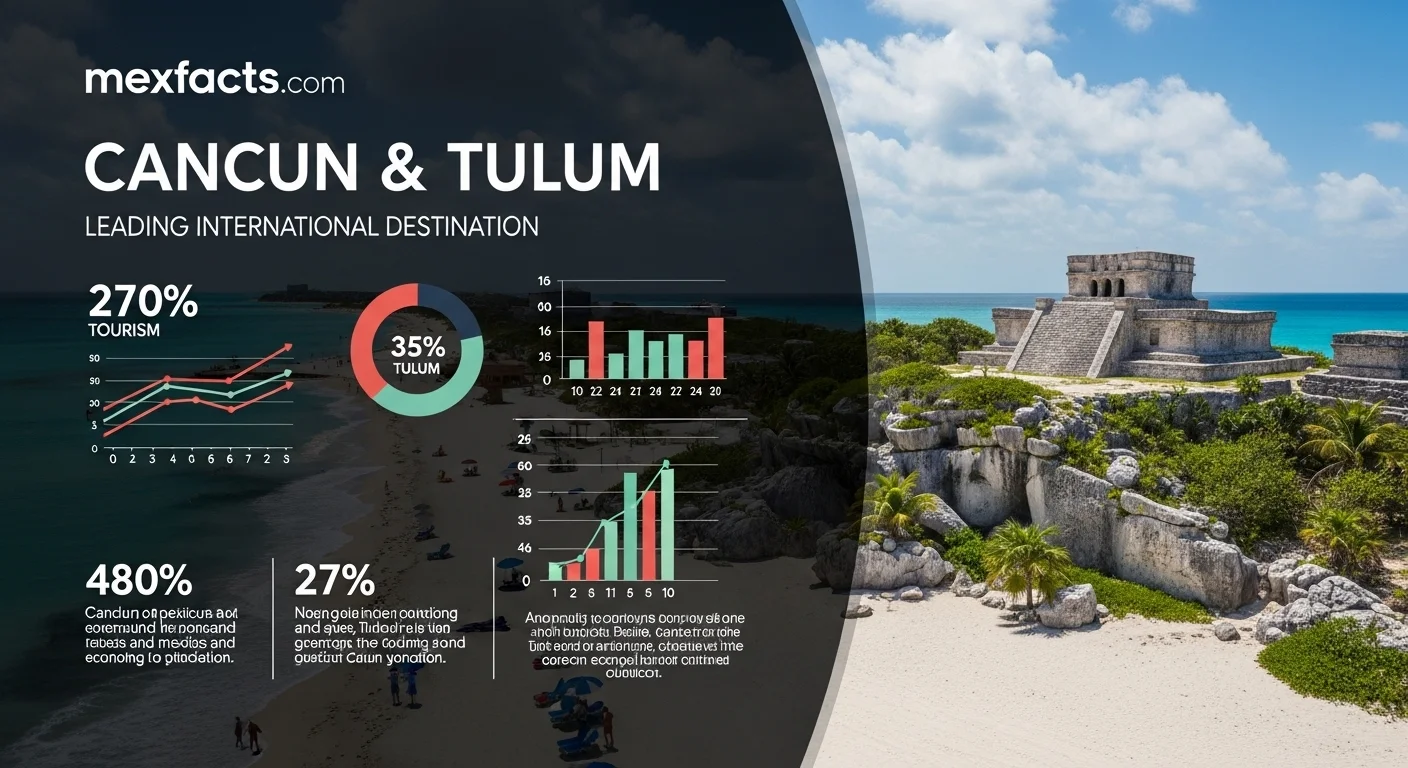
The Cancún-Tulum corridor is the premier economic engine of Quintana Roo and the primary contributor to Mexico's international tourism revenue. According to state tourism authorities (SEDETUR), Quintana Roo hosts over 130,000 hotel rooms and welcomes more than 20 million visitors annually. Tourism accounts for nearly nine percent of Mexico's national GDP, with Quintana Roo capturing over 40 percent of all international tourist arrivals entering the country.
Strategic infrastructure investments, specifically the Tren Maya rail corridor and Tulum International Airport, continue to decentralize tourism away from single-resort enclaves and distribute economic activity southward into Felipe Carrillo Puerto, Bacalar, and Maya Ka'an. This connectivity encourages extended multi-stop itineraries that combine Cancún's high-capacity hospitality with Tulum's boutique eco-tourism and surrounding indigenous cultural heritage.
Frequently Asked Questions
- How far is Tulum from Cancún and how long does the drive take?
Tulum is approximately 130 kilometers (81 miles) south of Cancún. By car or private transfer along Highway 307, the trip takes between 1 hour 45 minutes and 2 hours 15 minutes depending on traffic through Playa del Carmen.
- Is it cheaper to vacation in Cancún or Tulum?
Cancún generally offers a broader range of price points, including budget-friendly hotels in Cancún Centro and all-inclusive packages where meals and entertainment are prepaid. Tulum's beachfront zone commands premium boutique rates and higher restaurant costs, although staying in Tulum Pueblo (downtown) provides economical apartments and authentic dining.
- Should you fly into Cancún (CUN) or Tulum (TQO)?
If your entire trip is centered around Tulum, Akumal, or Bacalar, flying directly into Tulum International Airport (TQO) saves hours of ground transit. If you are staying in Cancún or the Riviera Maya north of Playa del Carmen, or seeking lower airfares and more nonstop international flight routes, Cancún International Airport (CUN) remains the preferred option.
- Can you easily visit both Cancún and Tulum on one vacation?
Yes. Many travelers book split stays—such as three nights at an all-inclusive resort in Cancún followed by four nights at a boutique hotel or rental villa in Tulum—transferring between destinations via ADO express bus, private shuttle, or the Tren Maya.
Expert Reviews
Amelia Clarke, First-time Visitor ⭐⭐⭐⭐⭐
This guide was a lifesaver! We were debating between Cancún and Tulum for our family vacation. The breakdown of the 'vibe' of each place was spot on and helped us choose a fantastic all-inclusive in Cancún that was perfect for the kids. The safety advice also gave us peace of mind. Thank you!
David Chen, Real Estate Investor ⭐⭐⭐⭐⭐
As someone looking at investment opportunities, this article provided the clear, data-driven perspective I needed. The insights on the new Tulum airport and the Tren Maya's impact were particularly valuable. It’s rare to find content that is both well-researched and easy to understand. Highly recommend.
Sofia Rossi, European Traveler ⭐⭐⭐⭐
I used this article to plan my multi-week trip through the Yucatán. The advice on the best time to visit was perfect—I went in late April and it was beautiful! The discussion on sargassum was also very honest and helped me set my expectations. It would be great to see even more on transportation between the smaller towns.