
Cancun's Island Miracle: From Sandbar to Mexico's Tourism Jewel

I'll never forget the first time I flew over Cancun. Seeing that perfect '7'-shaped sliver of white sand, cradled by the turquoise Caribbean on one side and the calm Nichupté Lagoon on the other, is a sight that stays with you. But the real story is even more incredible. This place, now a global icon, was once a deserted sandbar, home to just a handful of coconut farmers. Then, in the 1970s, the Mexican government, armed with computer data and a bold vision, decided to build a world-class paradise from the ground up. Today, Cancun Island is the heart of Mexico's tourism, a magnet for international visitors and a powerful engine for our national economy. In this article, we'll journey back to its fascinating origins, look at the numbers that prove its success, explore the diverse hotels that give it character, and peek into the future with game-changing projects like the Tren Maya. For anyone who loves Mexico or sees its vast potential, this is the story of a dream that became a breathtaking reality.
Table of Contents
- What is Cancun Island and Why is it Important Internationally?
- The Birth of a Mega-Resort: A Calculated Gamble
- Defining the Cancun Experience: A Spectrum of Hospitality
- Current statistics and data about Cancun Island in Mexico
- Investment and Development Data
- A Closer Look at Hospitality Models and Their Economic Contribution
- Future outlook and opportunities regarding Cancun Island in Mexico
- Navigating Challenges: Sustainability and Competition
- Investment and Business Opportunities
What is Cancun Island in Mexico and why is it so important internationally?
When people around the world dream of a Mexican beach vacation, the image they see is almost always Cancun Island. Known to us locals as the 'Zona Hotelera,' this stunning 14-mile strip of sand is the engine of Mexican tourism. It's a marvel of geography, a barrier island that separates the brilliant turquoise of the Caribbean Sea from the tranquil, deep green waters of the Nichupté Lagoon. But its existence as a global destination was no accident; it was a masterstroke of planning. Back in the late 1960s, the Mexican government knew it needed to bring in foreign money and develop new regions. So, through its tourism agency FONATUR, it did something almost out of science fiction for its time: it used computer models to find the perfect spot for a new mega-resort. The computers analyzed weather, beaches, and proximity to North America, and they chose this forgotten strip of sand and jungle in Quintana Roo, a place with barely any inhabitants.
This 'Cancun Project,' born in 1969, was a vision to build a paradise from scratch. The plan was brilliant in its simplicity: a dedicated island for hotels and fun, a proper city on the mainland for all the workers and their families, and a world-class international airport to bring everyone in. The international importance of this idea cannot be overstated. Cancun single-handedly created the 'Mexican Caribbean' brand and wrote the playbook for the development of the entire Riviera Maya, from Playa del Carmen down to Tulum. Its primary goal was always economic—to turn our natural beauty into a sustainable source of income and jobs. And it worked beyond anyone's wildest dreams. Today, Cancun's airport (CUN) is the gateway to Mexico for millions of international visitors, making it a vital source of employment and opportunity for the entire Yucatan Peninsula. It’s a living testament to a successful partnership where the government laid the foundation, and private investment built the dazzling structure we see today.
The Birth of a Mega-Resort: A Calculated Gamble
The origin of Cancun is a story I love to tell because it shows the ambitious spirit of Mexico. The Bank of Mexico created a fund specifically to develop tourism in overlooked areas. After the computers crunched the data and pointed to this specific spot, the master plan was laid out: a zone for tourists, a city for residents, and an airport. In January 1970, the first pioneers arrived, carving a road through the jungle to connect the island to the mainland. In those early days, private investors were nervous. Risking money on an unknown jungle paradise? It seemed crazy. So, the Mexican government put its own money on the line, financing the first nine hotels, including what would eventually be reborn as the vibrant Temptation Island Cancun. This act of faith was the spark. The first hotels opened in 1974, the same year Quintana Roo officially became a state. From just three souls living on a coconut plantation in 1970, a city was born. The success of those first hotels proved the concept, and a flood of private investment began that hasn't stopped since, creating the incredible skyline and diverse experiences Cancun offers today.
Defining the Cancun Experience: A Spectrum of Hospitality
Cancun's global fame comes from its incredible ability to be many things to many people. The island's resorts cover every taste and budget imaginable. You have the classic, family-friendly resorts that feel like a warm hug, places like the Royal Islander Cancun. I've met families who have been coming back to the Royal Islander for generations, creating memories in its spacious villas. It’s the kind of place that forms the reliable, welcoming heart of Cancun.
Then you have the innovators, the resorts that cater to very specific desires. A perfect example is the adults-only Temptation Island Cancun. After a massive, multi-million dollar rebuild, it branded itself as a 'Playground for Grown-Ups.' It’s a high-energy, topless-optional, and unapologetically fun resort for the 21-and-over crowd. This shows Cancun isn't a one-trick pony; it evolves and embraces different lifestyles.
And of course, there's the all-inclusive model, which Cancun has perfected. Companies like Karisma Hotels & Resorts have elevated it to an art form with their 'Gourmet Inclusive' experience. Take the Margaritaville Island Reserve Riviera Cancun. It brilliantly combines the relaxed, fun-loving vibe of the Jimmy Buffett brand with true luxury. The property, officially known as Margaritaville Island Reserve Riviera Cancun All Inclusive by Karisma, isn’t just about a room and a buffet. It's a complete experience—themed bars, swim-up suites, and fantastic food. When you see a resort managed by a top group, as with the Margaritaville Island Reserve Riviera Cancun by Karisma, you know you're getting a standard of quality that seasoned international travelers demand. This smart branding and variety are why Cancun continues to rule the global tourism stage, welcoming everyone from families to jungle and coastal adventurers to luxury seekers.
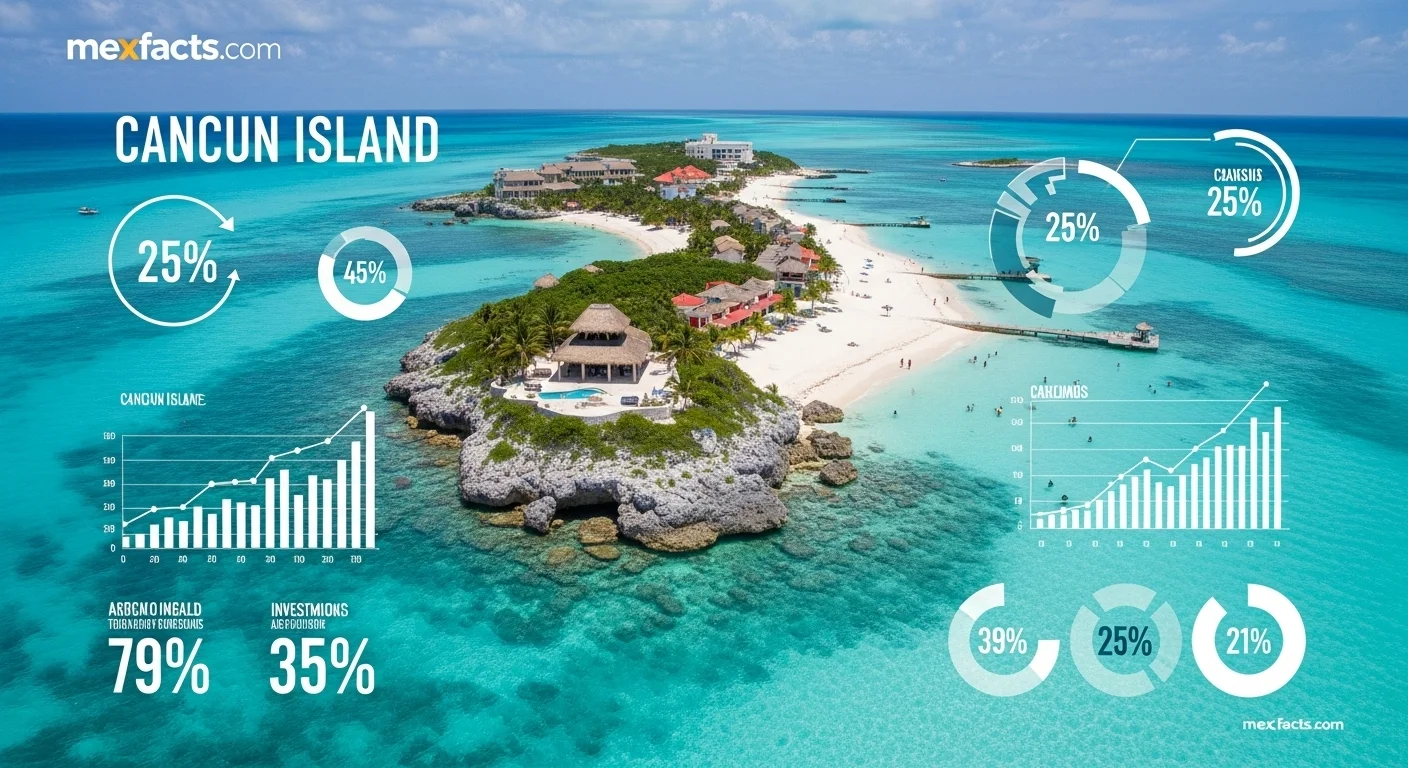
Current statistics and data about Cancun Island in Mexico
When you look at the numbers, you start to grasp the sheer scale of Cancun's success. Cancun International Airport (CUN) is the beating heart of the operation. In 2023, it welcomed around 32.75 million passengers. To put that in perspective, that's more than the entire population of Australia passing through one airport! It's the undisputed king of international travel in Mexico. While we've seen a slight leveling off in early 2024 and 2025, that's a natural adjustment after the post-pandemic travel explosion. It's also a sign of a maturing region, especially with the brand-new Tulum International Airport (TQO) now sharing some of the traffic. Even so, CUN remains a top destination; major airlines like Delta still list it as their most-searched Caribbean spot for 2025 travel.
Hotel occupancy tells a similar story of resilience. Historically, being 85% full was normal here. In March 2024, the rate was a very healthy 82.84%. Even when rates dipped slightly to 75% earlier in the year, it was largely because we have so many more rooms now—over 133,000 in Quintana Roo! The demand is still so strong that it's absorbing all this new inventory. The economic impact is huge. In the first seven months of 2024, tourism brought over $20 billion into Mexico, with the average international visitor spending over $1,185. Cancun is the main driver behind those incredible figures.
Investment and Development Data
The constant hum of construction you hear in the region is the sound of confidence. In the first eight months of 2024 alone, Mexico added over 4,000 new hotel rooms, and Cancun was responsible for nearly 70% of them. That’s almost 2,900 new rooms in just one area! It shows a boom fueled by an unending appetite for our sun-soaked beaches. Looking ahead, Cancun leads the nation in projects under construction, accounting for 31% of the more than 10,600 hotel rooms currently being built across Mexico.
The money is flowing in from all over the world. Foreign Direct Investment in Mexico's tourism sector hit $1.37 billion in the first half of 2024. All-inclusive hotels, the model we perfected here, are a magnet for this cash. This tells you that international investors see a bright and stable future. This investment also fuels technological innovation. We see it in properties like the Temptation Island Cancun, which underwent a complete teardown and rebuild to re-emerge as a cutting-edge lifestyle resort. That's a bold move that shows a commitment to staying fresh and appealing to modern travelers.
A Closer Look at Hospitality Models and Their Economic Contribution
The economic success here isn't just about numbers; it's about the rich variety of experiences offered. The traditional, family-focused resorts like the Royal Islander Cancun are the bedrock of our catering industry. They provide stable employment and support countless local businesses through generations of loyal guests who feel like family.
At the same time, the evolution of the all-inclusive has been a game-changer. A partnership like the one behind Margaritaville Island Reserve Riviera Cancun by Karisma is a masterclass in modern hospitality. Karisma is famous for its 'Gourmet Inclusive' philosophy, which swaps tired buffets for high-quality à la carte dining and premium service. This attracts a more sophisticated traveler who spends more. The Margaritaville Island Reserve Riviera Cancun taps into a beloved lifestyle brand to promise fun, relaxation, and luxury all in one. As the full name Margaritaville Island Reserve Riviera Cancun all inclusive by karisma suggests, guests get an entire world of amenities—multiple pools, a spa, 24-hour room service—all designed to create an unforgettable stay and boost the local economy. The success of these high-quality, branded resorts is proof that investing in luxury and unique experiences is the path to future growth.
Future outlook and opportunities regarding Cancun Island in Mexico
Looking ahead, Cancun's future is a vibrant mix of incredible opportunities and important responsibilities. The destination is on the cusp of another great transformation, thanks to huge infrastructure projects and evolving traveler tastes. The most exciting of these is the Tren Maya, a massive railway project connecting the entire Yucatan Peninsula. For us, it’s more than a train; it's a new artery that will carry visitors into the heart of the Mayan world, from ancient ruins to charming colonial towns. By helping visitors explore beyond the beach, it will spread the economic benefits of tourism more evenly and perhaps ease some of the pressure on Cancun Island itself. This opens up amazing opportunities for new tours, boutique hotels, and experiences all along its route.
Investment opportunities here are as strong as ever, especially in the luxury and wellness spaces. The real estate market is buzzing, with property values in Cancun projected to climb 14% between 2024 and 2025. There's a growing hunger for authentic, sustainable travel, creating openings for eco-lodges and businesses that blend luxury with a genuine respect for nature. Successful models like the Margaritaville Island Reserve Riviera Cancun show the power of combining a fun brand with the high-service standards of an operator like Karisma. This property, officially the Margaritaville Island Reserve Riviera Cancun all inclusive by karisma, is a perfect case study in creating a unique, high-value experience that modern tourists crave.
Navigating Challenges: Sustainability and Competition
Of course, with great success comes great responsibility. Our biggest challenge is protecting the very thing that makes this place magical: our environment. Decades of development have taken a toll on our fragile coastline and lagoon. Issues like beach erosion and the annual arrival of sargassum seaweed require our constant attention and investment in new, green technologies. The future of Cancun depends on our ability to become guardians of our natural paradise. I see this as an opportunity for investment in sustainable businesses that can help us protect this jewel for generations to come.
We also face growing competition. The new airport in Tulum and other beautiful beach destinations around the world mean we can't afford to stand still. We have to keep innovating. That means reinvesting in our properties, like the bold reconstruction of the Temptation Island Cancun to capture a modern, design-focused market. It also means showcasing more than just our beaches, by developing our potential in medical tourism and cultural tourism, and becoming a hub for digital nomads. The diversity of our hotels, from the family-oriented Royal Islander Cancun to the lifestyle-luxury of the Margaritaville Island Reserve Riviera Cancun by Karisma, is our strength. It shows that by catering to a wide array of tastes, we can navigate any competitive challenge.
Investment and Business Opportunities
For international investors with a keen eye, Cancun remains a golden opportunity. The secret is finding the right niche. High-end all-inclusives continue to draw huge investments. There is also a booming market for eco-luxury projects and for services that support tourism, from unique culinary ventures to new technology for hotels. The vacation rental market is soaring, thanks to tourists and a growing community of expats and remote workers. The government's commitment to huge projects like the Tren Maya sends a clear signal that this is a stable and supportive environment for long-term growth. By studying the winning formulas, like the partnership between Margaritaville and Karisma, savvy investors can find their own path to success in this dynamic market.
In the end, Cancun's future is about strategic growth. By building on its powerful name and new infrastructure, while tackling its challenges head-on, this incredible destination is ready to write its next chapter. For those who can align with the new trends of sustainability, luxury, and authentic experiences, Cancun offers a landscape rich with promise.
Expert Reviews
Michael Chen, Real Estate Developer ⭐⭐⭐⭐⭐
As an international investor, I'm always looking for clear, on-the-ground insights. This article was exactly that. The historical context combined with current development data on projects like the Tren Maya gave me the confidence to move forward with my research into the Riviera Maya. ¡Excelente análisis!
Sarah Jenkins, Repeat Visitor ⭐⭐⭐⭐⭐
My family and I have been visiting Cancun for over 15 years, staying at the Royal Islander. Reading this article felt like walking down memory lane but also seeing the 'why' behind all the changes we've witnessed. It perfectly captures the evolution from a simple beach spot to the sophisticated destination it is today. It made me appreciate our favorite vacation spot even more.
Alejandro Flores, University Student ⭐⭐⭐⭐⭐
I'm studying urban planning, and the story of Cancun's creation is legendary. This article brought it to life. The explanation of how it was a government-planned project, a 'calculated gamble' as they put it, was fascinating. It's the best summary I've found on the topic.