
Cancun Live: On-the-Ground Reality, Hotel Zone Guide, and Tourism Evolution

Understanding Cancun live means moving past promotional postcards to examine how Mexico's premier Caribbean destination operates on the ground today. What was once an uninhabited sandbar in 1970 has evolved into a global powerhouse welcoming tens of millions of travelers each year through Cancun International Airport. This guide cuts through marketing hype to deliver an accurate, real-time assessment of the destination: how to track live beach and sargassum conditions, the transformation of the Cancun Hotel Zone from standard hotels into luxury all-inclusive enclaves, the economic backbone sustaining the state of Quintana Roo, and how monumental infrastructure projects like the Tren Maya are reshaping the Mexican Caribbean for both vacationers and investors.
Table of Contents
- What Does 'Cancun Live' Mean for Travelers Today?
- Checking Real-Time Conditions: Beaches, Weather, and Sargassum
- The Origin Story: How Computer Algorithms Built a World Capital
- From European Plan to Luxury All-Inclusive: The Resort Transformation
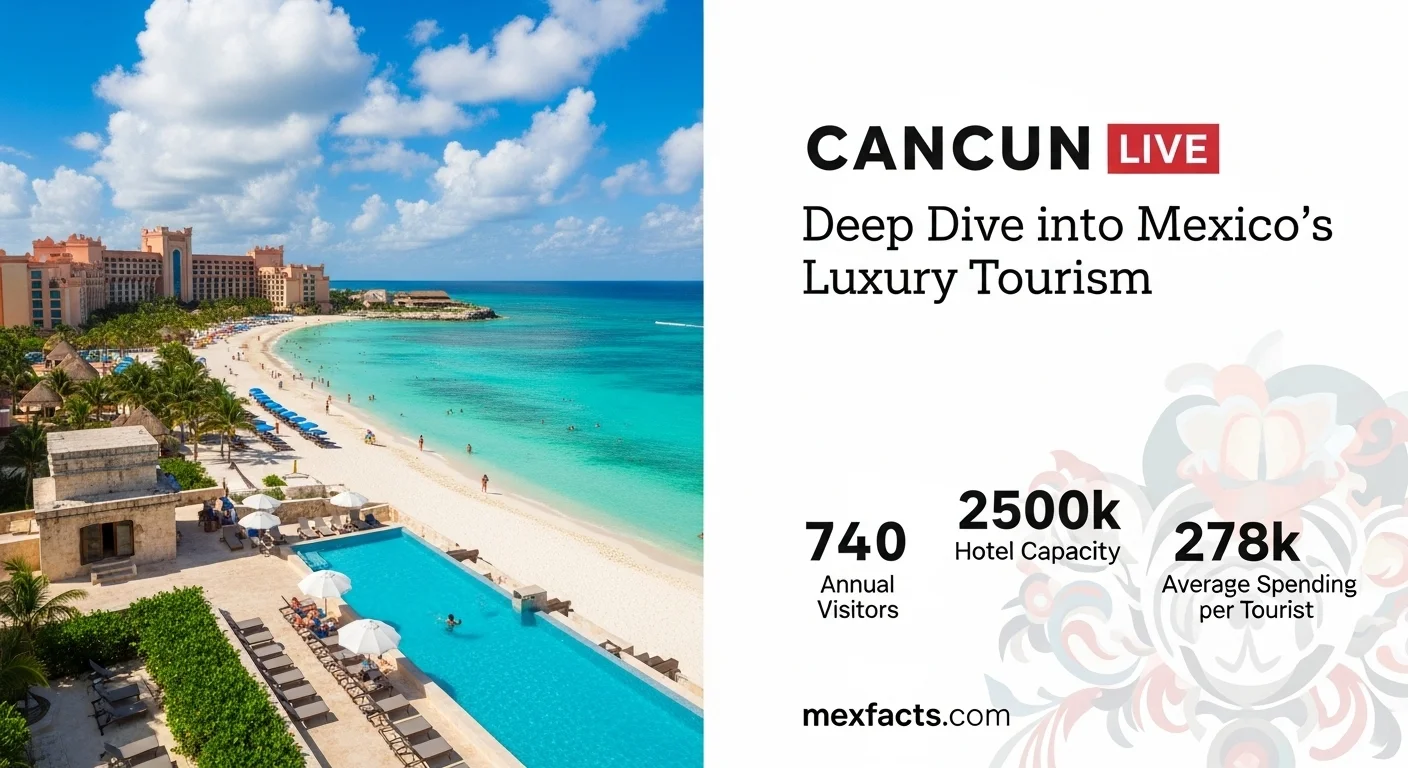
- By the Numbers: Airport Traffic, Hotel Occupancy, and Economic Scale
- Navigating the Destination: Hotel Zone vs. Downtown and Safety
- Future Outlook: Tren Maya, Regional Shifts, and Environmental Challenges
- Frequently Asked Questions About Visiting Cancun
What Does 'Cancun Live' Mean for Travelers Today?
When travelers search for "Cancun live," they typically want to know what is actually happening on the ground right now. Are the beaches clear of seaweed? Is the Hotel Zone crowded? How does the real-time atmosphere compare to social media videos and travel brochures? Experiencing Cancun live means navigating a multifaceted destination that balances high-energy entertainment, world-renowned Mexican hospitality traditions, and an engineered tourism infrastructure designed to process tens of thousands of international arrivals daily.
Unlike historic Mexican cities that grew organically over centuries around colonial plazas, Cancun was planned as a dual ecosystem. On one side lies the 17-mile (28-kilometer) barrier island known as the Hotel Zone (Zona Hotelera), flanked by the turquoise Caribbean Sea on the east and the Nichupté Lagoon on the west. On the other side sits mainland Cancun (El Centro), a vibrant commercial city of roughly one million residents where service workers, entrepreneurs, and local families live. Understanding this division is essential for anyone seeking an authentic, stress-free stay.
Checking Real-Time Conditions: Beaches, Weather, and Sargassum
Travelers monitoring real-time conditions before arriving in Quintana Roo should rely on standardized, verifiable monitoring systems rather than static weather apps, which often predict rain for every tropical afternoon despite clear sunny skies:
- The Municipal Beach Flag System: Cancun's civil protection authorities post daily flags along all public beaches (such as Playa Delfines, Playa Tortugas, and Playa Chac Mool). A green flag indicates calm water and safe swimming conditions; a yellow flag signals strong currents requiring caution; a red flag warns of dangerous undertows where swimming is strictly prohibited; and a black flag indicates severe hazards or complete beach closure.
- Sargassum Seaweed Tracking: Pelagic sargassum blooms naturally fluctuate based on ocean currents, sea temperatures, and seasonal trade winds, typically arriving between April and August. Mexico's Secretariat of the Navy (SEMAR), in coordination with municipal clean-up crews and private resort concessions, deploys offshore containment barriers and specialized harvesting vessels to keep prime hotel beaches clear. Travelers can check daily photographic updates via local sargassum monitoring networks (such as the Red de Monitoreo del Sargazo de Quintana Roo) to assess exact beach conditions.
- Live Webcams and Coastal Feeds: Several major oceanfront resorts and coastal authorities maintain publicly accessible live streaming cameras pointing toward the Caribbean shoreline. These feeds provide an unedited view of wave heights, cloud cover, and beach cleanliness at specific kilometers along Boulevard Kukulcán.
The Origin Story: How Computer Algorithms Built a World Capital
It is difficult to imagine that prior to 1970, Cancun was a virtually uninhabited, snake-shaped sand spit populated only by three coconut plantation caretakers and temporary fishermen. The creation of modern Cancun was not an accident of nature; it was a calculated master plan engineered by Mexico's central bank.
In the late 1960s, Banco de México officials Ernesto Fernández Hurtado and Antonio Enríquez Savignac recognized that Mexico required substantial foreign exchange earnings to support national industrialization. Knowing that international tourism generated rapid economic velocity, they assembled a specialized team of economists, architects, and statisticians. Using early mainframe computers, the team fed meteorological records, water temperatures, topography data, hurricane probabilities, and proximity to major North American airports into algorithmic models.
The computer analysis evaluated prospective sites across Mexico, including Oaxaca, Guerrero, and Baja California. Cancún emerged as the top candidate due to its white aragonite sand (which stays cool under intense sun), consistently warm Caribbean waters, and proximity to major Mayan archaeological complexes. INFRATUR (the Infrastructure Fund that later merged into FONATUR, the National Tourism Development Fund) was formed to execute the project. Ground broke in January 1970. Because private financial institutions initially considered the remote jungle venture too speculative, the Mexican government underwrote the construction of initial infrastructure, paved highways, installed municipal utilities, built the first nine hotel properties, and constructed Cancun International Airport, which welcomed its first commercial flight in 1974—the exact year Quintana Roo officially transitioned from a federal territory into an independent Mexican state.
From European Plan to Luxury All-Inclusive: The Resort Transformation
During the 1970s and 1980s, Cancun's hospitality landscape relied on the traditional European plan, where guests paid solely for lodging and purchased dining and entertainment separately. As global traveler expectations shifted toward convenience and cost predictability, the destination pioneered the modern transformation of the all-inclusive model.
Early all-inclusive concepts often struggled with perceptions of institutional dining and crowded buffets. Over the past two decades, however, leading Mexican and international hotel groups elevated the format into world-class luxury. Rather than standardized cafeterias, modern properties feature à la carte gourmet restaurants helmed by celebrated chefs, sommelier-curated wine lists, full-service sensory spas, and dedicated concierge services.
This luxury evolution is exemplified by flagship properties within the Cancun Hotel Zone. Resorts such as the adults-only Live Aqua Beach Resort Cancun introduced sensory-driven hospitality, where guests customize in-room aromatherapy scents, enjoy private cabanas across multi-temperature swimming pools, and access personalized beach concierges. Similarly, iconic properties like Paradisus Cancun showcase grand architectural design with multi-tiered glass pyramids, extensive wellness sanctuaries, and tiered luxury services (such as The Reserve) that blend all-inclusive ease with high-touch exclusivity. This pivot toward upscale all-inclusive offerings has insulated Cancun from broader economic downturns, attracting affluent international travelers seeking predictable, five-star experiences.
By the Numbers: Airport Traffic, Hotel Occupancy, and Economic Scale
The scale of Cancun's tourism machine is evidenced by regional operational data. Far from a seasonal beach retreat, the destination operates as an economic juggernaut driving a substantial percentage of Mexico's total tourism GDP.
At the center of this network sits Cancun International Airport (CUN), managed by Grupo Aeroportuario del Sureste (ASUR). Operating across four state-of-the-art commercial terminals and an executive aviation FBO, the airport regularly processes more than 30 million total passenger movements annually. Federal immigration statistics from Mexico's Ministry of Tourism (SECTUR) consistently show that Cancun receives more international air arrivals than Mexico City International Airport (AICM), making it the country's primary port of entry for foreign leisure travelers. The primary inbound source markets remain the United States and Canada, complemented by sustained flight connectivity from the United Kingdom, Spain, France, and South America.
Regional hotel performance mirrors this transit volume. Across Cancun and the greater northern Quintana Roo corridor, more than 40,000 hotel rooms maintain average year-round occupancy rates typically hovering between 70% and 85%, climbing above 90% during peak holiday seasons (Easter, summer, and the year-end festive weeks). Even during global travel disruptions, the combination of robust airlift, competitive luxury all-inclusive pricing, and comprehensive resort security has enabled Cancun to rebound faster than competing Caribbean and Central American destinations.
Navigating the Destination: Hotel Zone vs. Downtown and Safety
To experience Cancun effectively, visitors must understand the geographical and logistical layout of the city. Boulevard Kukulcán serves as the primary spine of the Hotel Zone, stretching from Kilometer 0 at downtown Cancun through Kilometer 21 near Punta Nizuc and connecting back toward the airport bypass.
Within the Hotel Zone, security and cleanliness are maintained at exceptional standards. Dedicated tourist police patrols, private resort security perimeters, and constant surveillance make walking around tourist corridors safely standard practice both day and night. Pedestrians can comfortably navigate sidewalk promenades to access shopping centers like Plaza La Isla and Luxury Avenue, waterfront restaurants, and public beach access points (ventanas al mar).
Public transportation within the tourist strip is notably efficient and inexpensive. The municipal R-1 and R-2 public bus lines run continuously up and down Boulevard Kukulcán 24 hours a day, charging roughly 12 Mexican pesos (under $1 USD) per ride and connecting guests directly between hotel lobbies, nightclubs at Punta Cancun, and downtown terminals. For travelers heading into mainland Cancun to experience local taco stalls at Parque Las Palapas or to catch ferry connections, official ADO buses provide secure, air-conditioned regional transit.
For maritime excursions, the Hotel Zone and Puerto Juárez host modern ferry terminals (such as Ultramar and Xcaret Xailing), which offer convenient 20-minute ferry trips to Isla Mujeres. This neighboring island provides tranquil, shallow waters at Playa Norte and offers an accessible day trip away from the bustling pace of the main resort strip.
Future Outlook: Tren Maya, Regional Shifts, and Environmental Challenges
While Cancun continues to lead Mexican tourism in revenue and volume, the destination is undergoing significant infrastructure and ecological transformations that will define its next quarter-century.
The most consequential infrastructure development is the 1,554-kilometer Tren Maya (Mayan Train). Designed to integrate southeastern Mexico, the railway connects Cancun International Airport with cultural hubs, archaeological sites, and secondary destinations across Quintana Roo, Yucatán, Campeche, Tabasco, and Chiapas. With a dedicated transfer hub situated directly adjacent to CUN Airport, the rail line enables international travelers to journey smoothly beyond resort confines into Valladolid, Chichén Itzá, Mérida, and Palenque without booking charter buses or rental cars.
Simultaneously, the opening of Tulum International Airport (Felipe Carrillo Puerto, TQO) has decentralized air arrivals across the Riviera Maya. Rather than funneling all southern Quintana Roo visitors through Cancun's terminals, travelers bound for Tulum, Bacalar, and the southern biosphere reserves can bypass Cancun entirely. Far from weakening Cancun, this redistribution relieves highway congestion along Federal Highway 307 and allows Cancun's hospitality sector to focus on its core strength: high-capacity luxury, meetings and conventions (MICE) tourism, and premium all-inclusive stays.
Nonetheless, rapid regional growth carries critical environmental imperatives. The fragile limestone karst landscape of the Yucatan Peninsula features vast subterranean river systems (cenotes) and sensitive mangrove estuaries that buffer the coastline against tropical storms. In addition, the Mesoamerican Barrier Reef—the second-largest coral reef system on Earth—lies just offshore. Sustainable tourism is no longer an optional marketing phrase; it is an economic necessity. Forward-thinking resorts have implemented strict zero-single-use-plastic policies, certified reverse-osmosis desalination and graywater treatment systems, and active marine conservation programs, such as turtle release sanctuaries that safeguard nesting sea turtles between May and October.
Independent global entities, including World Bank economic assessments, emphasize that balancing infrastructure modernization with environmental conservation is critical to preserving Mexico's natural capital for future generations.
Frequently Asked Questions About Visiting Cancun
How can I check live beach and seaweed conditions in Cancun before traveling?
The most reliable method is to check daily updates published by the Quintana Roo Sargassum Monitoring Network (Red de Monitoreo del Sargazo) or live oceanfront webcams operated by Hotel Zone resorts. Weather forecasts on generic smartphone apps often display rain icons due to brief, passing tropical showers that rarely disrupt an entire beach day.
Is Cancun's Hotel Zone safe for international tourists?
Yes. The Cancun Hotel Zone is one of the most secure and heavily monitored tourist areas in Latin America. It features specialized tourist police forces, modern security monitoring, well-lit sidewalks along Boulevard Kukulcán, and gated private resort security. Standard travel awareness applies, particularly regarding late-night revelry or handling valuables.
When is the best time of year to experience Cancun?
The optimal window for weather is from December through April, featuring clear skies, warm temperatures, and low humidity. May through August brings warmer waters and summer energy, though with higher humidity and greater likelihood of seasonal sargassum. September and October represent the peak of the Atlantic hurricane season, offering the lowest hotel rates alongside increased chances of rain.
How does the Tren Maya connect to Cancun International Airport?
The Cancun Airport Tren Maya Station is located just outside the airport perimeter and is linked to Terminals 2, 3, and 4 via an electric shuttle transit service. From this station, passengers can board passenger trains traveling west toward Chichén Itzá and Mérida or south toward Playa del Carmen, Tulum, and Chetumal.
Expert Reviews
Laura Chen, Recent Traveler ⭐⭐⭐⭐⭐
My husband and I just came back from the Live Aqua and this article perfectly describes the 'sensory' experience they aim for. It really is a different level of all-inclusive. Reading about the history after visiting made me appreciate our trip so much more!
Mark Davis, Business Consultant ⭐⭐⭐⭐
This was a fantastic overview. I needed a clear picture of the investment landscape in Quintana Roo, and the section on the Tren Maya and sustainability challenges was particularly insightful. It's not just hype; it presents a balanced view of the opportunities and risks. Very helpful for my report.
Sofia Ramirez, Cultural Studies Student ⭐⭐⭐⭐⭐
I loved the historical context! I’ve always been fascinated by how Cancun was essentially 'invented.' The article connected the dots from that initial government project to the luxury resorts we see today. It gave me a great foundation for my research paper on tourism development in Mexico.