
Nuevo Laredo, Mexico: Trade Logistics, Port Data, and Travel Safety Realities

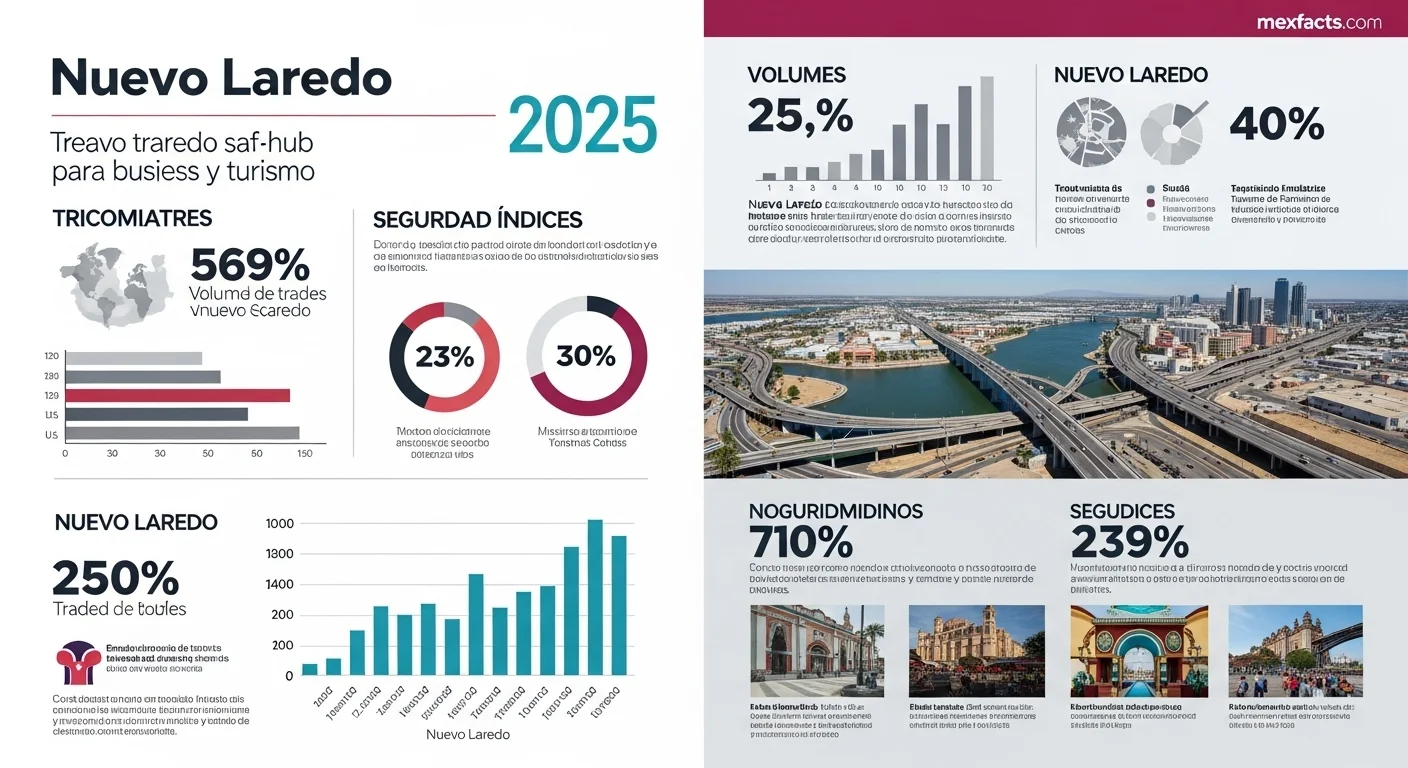
Nuevo Laredo, Tamaulipas, serves as the primary overland freight corridor in North America, processing hundreds of billions of dollars in bilateral trade annually under the United States-Mexico-Canada Agreement (USMCA). Situated directly across the Rio Grande from Laredo, Texas, the binational commercial port accounts for nearly 40% of all motorized cargo crossing between Mexico and the United States. However, the city's critical economic function exists alongside an acute security landscape, marked by a persistent Level 4 "Do Not Travel" advisory issued by the U.S. Department of State. This operational guide details the infrastructure driving Nuevo Laredo's commercial dominance, analyzes freight data, and outlines the enterprise risk mitigation protocols necessary for conducting cross-border business.
Executive Overview & Contents
- The North American Freight Epicenter: Los Dos Laredos
- Customs Infrastructure: World Trade Bridge and Rail Systems
- Security Environment: Official Travel Advisories and Regional Realities
- Corporate Risk Management on the Monterrey-Nuevo Laredo Corridor
- Trade Metrics, Nearshoring Inflows, and Regional Comparisons
The North American Freight Epicenter: Los Dos Laredos
Nuevo Laredo occupies an unparalleled geographic position in northern Tamaulipas. Positioned directly opposite Laredo, Texas, the urban area operates as a functionally integrated binational ecosystem frequently termed "Los Dos Laredos." Rather than functioning as separate economies divided by the Rio Grande, the two cities share interconnected industrial parks, customs brokerage networks, and transportation systems that form the main artery of the USMCA logistics corridor.
The municipality was founded in 1848 by Mexican families from Laredo who chose to retain their nationality following the Treaty of Guadalupe Hidalgo, which established the Rio Grande as the international boundary. Over the subsequent 175 years, that frontier outpost transformed into the highest-volume commercial land port in the Western Hemisphere. The corridor connects the manufacturing epicenters of northern and central Mexico—including Monterrey, Saltillo, San Luis Potosí, and Mexico City—directly with the Interstate 35 corridor in the United States, linking Mexican industrial production with retail distribution networks across North America.
Customs Infrastructure: World Trade Bridge and Rail Systems
Nuevo Laredo's logistical supremacy rests on specialized port infrastructure engineered to handle heavy commercial traffic away from pedestrian and non-commercial crossings:
- World Trade International Bridge (Puente Internacional Comercio Mundial / Bridge III): Commissioned exclusively for commercial cargo in 2000, this bridge processes between 14,000 and 16,000 commercial tractor-trailers daily. It handles northbound and southbound freight with dedicated FAST (Free and Secure Trade) lanes to expedite pre-cleared industrial shipments.
- Colombia-Solidaridad International Bridge: Located immediately northwest in neighboring Anáhuac, Nuevo León, this crossing provides an auxiliary commercial route frequently utilized by regional freight carriers seeking alternative customs throughput.
- International Railway Bridge: Operated by Canadian Pacific Kansas City (CPKC), this direct single-line rail corridor connects Mexico, the United States, and Canada without intermediate interchange delays, moving automotive assemblies, steel coils, bulk agricultural commodities, and chemical products across the border.
The concentration of national customs infrastructure is reinforced by the presence of the Agencia Nacional de Aduanas de México (ANAM), which established central operational offices in Nuevo Laredo to oversee national border revenue collection, clearance verification, and customs compliance.
Security Environment: Official Travel Advisories and Regional Realities
A rigorous assessment of Nuevo Laredo requires reconciling its commercial vitality with its severe security challenges. The U.S. Department of State classifies the state of Tamaulipas under a Level 4: Do Not Travel advisory—the same risk category assigned to active conflict zones. The advisory cites prevalent violent crime, including armed clashes, vehicle ambushes, kidnapping, extortion, and robbery.
The security environment in Nuevo Laredo is heavily shaped by organized crime dynamics, predominantly the Cartel del Noreste (CDN), an offshoot of the historical Zetas organization. The group maintains operational presence in the border strip, contesting territorial hegemony and seeking illicit revenues through extortion, human smuggling, and predatory theft. While multinational manufacturing plants inside secure industrial parks are rarely the target of indiscriminate kinetic attacks, collateral exposure remains a substantial operational hazard for personnel transit and non-commercial movement.
For casual leisure travelers, standard tourism is strongly ill-advised. Public transportation and unmonitored road journeys present substantial vulnerabilities. Business visits require specialized planning, institutional authorization, and vetted logistical coordination rather than casual border crossing.
Corporate Risk Management on the Monterrey-Nuevo Laredo Corridor
Global supply chains continue to operate through Nuevo Laredo by implementing structured enterprise risk mitigation strategies. Rather than treating security as an afterthought, industrial operators treat physical and operational security as standard operational expenditures:
- Transit Corridors and Federal Highway 85D: The primary terrestrial artery linking Monterrey to Nuevo Laredo is Carretera Federal 85D (the toll highway). Corporate transport strictly enforces travel exclusively along the toll road (cuota) during daylight hours, prohibiting nighttime transit and avoiding the free road (libre).
- Secure Logistics Compounds: Industrial parks such as Parque Industrial Oradel and FINSA operate as fortified perimeters featuring 24/7 armed perimeter security, biometric access control, video monitoring, and direct coordination with state and federal security forces.
- Telematics and GPS Geofencing: Commercial logistics fleets utilize real-time satellite tracking, dual-driver shifts, remote engine immobilizers, and electronic door-seal verification to detect route deviations and prevent en-route tampering.
- Executive Executive Escorts: Multinational corporate travelers routinely avoid personal vehicle transit. Instead, companies deploy vetted private transport providers, executive protection details, or direct border transfers where personnel cross through official U.S. ports of entry and are transferred directly into secured facility compounds.
Trade Metrics, Nearshoring Inflows, and Regional Comparisons
Data from the U.S. Census Bureau and the Laredo Customs District reveals the monumental scale of commerce managed through this port. In 2023 and 2024, the Laredo Port of Entry processed over $320 billion to $340 billion in bilateral trade, regularly ranking as the number-one customs district in the United States by overall value, surpassing coastal giants such as the Port of Los Angeles and Port of Long Beach.
Key economic indicators highlight the industrial composition of the port:
- Primary Export Commodities: Automotive parts and completed vehicles, medical apparatus and surgical instruments, computer processors, specialized electrical appliances, and air conditioning equipment.
- Nearshoring Investments: Companies seeking to reduce Asian supply chain vulnerabilities have expanded operations along the Tamaulipas border. Major healthcare suppliers, including Medline Industries, have committed multimillion-dollar facilities in Nuevo Laredo to capitalize on zero-tariff USMCA access and short overland shipping transit times to American logistics hubs.
- Infrastructure Expansions: Binational planning is underway to expand the World Trade Bridge from 8 to 18 operational lanes, accompanied by modernized automated non-intrusive inspection (NII) scanning technology deployed by U.S. Customs and Border Protection (CBP) and Mexican customs authorities.
Regional Logistics Comparison: Nuevo Laredo, Reynosa, and Ciudad Acuña
Supply chain planners evaluating northern border entry points must consider differing operational profiles across neighboring border crossings:
- Reynosa Mexico: Located downriver in eastern Tamaulipas across from McAllen and Pharr, Texas, Reynosa serves as an intensive manufacturing maquiladora hub specializing in consumer electronics, automotive components, and telecommunications equipment, with direct access to South Texas maritime ports.
- Acuna Mexico business: Situated northwest in Coahuila across from Del Rio, Texas, Ciudad Acuña provides an established manufacturing environment with an alternative regional security environment, though with lower overall freight processing capacity than the major Tamaulipas arterial bridges.
Frequently Asked Questions About Doing Business in Nuevo Laredo
- Is Nuevo Laredo safe for general tourism?
- No. The U.S. State Department maintains a Level 4 'Do Not Travel' advisory for Tamaulipas. Unmonitored civilian movement, leisure travel, and personal road journeys carry elevated risks of crime, robbery, and armed violence.
- How do multinational corporations operate safely in Nuevo Laredo?
- Enterprises operate through strictly compartmentalized logistics pipelines: daylight-only transit on the 85D toll road, fortified industrial parks, continuous GPS-monitored freight, and direct transfers from U.S. border checkpoints into private, secured facilities.
- Why is Nuevo Laredo the highest-value inland port in North America?
- Its geographical alignment directly connects the core industrial belt of Mexico (Monterrey, Saltillo, El Bajío) with U.S. Interstate 35, supported by dedicated commercial bridges and transcontinental CPKC rail infrastructure.
Expert Reviews
Carlos Mendoza, Supply Chain Director ⭐⭐⭐⭐⭐
As someone who manages supply chains across North America, this article hit the nail on the head. It perfectly captures the dual reality of Nuevo Laredo: the immense opportunity and the critical need for robust security protocols. It’s not a place you go into blindly, and this guide is a fantastic, realistic starting point.
Dr. Annelise Schmidt, Economic Researcher ⭐⭐⭐⭐⭐
I appreciated the honest and balanced perspective. It's easy to find articles that are either pure fear-mongering or overly optimistic. This piece respects the reader by presenting the hard data on trade alongside the stark realities of the security warnings. It gave me the context I needed for my research on US-Mexico border economics.
Brian O'Connell, Operations Manager ⭐⭐⭐⭐
I had to travel to Nuevo Laredo for a site visit and this was incredibly helpful. The advice to stick to secure zones and travel during the day is not an exaggeration. The city is a powerhouse, you can feel the energy of commerce, but you also have to be smart and prepared. This article prepares you.