
Cancun: The Dream That Forged Mexico's Tourism Empire

When people imagine Cancun, they see pristine beaches and turquoise waters. But as someone who has walked its streets for decades and studied its growth, I see something more: a testament to Mexican ambition. Cancun is more than a global tourism powerhouse; it's the result of a bold 1970s dream. A government-led project that transformed a deserted strip of sand into a global tourism powerhouse. Its modern airport is the main welcome mat for millions of international visitors to Mexico. This constant flow of people doesn't just support hotels; it fuels a vibrant economy, from real estate to countless local businesses. Understanding Cancun is understanding a key pillar of modern Mexico—a story of planning, investment, and its vital role in the nation's economy. As it evolves with projects like the Tren Maya, Cancun offers a fascinating lesson in tourism, business, and the delicate balance of progress.
1. The Birth of a Dream: How Cancun Was Created
2. Cancun's Unmatched Global Footprint
What is Cancun, and Why Does It Matter to the World?
When you picture Mexico, chances are the image that pops into your head—crystal-clear turquoise water, soft white sand, and incredible resorts—is the very image of Cancun. But to see it just as a vacation spot is to miss the incredible story behind it. Cancun isn't just a city; it's a phenomenon. It was a marvel of engineering and economic planning that reshaped modern Mexico and set the standard for resort cities around the globe. Its importance goes far beyond tourism, touching on economics, international business, and cultural exchange. Every Cancun trip is a step into a massive economic ecosystem that keeps a huge part of our country's service industry thriving.
To truly get what Cancun Mexico is, you have to travel back with me to the late 1960s. Imagine an almost forgotten sliver of land, nothing but sand dunes, mangroves, and a few coconut farmers. The Mexican government had a vision: to diversify the economy and bring in foreign currency. Tourism was the answer. In 1969, the Bank of Mexico, through a fund that would become FONATUR (National Fund for Tourism Development), took on a massive challenge: build a world-class tourist destination from absolutely nothing. They used computers—a novel idea back then—to analyze weather, beach quality, and closeness to North American cities, and this remote corner of the Yucatán was chosen. The Cancun Project was born, and by January 1970, the first machines were moving earth.
The plan was brilliant. It had two parts. First, the "Zona Hotelera" (Hotel Zone), a 14-mile-long island just for tourism, with hotels, golf courses, and marinas, but no one living there permanently. Second, and just as important, was building a real city on the mainland for all the workers and their families, with schools, hospitals, and markets. I remember hearing stories about how visionary this was; they wanted to avoid the chaotic growth that had hurt other resort towns. The government itself had to fund the first nine hotels because private investors were skeptical. By 1974, the first hotels opened, the international airport was running, and Quintana Roo became a state, with Cancun as its crown jewel.
Cancun's Unmatched Global Footprint
You can't overstate Cancun's importance on the world stage. For many, it's their first taste of Mexico. Its name is recognized everywhere. This is clear when you look at Cancun International Airport (CUN), which is consistently one of the busiest airports in Latin America for international travelers. Before the pandemic, it handled over 25 million passengers. It bounced back incredibly, reaching over 32 million by 2023. This flood of visitors makes Cancun a vital hub, connecting Mexico to the world and feeding the tourism economies of the entire Riviera Maya, from Playa del Carmen down to Tulum.
Economically, Cancun is a giant. Tourism makes up a huge slice of Mexico's national GDP, and Quintana Roo, with Cancun as its anchor, is a primary driver. In some recent years, the state's economy has grown at rates that have surpassed even China's, all thanks to tourism. The foreign money spent here is crucial for our national finances. This economic power creates jobs—millions of them across the country. The hotels, construction sites, and service industries in Cancun are a magnet for people from all over Mexico seeking opportunity. For international businesses, this creates a buzzing market for investment far beyond hotels, including logistics, technology, and real estate for both tourists and the growing local community.
Beyond the Beach: A World of Adventure and Culture
While sun and sand were the original draw, Cancun's success today lies in its incredible variety. A key reason people keep coming back is the sheer number of things to do in Cancun. The range of Cancun activities is mind-boggling. For the adventurous, you can ride ATVs through the jungle, zipline over the canopy, or pilot a speedboat through the Nichupté Lagoon's mangrove channels. Just offshore lies the Mesoamerican Barrier Reef, the second-largest in the world, offering world-class diving and snorkeling. One of my favorite spots is the Underwater Museum (MUSA), where you can dive among more than 500 submerged sculptures—it's hauntingly beautiful.
For those, like me, who are fascinated by history, a Cancun trip is the perfect gateway to the Mayan world. The famous Chichén Itzá, a New Seven Wonder of the World, is an easy day trip. But you don't have to go far; the El Rey ruins are right in the Hotel Zone. A little farther, you'll find El Meco and the fantastic Museo Maya de Cancún. And then there are the cenotes, those sacred, crystal-clear sinkholes that were central to Mayan life. Swimming in a cenote like Ik Kil is a spiritual experience you'll never forget.
Over the years, Cancun has also become a fantastic family destination with amazing eco-parks like Xcaret and Xel-Há, which blend nature, culture, and adventure perfectly. The nightlife is still legendary, with shows like Coco Bongo, but the city has also grown a sophisticated side with world-class restaurants, luxury spas, and high-end shopping. This wide appeal ensures that Cancun remains a top choice for everyone, from students on break to families and luxury travelers, cementing its global importance.
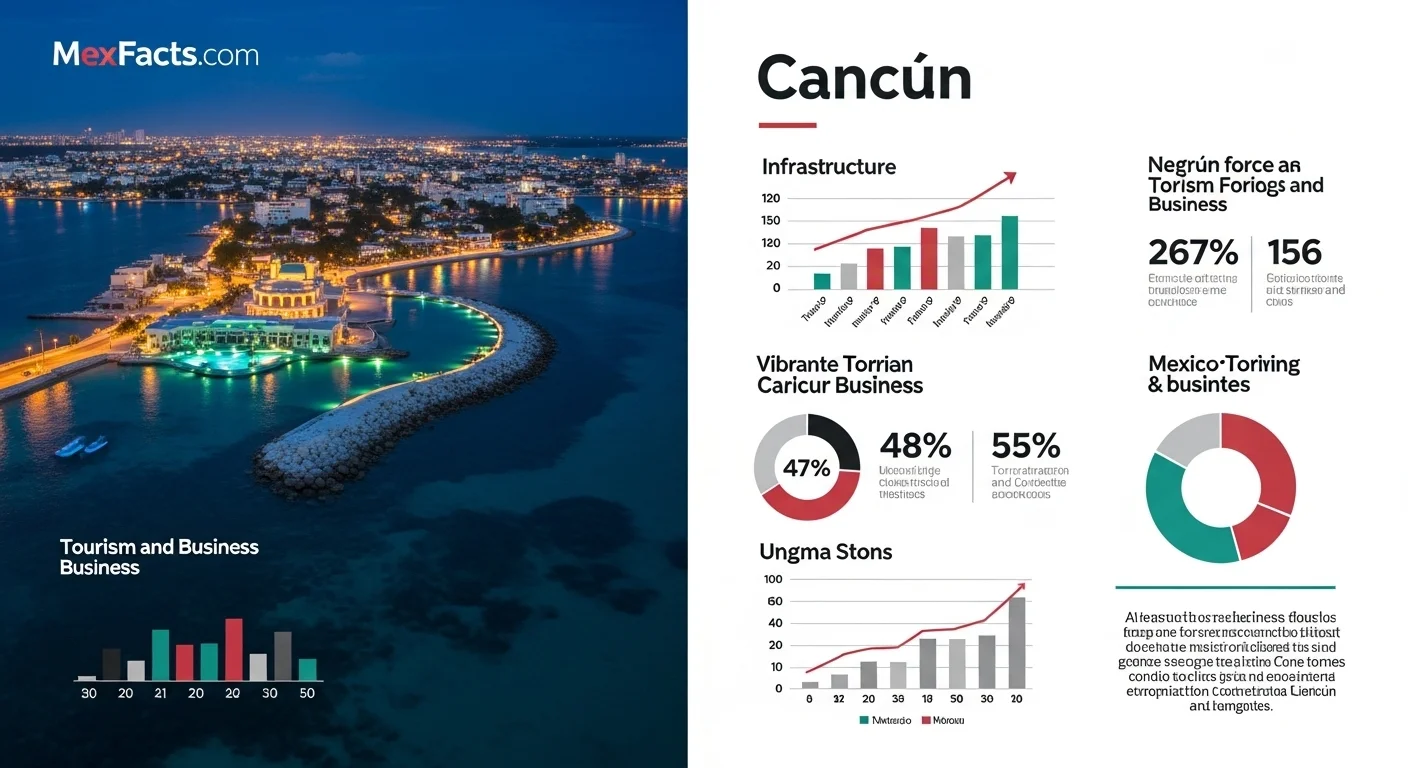
Cancun by the Numbers: The Beating Heart of Mexican Tourism
To truly appreciate Cancun's massive role in global tourism and business, you have to look at the numbers. They tell a story of a city operating on an immense scale, consistently fueling Mexico's economic engine. For any investor, analyst, or traveler, these figures show why a Cancun trip is more than a holiday—it's a visit to a globally significant economic hub.
The Gateway to Mexico: Cancun's Airport by the Numbers
The main artery pumping life into the region is Cancun International Airport (CUN). It's the definitive gateway not just to Cancun Mexico, but to the entire Riviera Maya. In 2023, it handled an incredible 32.75 million passengers. This isn't just a recovery from the pandemic; it's a huge leap over previous records, placing it among the top 10 busiest airports in the world for international travelers. Think about that: of those passengers, over 20 million were from other countries, a clear sign of its global appeal. Projections for 2024 show this demand isn't slowing down.
Let's break that down further. In 2023, nearly half (45.9%) of all international tourists who flew into Mexico landed in Cancun. That means almost one of every two visitors starts their Mexican journey here. The United States is our biggest market by far, followed by Canada and countries from Europe and Latin America. To handle this volume, CUN has four terminals—a feature you won't find at many other airports in Mexico. Even with the new airport in Tulum, Cancun's established network and infrastructure mean it will remain the region's main hub for years to come.
The Economic Powerhouse: Hospitality and Revenue
This flood of tourists supports a massive hospitality industry. In 2023, hotel occupancy in Cancun averaged a strong 75.6%. When you apply that rate across tens of thousands of hotel rooms, you start to see the economic ripple effect. The tourism industry contributes over 8% to Mexico's national GDP, and Quintana Roo, with Cancun as its anchor, is a primary driver. In some recent years, the state's economy has grown at rates that have surpassed even China's, all thanks to tourism.
Foreign currency is another critical piece of the puzzle. The billions of dollars tourists spend here are vital to Mexico's financial health. This activity supports a huge web of jobs. From the concierge at your hotel and the guide on your tour to the construction workers building new resorts and the farmers supplying the restaurants, hundreds of thousands of livelihoods depend on Cancun. The incredible variety of Cancun activities available means that every dollar a tourist spends spreads out across many sectors, multiplying its impact and creating a resilient local economy.
A Hotspot for Investment: Cancun's Real Estate Boom
Cancun's success has also ignited a red-hot real estate market. This isn't just about big hotels; it's a thriving residential sector for expats, retirees, digital nomads, and investors looking for rental income. Property values have seen impressive growth, with some reports showing double-digit increases year over year. This boom is fueled by steady tourism, major infrastructure improvements, and the simple fact that the Cancun Mexico lifestyle is incredibly desirable.
Key investment areas include the famous Hotel Zone, the luxurious Puerto Cancun community, and the booming Downtown and Costa Mujeres areas. Investors are drawn by strong potential returns, often seeing annual ROIs of 8-12% on vacation rentals. I often get asked by foreigners if it's safe to buy property here. The answer is yes. A legal mechanism called a *fideicomiso* (a bank trust) allows non-Mexicans to securely own coastal property, making the market both accessible and safe. The real estate offerings are diverse, from beachfront condos to family homes. As the city matures with more universities, hospitals, and corporate offices, the long-term value of its real estate is only getting stronger. It proves that there are more things to do in Cancun than just vacationing; there's serious business to be done.
What's Next for Paradise? Cancun's Future Outlook
As Cancun looks to the future, it stands at a turning point. Having cemented its status as a tourism giant, its next chapter will be about navigating new challenges and seizing fresh opportunities. The future for Cancun Mexico is a story of evolution—moving from a model of pure volume towards one that weaves in sustainability, innovation, and a more diverse economy. For investors, businesses, and even those planning their next Cancun trip, understanding this shift is key to seeing the incredible potential ahead.
The Future is on Rails: The Tren Maya and Infrastructure
The single biggest game-changer for Cancun's future is the Tren Maya (Mayan Train). This massive 1,554-kilometer railway is set to completely transform how people travel and experience the Yucatán Peninsula. With its main hub connected right to the Cancun airport, the train will link Cancun to other beloved spots like Playa del Carmen and Tulum, but also to incredible, hard-to-reach archaeological sites and communities across the region. As someone who loves exploring the hidden corners of my country, I'm excited about this. The train aims to spread tourism dollars more evenly, encourage people to stay longer, and cut down on traffic. For tourists, this means the list of things to do in Cancun will get much longer, allowing for seamless day trips and multi-stop adventures. For businesses, the Tren Maya opens up a new world of logistical and commercial opportunities.
Alongside the train, other major upgrades are underway. A new bridge over the Nichupté Lagoon will connect the Hotel Zone to the city, easing the infamous traffic on Kukulcan Boulevard. The main road to the airport has been expanded, and the airport itself is constantly being modernized. All these projects show a powerful commitment to ensuring Cancun has the world-class infrastructure to support its growth.
New Horizons: Investment and Business Opportunities
Looking beyond traditional tourism, Cancun is ready to grow in several exciting new areas. The future of Cancun activities and its economy will likely include:
1. **Sustainable and Eco-Tourism:** Travelers today care more about the planet. Cancun is responding with a push for eco-friendly hotels and conservation-focused tours. I've seen a growing interest in community-led tourism projects that offer a more authentic experience. There are huge opportunities here in renewable energy for resorts, solutions for the sargassum seaweed problem, and protecting our precious coral reefs and mangroves.
2. **Medical and Wellness Tourism:** Cancun is building a reputation for excellent, affordable medical and dental care. Combining a vacation with a procedure is a smart choice for many international visitors. Wellness tourism—think yoga retreats, spas, and holistic health—is also a natural fit for the region's tranquil beauty.
3. **Real Estate and Retirement Living:** The real estate market is set to keep booming. With the rise of remote work, Cancun has become a top spot for digital nomads. Its great flight connections, perfect climate, and established expat community also make it a prime location for retirees from the US, Canada, and Europe. New developments are increasingly designed for this long-term residential market.
4. **Conferences and Business Events (MICE):** With its thousands of hotel rooms and global connectivity, Cancun is a major player for business events. It offers something unique: the ability to host a major conference where attendees can enjoy a world-class vacation at the same time.
Balancing Paradise: The Challenges Ahead
Of course, Cancun's future isn't without its hurdles. The biggest is environmental sustainability. I've seen the beaches transform overnight due to waves of sargassum seaweed. It's a real, tangible threat to the very beauty that draws people here. While there are massive efforts to contain it, long-term solutions are needed. We also have to protect our precious coral reefs and mangroves, manage our freshwater supply, and control urban sprawl's impact on the mangroves.
Socially, the rapid growth has created a divide between the glamorous Hotel Zone and the mainland city where the workers live. Managing this growth, ensuring everyone has access to good services, and maintaining security are all crucial for the city's long-term well-being. The challenge is to make sure the prosperity from tourism lifts up the entire community.
In the end, Cancun's future is bright but complex. The city that was dreamed up on a planner's map now has a life of its own. By embracing huge projects like the Tren Maya, diversifying its economy, and facing its environmental and social challenges head-on, Cancun Mexico is positioning itself to not just remain a tourism leader, but to become a more resilient, sustainable, and complete global city. For more official information, the Mexican Secretariat of Tourism (SECTUR) website is an excellent resource.
Expert Reviews
Liam O'Connell, Investor ⭐⭐⭐⭐⭐
As an investor from Canada, this article was a goldmine. It went beyond the typical travel fluff and gave me the hard data and future outlook on projects like the Tren Maya I needed. The explanation of the fideicomiso was particularly clear. It helped me see the real business potential in Cancun.
Sofia Garcia, Cultural Traveler ⭐⭐⭐⭐⭐
I've been on a few 'Cancun trips,' but this piece gave me a whole new appreciation for the city. I never knew its origin story or how it connects to the wider Mayan world. Reading this has inspired me to explore beyond the Hotel Zone on my next visit and see the cenotes and local museums mentioned.
Dr. Anika Patel, Researcher ⭐⭐⭐⭐
Finally, a balanced perspective! This article doesn't just praise Cancun; it also addresses the real environmental and social challenges like sargassum and urban growth. It was a fantastic resource for my research paper on tourism development in Latin America.