
Chichen Itza Tours Guide: Excursions, Itineraries, and Visiting Rules

A tour to Chichen Itza is one of the most popular archaeological excursions in Mexico, connecting travelers from the Riviera Maya and Cancun to the ceremonial center of the ancient Maya civilization. This practical editorial guide breaks down the major tour formats—from full-day coach excursions to early-morning private visits—explaining travel times, dual entrance fee structures under INAH and CULTUR, preservation rules prohibiting climbing, and supplementary stops at cenotes and colonial Valladolid. Whether planning a day trip or considering rail transit via the Tren Maya, here is everything you need to make an informed, seamless visit.
Table of Contents
- What to Expect on a Chichen Itza Tour
- Tour Formats and Departure Routes
- Site Regulations, Admission Fees, and Practical Logistics
- Key Monuments and Architectural Highlights
- Visitor Trends, Crowds, and Timing Strategies
- Future Outlook: Tren Maya, New Museum, and Sustainable Travel
- Frequently Asked Questions About Chichen Itza Tours
What to Expect on a Chichen Itza Tour
An organized excursion to Chichen Itza represents a full-day commitment regardless of your departure point in the Yucatán Peninsula. The archaeological site sits inland in the municipality of Tinum, roughly midway between the Caribbean coast and the Gulf of Mexico. For most international visitors based in resort corridors, the trip involves between 10 and 12 hours total, combining road transportation, a guided exploration of the ruins, a regional lunch, and often a refreshing cenote swim.
Upon arriving at the complex, visitors step into an expansive open-air park spanning several square kilometers. Walking paths consist primarily of packed earth, grass, and crushed limestone, offering minimal shade around the primary monuments. Midday temperatures regularly exceed 90°F (32°C) with elevated humidity, making lightweight breathable clothing, comfortable walking footwear, and diligent sun protection essential.
A standard guided tour of the archaeological perimeter lasts approximately 90 minutes to two hours, led by licensed guides who unpack Maya history, astronomical alignments, and Toltec-Maya architectural influences. Most excursions then allow 60 to 90 minutes of free time for self-guided photography, artisan browsing, or visiting secondary architectural complexes before reboarding transport for lunch or cenote stops.
Tour Formats and Departure Routes
Travelers selecting among Mexico tours can choose between three primary excursion styles, each suited to different budgets, schedules, and travel styles:
- Classic Coach Day Tours: Large air-conditioned coaches departing from major hotel zones. These are the most economical option, typically bundling round-trip transport, basic admission, a certified bilingual guide, a buffet lunch, and a cenote stop. They require early pickups and coordinated group schedules.
- Small-Group Excursions: Operating in passenger vans (12–16 passengers), small-group tours offer faster boarding, fewer hotel stops, and greater agility at the ruins and restaurants.
- Private Day Tours: Private transportation with a dedicated driver and private guide allows complete schedule customization, such as arriving right at the 8:00 AM opening gate to beat tour bus arrivals and midday heat.
The primary departure corridors differ in drive time and route logistics:
- From Cancún: The journey covers approximately 200 kilometers (125 miles) westward along federal toll highway 180D (Autopista Cancún-Kantunil). One-way drive time by direct private vehicle takes roughly 2.5 hours, whereas large coach tours may take 3 to 3.5 hours when accounting for multi-resort pickup sequences.
- From Playa del Carmen: Travelers take highway 305D to connect with highway 180D. Direct transit averages 2 hours and 15 minutes to 2.5 hours each way. Most operators pair the ruins with a visit to Cenote Ik Kil or Cenote Saamal near Valladolid.
- From Tulum: Driving northwest through Cobá toward Chemax and federal road 180 takes approximately 2 to 2.5 hours. Excursions originating in Tulum frequently incorporate cultural heritage stops highlighting the enduring traditions of the Maya family and communities in rural Yucatán.
- From Mérida: Located only 120 kilometers (75 miles) west, the state capital offers the shortest transit route, reaching the ruins in roughly 1.5 hours via highway 180.
Site Regulations, Admission Fees, and Practical Logistics
Understanding site regulations and entrance logistics ensures a smooth visit without unexpected surcharges or delays:
- No Climbing Permitted: To protect delicate stone structures from erosion and ensure visitor safety, climbing El Castillo (the Pyramid of Kukulcan), the Temple of the Warriors, and all other structures has been strictly prohibited by Mexico's National Institute of Anthropology and History (INAH) since 2006. All monuments must be viewed from designated ground-level perimeter paths.
- Dual Admission Ticket: Total admission to Chichen Itza is split into two mandatory fees collected at the ticket counters: a federal fee levied by INAH and a state fee levied by the Yucatán state government (Patronato CULTUR). Standard tour packages usually incorporate both fees, but budget operators sometimes omit them from the base tour price. Verify whether your booking includes both tickets or requires payment on-site.
- Camera and Drone Permits: Standard mobile phones and non-professional handheld digital cameras are permitted without surcharge. However, professional video gear, cameras with detachable telephoto lenses, and tripods require a special INAH permit and fee. Drones are strictly forbidden across all federal archaeological zones in Mexico without advance institutional authorization.
- Time Zone Differential: The state of Quintana Roo (Cancún, Playa del Carmen, Tulum) operates in the Eastern Standard Time zone (UTC-5) throughout the year, whereas the state of Yucatán operates in the Central Standard Time zone (UTC-6). When traveling west into Yucatán, visitors gain one hour, meaning an 8:00 AM site opening in Yucatán corresponds to 9:00 AM Quintana Roo time. Review departure itineraries closely to account for this shift.
Key Monuments and Architectural Highlights
Chichen Itza was a major regional capital between the Late Classic (c. 600–900 CE) and Terminal Classic (c. 800–1200 CE) periods. Its monuments reflect profound civic planning, astronomical calculation, and cross-cultural trade:
- El Castillo (Pyramid of Kukulcan)
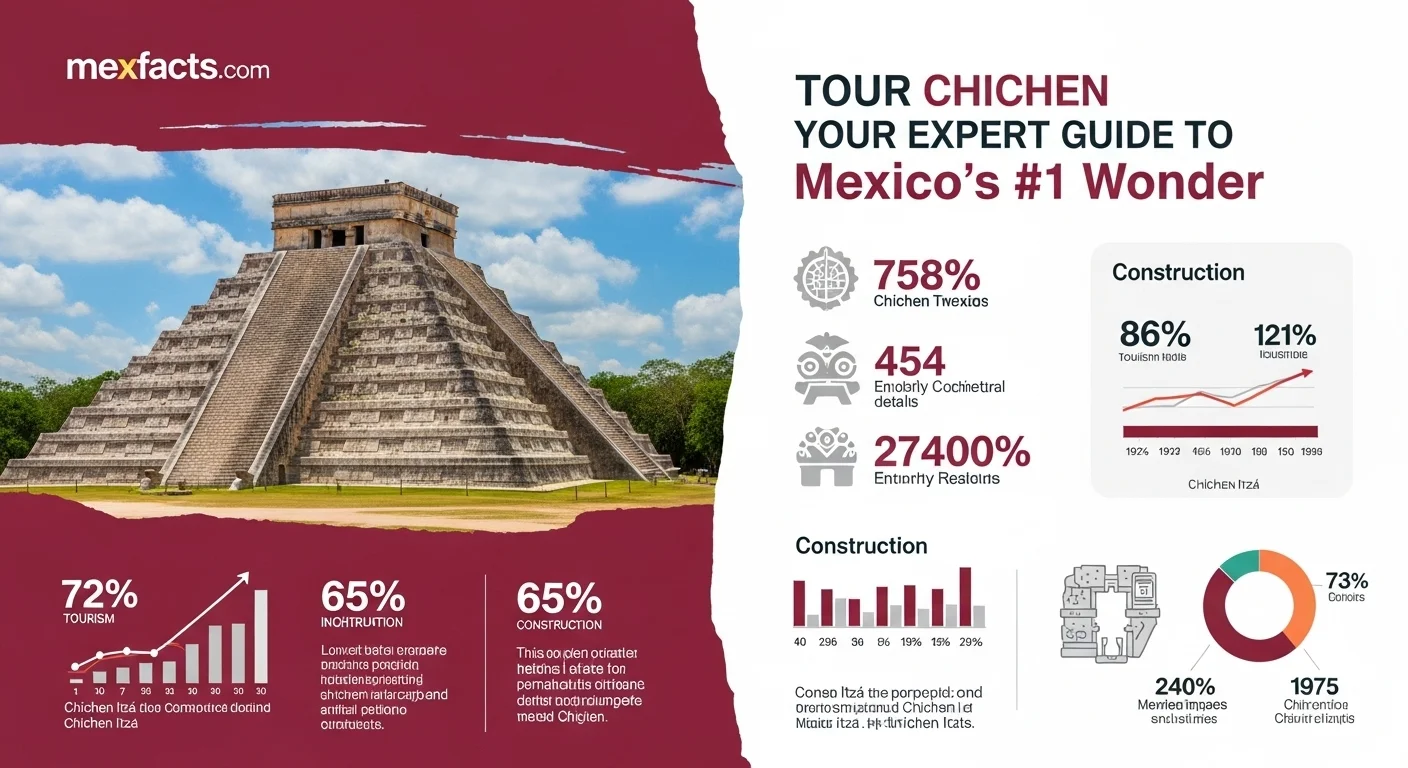
- The 30-meter-tall step pyramid anchoring the central plaza. Built as a physical calendar, its four stairways each feature 91 steps, which—combined with the upper platform—total 365 steps. During the spring and autumn equinoxes, afternoon sunlight casts shadows creating the optical illusion of a serpent slithering down the northern balustrade.
- The Great Ball Court (Gran Juego de Pelota)
- Measuring 168 meters long and 70 meters wide, this is the largest ancient Mesoamerican ball court ever discovered. The vertical stone walls feature sculpted relief panels illustrating ceremonial decapitations, alongside remarkable acoustic properties where a whisper at one end can carry clearly across the expanse.
- Temple of the Warriors and Group of the Thousand Columns
- A vast architectural complex featuring stepped terraces and carved stone pilasters that originally supported expansive wooden roofs, reflecting strong Toltec architectural influences.
- El Caracol (The Observatory)
- A distinctive circular structure positioned on a dual platform. Its upper chamber windows align with celestial events, including the solstices and the complex orbital cycles of the planet Venus.
- The Sacred Cenote (Cenote Sagrado)
- A dramatic natural limestone sinkhole 60 meters in diameter, connected to the main plaza via a 300-meter sacbé (ceremonial raised causeway). Archaeological dredging recovered jade, gold, ceramics, and human remains dedicated to the rain deity Chaac during times of drought.
Visitor Trends, Crowds, and Timing Strategies
As a designated UNESCO World Heritage Site and one of the New 7 Wonders of the World, Chichen Itza is one of the most frequented cultural landmarks in the Americas. Annual visitation consistently totals between two and 2.5 million visitors, creating significant congestion during peak midday windows between 11:00 AM and 2:00 PM.
Travelers seeking fewer crowds and milder temperatures should aim for early access. Booking a private transfer or departing coastal hotels before 6:30 AM allows arrival right at the 8:00 AM opening gate. This provides roughly two hours of quiet exploration before large tour buses arrive from Cancun and the Riviera Maya.
Beyond the monuments, visitor expenditures create substantial economic stability for adjacent Mayan towns such as Pisté and the colonial municipality of Valladolid. Choosing tour operators that work with local certified community guides and frequent family-operated restaurants helps direct tourism benefits into regional host communities.
Future Outlook: Tren Maya, New Museum, and Sustainable Travel
Transportation and heritage infrastructure around Chichen Itza have evolved substantially with modern federal transit investments:
- Tren Maya Station: The operational Tren Maya railway features a dedicated Chichén Itzá station on Section 4 (connecting Izamal and Cancún). This passenger rail option provides an alternative to highway transit, enabling independent day travelers and cultural visitors to reach the site directly from Cancun International Airport or Mérida.
- Gran Museo de Chichén Itzá: Opened adjacent to the archaeological zone, this state-of-the-art museum facility houses hundreds of newly restored artifacts, jade carvings, and architectural reliefs excavated during decades of research and recent rail corridor surveys, providing crucial historical context prior to touring the grounds.
- Chichén Viejo (Initial Series Group): Ongoing archaeological restoration has enabled controlled access to the elite residential zone of Chichén Viejo, expanding the visitor perimeter beyond the central plaza to distribute tourist density more sustainably.
- Sustainable Visitor Practices: Environmental stewardship is critical for preserving fragile limestone ecosystems and nearby cenotes. Visitors should bring refillable water containers, wear protective sun apparel to reduce the use of sunscreens that contaminate cenote aquifers, and respect all designated barriers set by archaeological conservation teams. Travelers can review essential travel prerequisites and health guidelines in our overview of rules for going to Mexico.
Frequently Asked Questions About Chichen Itza Tours
- Can visitors climb the pyramid at Chichen Itza?
- No. Climbing El Castillo and all other structures at Chichen Itza has been strictly prohibited since 2006 to preserve the stone monuments and ensure visitor safety.
- How long does an excursion to Chichen Itza take from Cancun or Riviera Maya?
- A standard tour from Cancun, Playa del Carmen, or Tulum typically lasts between 10 and 12 hours round-trip, including transit, guided site visits, lunch, and a cenote swim stop.
- Are entrance tickets included in standard tour prices?
- Most full-service tours include both federal INAH and state CULTUR fees in their listed booking price. However, budget transportation operators sometimes exclude these fees, requiring visitors to pay them at the gate. Always verify package inclusions before booking.
- What is the best time of day to tour Chichen Itza?
- The optimal time to explore the site is between 8:00 AM and 10:30 AM. Arriving when the gates open ensures cooler temperatures and significantly smaller crowds before large tour buses arrive.
- Can you bring bags, food, or water into the archaeological site?
- Small backpacks, personal purses, and water bottles are permitted. Large luggage, tripods, drones, and outside picnic food are restricted at security checkpoints, though luggage storage lockers are available at the main visitor pavilion.
Expert Reviews
Sarah and Tom Jenkins, from Ohio ⭐⭐⭐⭐⭐
We took a private tour from Cancun after reading this article, and it was the best decision of our trip. Arriving early before the crowds was magical. Our guide, Miguel, brought the history to life, and the tips about the cenote swim were spot on. It felt like we had the place to ourselves for a moment. Truly unforgettable!
Liam Carter, History Student ⭐⭐⭐⭐⭐
This is by far the most insightful and human guide to Chichen Itza I've found online. It goes beyond the usual tourist info and gets into the cultural significance and the real-world impact of visiting. It helped me appreciate my trip on a much deeper level. Thank you for sharing your passion and knowledge.
Isabella Rossi, Solo Traveler ⭐⭐⭐⭐
I booked a group tour from Playa del Carmen, and this guide prepared me perfectly. I knew what to expect, from the early start to the amazing feeling of jumping into the cenote. The article’s perspective on the local artisans made me seek them out and buy a beautiful hand-painted sculpture. It made my souvenir feel so much more meaningful.