
Costa Cancún: Guide to the Hotel Zone, Costa Mujeres, and Regional Development

When travelers research Costa Cancún, they encounter one of the world's most dynamic vacation corridors. Rather than designating a single municipality, the term describes the greater beachfront development surrounding Cancún, anchored by the legendary 23-kilometer Cancún Hotel Zone and expanding northward into the exclusive coastal enclave of Costa Mujeres. Together, these two coastal sectors power Mexico's tourism economy, renowned globally for warm Mexican hospitality, turquoise waters, and premier accommodations. This comprehensive guide details the geographic distinctions between the classic Hotel Zone and modern Costa Mujeres, profiles standout properties such as Occidental Costa Cancún (formerly Barcelo Costa Cancún), Paradisus Cancun, and the RIU and Majestic complexes, and evaluates key economic data, airport statistics, and regional infrastructure projects like the Tren Maya and the Nichupté Lagoon Bridge.
Table of Contents
What is Costa Cancún? Geographic Scope and Definition
Geographically and administratively, "Costa Cancún" is not a distinct municipality or official political subdivision of Quintana Roo. Instead, it is a prominent commercial and descriptive term used in hospitality and travel to designate the greater coastal resort strip of northeastern Quintana Roo. This coastal corridor encompasses two primary zones: the master-planned barrier island of the Cancun hotel zone in the municipality of Benito Juárez, and the rapidly growing continental mainland sector known as Costa Mujeres, situated just north in the mainland portion of the municipality of Isla Mujeres. The phrase also frequently refers to specific landmark properties that carry the name, most notably the Occidental Costa Cancún (historically known as Barcelo Costa Cancún) located on Playa Linda.
The regional transformation began in the late 1960s under Mexico's National Tourism Fund (FONATUR). Planners recognized the extraordinary natural asset of the Yucatán Peninsula's Caribbean coastline—sheltered waters, coral reefs, and brilliant white sand made of crushed coral that remains cool under the sun. Between 1970 and 1974, engineers carved out Boulevard Kukulcán along a narrow, 23-kilometer sandspit that separates the open Caribbean Sea from the 3,000-hectare Nichupté Lagoon system. This pioneering master plan transformed a sparsely inhabited fishing shore into an international tourism titan, which has now expanded northward along the mainland coast toward Costa Mujeres.
The Two Dynamic Faces of Costa Cancún
Travelers evaluating Costa Cancún must navigate two distinct geographic environments, each offering contrasting atmospheres, resort architectures, and access characteristics.
The Classic Cancun Hotel Zone
The classic Hotel Zone (Zona Hotelera) is the energetic urban core that established Cancún's worldwide fame. Stretching along Boulevard Kukulcán from Kilometer 1 to Kilometer 25, this barrier island offers continuous beach access, walkability to dining and nightlife districts like Punta Cancún, and retail destinations such as La Isla Shopping Village and Luxury Avenue. The zone accommodates every travel demographic, from family vacations to conventions and luxury wellness retreats, supported by a dense selection of all-inclusive resorts.
A defining example of the classic beachfront experience is the Occidental Costa Cancún (long known as the Barcelo Costa Cancún), operated by Barceló Hotel Group. Positioned at Kilometer 4.5 along Playa Linda, this 358-room Mediterranean-style resort borders the calm waters of the Bahía de Mujeres and the Nichupté channel, offering tranquil swimming conditions that appeal particularly to families. Further south along Boulevard Kukulcán stands Paradisus Cancun, an expansive luxury resort recognizable by its dramatic glass pyramid architecture, extensive convention facilities, and premier beachfront on the open Caribbean side of the island.
Costa Mujeres: The Expanding Luxury Frontier
Situated roughly 15 to 20 minutes north of downtown Cancún and the Puerto Juárez maritime terminal, Costa Mujeres represents the newest chapter in regional hospitality. Unlike the high-density Hotel Zone, Costa Mujeres was conceived as a low-density, gated coastal enclave along the mainland coast facing Isla Mujeres. The area is characterized by broader beachfronts, expansive resort footprints, preserved coastal mangroves, and the championship Greg Norman-designed Playa Mujeres Golf Course.
Major international hotel operators have established flagship properties in Costa Mujeres:
- RIU Costa Mujeres Complex: The RIU chain developed a major multi-property presence along the coast. The Hotel Riu Costa Mujeres (adjoining the Riu Dunamar development) operates as a high-capacity, family-centric all-inclusive complex complete with the Splash Water World water park. Adjacent to it, the Riu Palace Costa Mujeres delivers elevated luxury with architectural layouts orienting restaurants, swim-up suites, and infinity pools directly toward the sea.
- Catalonia Grand Costa Mujeres All Suites & Spa: This modern resort incorporates an innovative layout centered on an open-air promenade dubbed 'Quinta Avenida', mirroring the famous pedestrian boulevard in Playa del Carmen. The promenade features specialized culinary venues, shops, and social hubs, surrounded exclusively by all-suite accommodations.
- Majestic Elegance Costa Mujeres: Opened in late 2019, this upscale resort features dedicated family sections alongside the adults-only 'Elegance Club'. The property emphasizes private plunge pools, oceanfront plunge suites, and personalized butler service tailored to couples and wedding parties.
A Global Tourism and Economic Engine
The combination of the established Hotel Zone and the newer Costa Mujeres development constitutes Quintana Roo's most lucrative economic asset. Tourism remains the primary driver of state employment and foreign exchange revenue in southeastern Mexico. The region provides direct and indirect livelihoods for hundreds of thousands of workers across hospitality, logistics, ground transportation, and commercial services. With sustained international connectivity through Cancún International Airport, the Costa Cancún corridor continues to lead the Caribbean basin in passenger volume and hospitality investment.
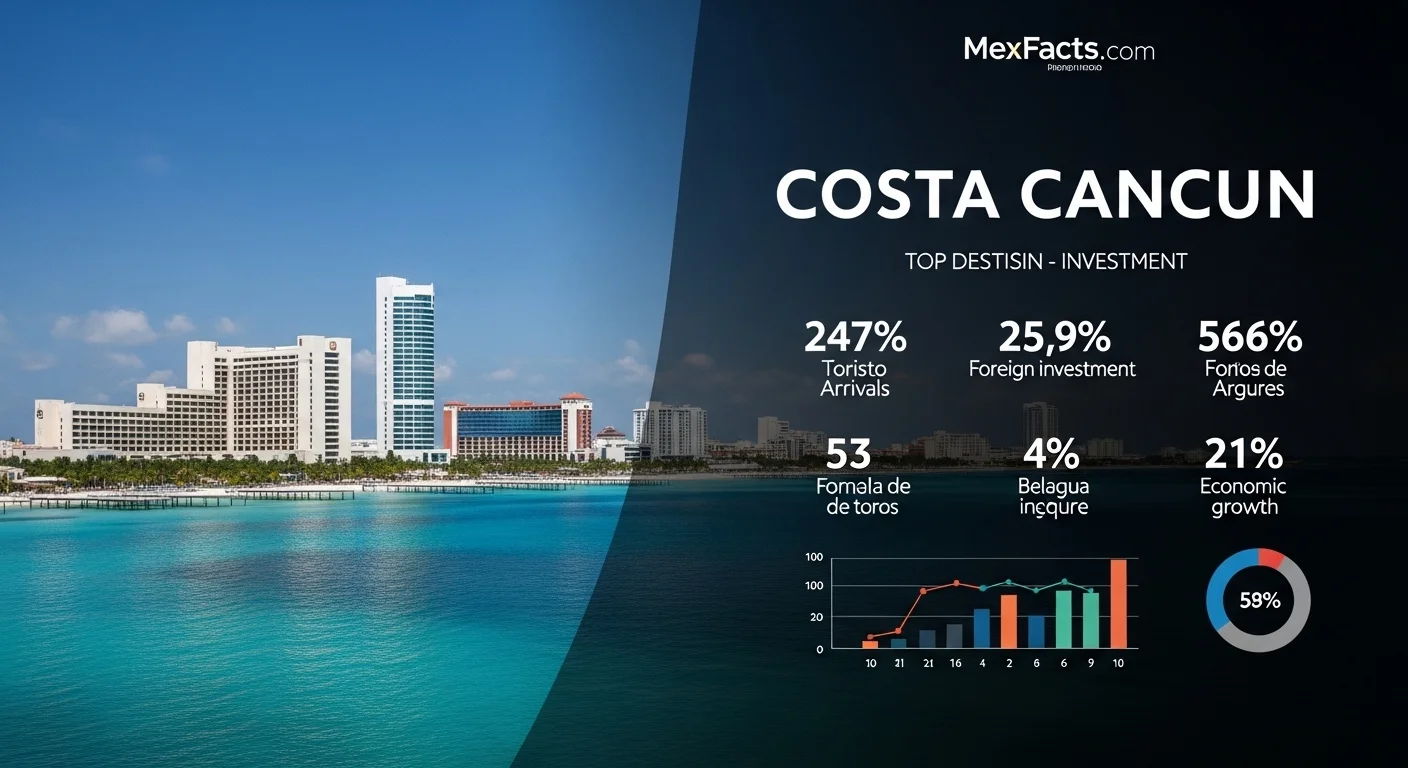
Key Statistics and Market Data for Costa Cancún
A data-driven look at Costa Cancún reveals a resilient and expanding tourism ecosystem. Spanning both the Benito Juárez and Isla Mujeres coastal sectors, the region remains the dominant economic driver of Mexico's tourism economy, setting national benchmarks for flight arrivals, hotel room inventory, and foreign currency generation.
Airport Traffic and Hotel Occupancy
The primary barometer of regional travel demand is Cancún International Airport (CUN), managed by ASUR (Grupo Aeroportuario del Sureste). In 2023, the airport established an all-time record by processing 32.7 million passengers, connecting the destination to more than 100 international and domestic cities. Annual foreign visitor arrivals to the state routinely surpass 10 million individual travelers.
High arrival volumes sustain consistent hotel occupancy throughout the corridor. During peak winter and spring travel months, average occupancy across the Cancún Hotel Zone regularly reaches 85% to 89%, while Costa Mujeres mirrors this strength with occupancy rates between 84% and 87%. This performance is underpinned by significant infrastructure: Quintana Roo maintains over 130,000 licensed hotel rooms. In Costa Mujeres alone, rapid construction has added thousands of luxury rooms—with mega-developments like the RIU complex exceeding 1,300 keys, supported by sizable inventories at Majestic Elegance and Catalonia. Meanwhile, traditional Hotel Zone properties such as Occidental Costa Cancún (358 rooms) and larger complexes along Boulevard Kukulcán maintain steady year-round occupancy through established brand distribution.
Economic Contribution and Capital Investment
According to official data from the Quintana Roo Tourism Secretariat (SEDETUR), tourism expenditure across the state exceeds $20 billion annually. This economic influx sustains public revenues, private investment, and service-sector jobs throughout the northern corridor. Private and public capital continues to pour into regional infrastructure:
- Cancún-Costa Mujeres Tourist Boulevard: With an allocated investment exceeding 2.7 billion pesos, this highway project enhances direct connectivity between the Cancún urban core and Costa Mujeres, reducing transit times for guests and service workers.
- Costa Mujeres Master Plan: Long-term municipal development frameworks project capacity for up to 22,000 hotel rooms across Costa Mujeres, solidifying its position as a luxury extension of the Cancún resort corridor.
- Puente Vehicular Nichupté: An 8.8-kilometer vehicular bridge spanning the Nichupté Lagoon designed to bypass urban congestion and provide a direct evacuation and transit route to Boulevard Kukulcán.
Environmental Management and Market Dynamics
Regional authorities and resort managers actively monitor several operational factors that influence visitor experience:
- Sargassum Mitigation: Pelagic sargassum seaweed follows seasonal oceanic currents into the Caribbean Sea. To safeguard coastlines, the Mexican Navy (SEMAR), municipal clean-up crews, and private resorts deploy offshore containment barriers and mechanized beach-sweeping equipment. Because Costa Mujeres faces Isla Mujeres across a semi-sheltered bay, its shoreline frequently experiences different sargassum accumulation patterns compared to open ocean-facing beaches.
- Regional Airport Diversification: The inauguration of Felipe Carrillo Puerto International Airport in Tulum provides a southern air gateway to the Riviera Maya. Rather than diminishing Cancún's appeal, this second international hub relieves pressure on CUN while encouraging multi-destination itineraries across the Mexican Caribbean.
- Extended Stays and Remote Work: Growth in flexible remote work has lengthened the average duration of stay. Properties featuring multi-room suite layouts, such as Catalonia Grand Costa Mujeres, increasingly accommodate extended travelers seeking business connectivity alongside leisure amenities.
Infrastructure Megaprojects and Long-Term Outlook
The future development of Costa Cancún focuses on regional integration, transport modernization, and sustainable coastal stewardship. As tourism evolves beyond beachfront lounging, public agencies and hospitality operators are aligning to connect coastal resorts with regional cultural heritage and natural attractions.
Transformative Regional Megaprojects
Two cornerstone infrastructure initiatives are reshaping transit and access throughout northern Quintana Roo:
- The Tren Maya (Mayan Train): Centered around the Cancún Airport station, the Tren Maya railway network links Quintana Roo's resort corridor directly with historic inland cities and archaeological zones, including Chichén Itzá, Valladolid, Mérida, and Palenque. Guests staying at Hotel Zone properties like Occidental Costa Cancún or northern resorts like Riu Palace Costa Mujeres can incorporate low-stress overland day trips into their itineraries, expanding travel beyond traditional beach excursions.
- The Cancún-Costa Mujeres Connectivity Corridor: Upgrades to the northern highway artery ensure swift transfers between Cancún International Airport and the Costa Mujeres resort zone. This artery mitigates logistical bottlenecks for transport operators, staff commuting from mainland municipalities, and freight supply chains.
Emerging Business and Travel Trends
Investment across the corridor is expanding into specialized hospitality verticals:
- Eco-Conscious Architecture: New developments in Costa Mujeres increasingly prioritize low-impact construction standards, mangrove buffer conservation, and solar power integration, appealing to environmentally conscious luxury travelers.
- Specialized Hospitality Sectors: Destination weddings, executive retreats, and wellness programs represent high-growth revenue segments. Resorts like Majestic Elegance Costa Mujeres cater directly to these markets with dedicated event coordinators and adults-only club wings, while culinary offerings highlight authentic Mexican cuisine alongside international gastronomy.
- High-End Sports and Recreation: Beyond water sports, Costa Mujeres has emerged as a premier sports tourism destination, highlighted by the Greg Norman-designed golf links and world-class tennis training academies that draw international athletes year-round.
Sustainable Growth and Responsible Tourism
Long-term prosperity across Costa Cancún hinges on responsible environmental management. The regional tourism industry relies directly on the health of the Mesoamerican Barrier Reef System, coastal dunes, and subterranean aquifer networks. Coordinated initiatives between private operators, local academic institutions, and federal authorities focus on coral restoration, rigorous wastewater treatment, and single-use plastic reduction across hotel properties. For travelers and industry stakeholders seeking official statistics and regional development guidelines, the Mexican Secretariat of Tourism (SECTUR) publishes updated policy frameworks and travel directives.
Expert Reviews
Elena G., First-Time Visitor ⭐⭐⭐⭐⭐
My husband and I were so confused about where to stay in Cancún. This article was a lifesaver! The description of the Hotel Zone versus Costa Mujeres was perfect. We chose a resort in Costa Mujeres based on the review here and it was the serene, luxurious escape we were dreaming of. Thank you!
Michael B., Real Estate Investor ⭐⭐⭐⭐⭐
As an investor from Texas, it's hard to find practical insights that go beyond the typical tourist fluff. This piece was different. The analysis of the new boulevard project and the long-term vision for the area provided real, actionable intelligence. Very well-written and extremely valuable.