
The Soul of Mexico: A Journey Through Its History and Culture

Mexico's story is one you can feel in the air, a journey that stretches from the colossal stone heads of the Olmecs to the bustling, modern streets of Mexico City. It’s a tale of empires rising and falling, of a dramatic collision between two worlds, and the birth of a unique identity—a 'mestizaje' or blending of indigenous and Spanish roots that is alive and breathing today. This article isn't just a timeline; it's an invitation to understand the heart of Mexico. We'll walk through the jungles to find Mayan temples, stand in the shadow of Aztec pyramids, and see how 300 years of Spanish influence created a culture that is a vibrant tapestry of faith, food, and family. To truly know Mexico, whether you're visiting for a week or building a business partnership, is to understand this powerful blend of past and present.
Table of Contents
Why Mexico's History and Culture Matter: A Story Woven Through Time
To talk about the history and culture of Mexico is to tell a story that is both epic and deeply personal. It's not just a collection of dates and events; it's the living soul of a nation, a key that unlocks everything from its art and food to the way people do business. I've always felt that the true essence of Mexico lies in its mestizaje—the profound mixing of its indigenous peoples with Spanish traditions. But this isn't a simple recipe. It’s a complex, beautiful fusion that you can see everywhere, from the features of its people to the festivals that light up its towns. Within this blend, dozens of indigenous groups continue to thrive, speaking their own languages and keeping ancient traditions alive, making Mexico a mosaic rather than a monolith.
The Ancient Roots: From Olmecs to Aztecs
Our journey begins long before a single European ship reached these shores, in the cradle of Mesoamerican civilization. The story of ancient Mexican archaeology and culture starts with the Olmecs, who arose around 1500 BCE. When you stand before one of their colossal stone heads, with its powerful, brooding face, you can't help but feel a connection to a mystery thousands of years old. They were the 'mother culture,' laying the groundwork for all who would follow. After them came other incredible civilizations. High in the mountains of Oaxaca, the Zapotecs built their stunning capital at Monte Albán, a city that seems to float among the clouds. And then there was Teotihuacán. Walking down its Avenue of the Dead, flanked by the immense Pyramids of the Sun and Moon, you feel impossibly small. It was one of the largest cities in the ancient world, a powerhouse whose influence stretched for hundreds of miles.
Of course, many people immediately think of the Maya, who flourished in the lush jungles of the south. They weren't one big empire but a network of brilliant city-states. Their grasp of mathematics, astronomy, and writing was astounding. I remember the first time I visited Palenque, seeing the intricate carvings emerge from the jungle mist—it felt like stepping into another world. The legacy of cities like Chichén Itzá and Uxmal continues to captivate us. Later, the warlike Toltecs left their mark, and finally, the Aztecs, or Mexica, arrived. In 1325, they founded their incredible capital, Tenochtitlan, on an island in a lake—the very spot where Mexico City stands today. Through sheer will and military might, they built an empire that dominated the region.
A New World: The Spanish Conquest and Colonial Era
The arrival of Hernán Cortés in 1519 was the cataclysmic event that changed everything. The Spanish conquest of the Aztec Empire in 1521 wasn't just a war; it was a collision of universes. For 300 years, under the rule of New Spain, a new cultural history of Mexico was forged. The Spanish brought their language, their Catholic faith, and a new social order. It was a painful period of exploitation, but also one of incredible fusion. Indigenous beliefs didn't disappear; they blended with Catholicism in fascinating ways. The Virgin of Guadalupe, Mexico's beloved patron saint, is a perfect example—a symbol of faith who is also deeply connected to the indigenous mother goddess, Tonantzin. This syncretism is the secret ingredient in so much of Mexican culture. You taste it in the food, where European meats met native corn, beans, and chiles. You feel it during Día de Muertos (Day of the Dead), a beautiful celebration that merges indigenous reverence for ancestors with Catholic traditions.
Forging a Nation: Independence and Revolution
The fire for independence was lit in the early 19th century by leaders like the priest Miguel Hidalgo. After a brutal decade-long war, Mexico finally broke free from Spain in 1821. The century that followed was chaotic, a period of instability, war with the United States, and even a French invasion. All this turmoil boiled over into the Mexican Revolution (1910-1920), a bloody conflict that completely reshaped the country. It was a fight for 'Tierra y Libertad' (Land and Liberty), and its heroes, like Emiliano Zapata and Pancho Villa, are now legends. The Revolution gave birth to the 1917 Constitution and a new sense of national pride, one that looked inward and celebrated its own unique identity.
The Modern Beat: Art, Music, and Global Influence
Out of the ashes of revolution came a cultural explosion. Artists like Diego Rivera, Frida Kahlo, and David Alfaro Siqueiros became international stars. Their powerful murals and paintings told the story of Mexico—its struggles, its history, its indigenous heart. This was the moment Mexico defined its modern identity for the world. Today, the importance of Mexican culture is felt globally. Its cuisine is a UNESCO Intangible Cultural Heritage. Its music, from mariachi to modern rock, has fans everywhere. Its filmmakers and writers win the world's most prestigious awards. For travelers, this rich history is the real treasure. Even a modern resort town like Cancún is inextricably linked to this past. You can spend the morning on a perfect Caribbean beach and the afternoon exploring the ancient Mayan ruins of Tulum, perched on a cliff over the sea. The history and culture of Cancún is a testament to this blend—a modern paradise built in the heart of an ancient world. This living history is not just Mexico's story; it's a gift to us all.
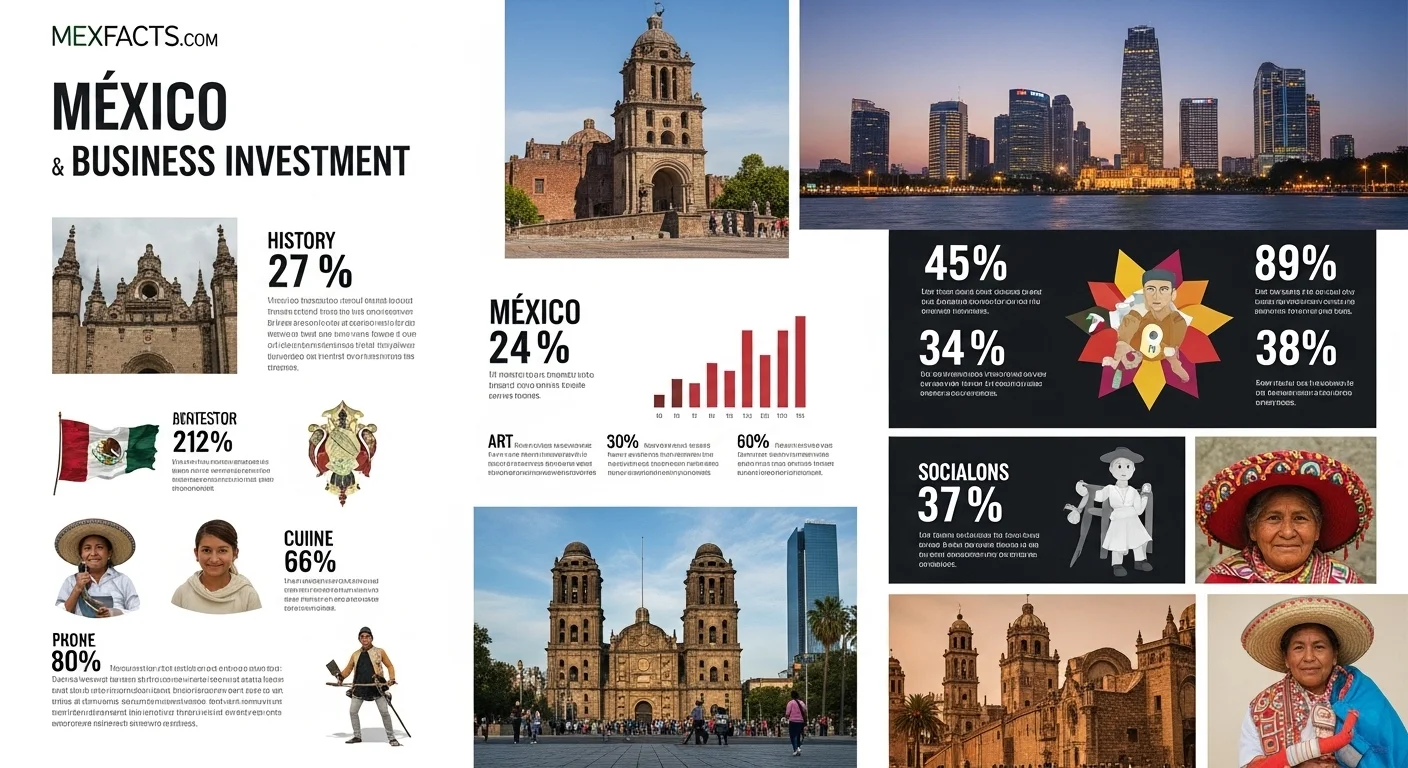
Mexico's Living Heritage by the Numbers
To truly grasp the scale of Mexico's history and culture, sometimes you have to look at the numbers. They tell a powerful story of a heritage that is not just a relic of the past, but a vital, driving force in the nation's present and future. Tourism, one of Mexico's economic cornerstones, is fueled by this cultural wealth. Well over half of international visitors do more than just sit on a beach; they come to immerse themselves in cultural activities, proving that the country's soul is its biggest draw.
At the heart of it all are the archaeological treasures. The Instituto Nacional de Antropología e Historia (INAH), the guardian of this legacy, manages an almost unbelievable number of sites. Imagine this: while INAH operates over 190 archaeological zones open to the public and more than 160 museums, it's estimated that tens of thousands more sites lie hidden, waiting to be discovered. Before 2020, these open sites drew over 26 million people a year. Think of the crowds at world-famous sites like Chichén Itzá or Teotihuacán, which welcome millions annually, making them global icons of ancient Mexican history. This isn't just about tourism; it's about providing jobs and supporting entire communities, from the local guide who shares stories passed down through generations to the family running a small restaurant nearby.
The world has taken notice. Mexico is a heavyweight on the UNESCO World Heritage list, with 35 sites, one of the highest counts in the Americas. This prestigious list includes everything from pre-Hispanic marvels like Palenque to the charming historic centers of cities like Oaxaca and Puebla. This recognition does more than bring prestige; it drives conservation and attracts travelers seeking truly unique experiences. The story of Cancún's history and culture is a perfect case study. When it was developed in the 1970s, it wasn't just about the beaches; it was strategically placed as a gateway to the Mayan World. Today, a huge number of tourists who fly into Cancún make the pilgrimage to see Tulum, Cobá, or the magnificent Chichén Itzá, creating a powerful link between modern resorts and ancient wonders.
Another number that speaks volumes is 68. That's how many national languages are officially recognized in Mexico. While Spanish is spoken everywhere, those 67 other languages are the indigenous voices of the country's past and present. About 6% of Mexicans speak an indigenous language like Nahuatl, Yucatec Maya, or Zapotec. This linguistic diversity is a living library of the cultural history of Mexico, each language holding a unique worldview and connection to the land.
The creative pulse of Mexico also shows up in the economic data. The 'creative economy'—film, music, design, and more—is a booming sector. In recent years, culture contributed significantly to the nation's GDP, creating billions of dollars in value. Mexico's "Golden Age of Cinema" in the mid-20th century has been reborn, with its directors now being some of the most celebrated in the world. Mexico City itself is a cultural powerhouse, boasting more museums than almost any city on Earth—over 150 of them. These aren't just for tourists. The heart of this cultural appreciation is domestic; Mexicans themselves make up the vast majority of visitors to their own heritage sites, showing a deep, personal pride in the incredible story of Mexico's history and culture.
The Future of Mexico's Past: Opportunities and Challenges
Looking ahead, the future of Mexico's history and culture is a landscape filled with both exciting opportunities and serious responsibilities. As travelers around the world seek more meaningful, authentic experiences, Mexico's incredible heritage gives it a powerful edge. For anyone looking to invest or innovate, the key will be to blend progress with preservation.
A huge project shaping this future is the Tren Maya, a railway designed to connect the key cultural and natural gems of the Yucatán Peninsula. The vision is to open up lesser-known Mayan ruins, spread the economic benefits of tourism beyond the hotspots, and bring new opportunities to local communities. It's a direct engagement with ancient Mexican archaeology and history, aiming to make remote sites more accessible. This opens the door for new boutique hotels, eco-tours, and businesses all along its route. But it's also a project that sparks intense debate. I’ve spoken with archaeologists and community leaders who hold both immense hope and deep concern about its impact on fragile ecosystems and undiscovered history. Its success will hinge on finding that delicate balance between development and protection.
The digital world offers another incredible frontier. Imagine putting on a VR headset and walking through the bustling, colorful market of the Aztec capital, Tenochtitlan, just moments before the Spanish arrived. Or exploring the intricate tombs of Palenque without ever leaving your home. Technology offers amazing opportunities for virtual and augmented reality experiences that can both educate and preserve. Digitizing the vast collections of museums and archives can also share the cultural history of Mexico with the world, creating invaluable resources for everyone.
There's also a powerful shift happening in tourism itself. People are tired of generic vacations; they crave connection. This is where community-based tourism shines. Think of staying in a small village in Oaxaca, learning to cook traditional mole from a local matriarch, or having a guide whose ancestors built the nearby ruins share their stories. These initiatives ensure tourism money directly supports the communities who are the true guardians of the culture. It’s a more responsible and profoundly more rewarding way to travel.
Mexico's creative industries are also poised for explosive growth. The country has an amazing pool of talent in design, animation, and film. The global success of its filmmakers is just the beginning. There are huge opportunities to invest in new studios, gaming companies, and fashion labels that draw inspiration from Mexico's unique aesthetic. The story of Cancún's history and culture—that blend of ancient mystery and modern luxury—could itself be the backdrop for a hit TV series or video game.
Of course, challenges remain. We have to be smart about managing tourism to avoid loving our most popular sites to death. Climate change is a real threat to coastal forts and jungle temples. And the fight to protect cultural artifacts from trafficking is ongoing. The future of Mexico's history and culture depends on a shared commitment from the government, businesses, and travelers alike. It’s about protecting this irreplaceable legacy while harnessing its power for a prosperous and proud future. For those interested in the official policies shaping these developments, the government's tourism development fund, FONATUR, is a key player to watch, as they are behind major projects like Cancún and the Tren Maya. By navigating this path with care, Mexico can ensure its vibrant past continues to illuminate its future.
Expert Reviews
Sarah K., Future Traveler ⭐⭐⭐⭐⭐
I'm planning my first trip to Mexico, and this article was a game-changer. It went so much deeper than the usual travel blogs. The way you described 'mestizaje' and the living history really stuck with me. Now I feel like I'll be seeing the country with new eyes, not just as a tourist. Thank you!
Michael Chen, International Consultant ⭐⭐⭐⭐⭐
As someone who does business in Mexico, this was incredibly insightful. Understanding the historical context, especially the post-revolutionary pride and the deep respect for heritage, has given me a much better framework for building relationships with my Mexican colleagues. Far more valuable than a simple list of do's and don'ts.
Elena Garcia, History Enthusiast ⭐⭐⭐⭐⭐
What a fantastic read! I’ve always been fascinated by Mesoamerican cultures, and this piece connected the dots from the Olmecs to modern Mexico City in a way that was both informative and deeply human. It feels like it was written by someone who truly loves and understands the country's soul. Absolutely brilliant!