
Oaxaca, Mexico: Complete Guide to Travel, Culture & Living

Located in southwestern Mexico, the state of Oaxaca represents one of the country's most culturally profound and biologically diverse regions. Renowned globally for its sixteen distinct Indigenous peoples, UNESCO World Heritage treasures like Monte Albán, and an internationally celebrated culinary heritage rooted in seven distinct moles and artisanal mezcal, Oaxaca blends deep ancestral tradition with modern vitality. Beyond its colonial capital of Oaxaca de Juárez, the state is experiencing significant infrastructure modernization—highlighted by the Barranca Larga–Ventanilla toll highway connecting the Central Valleys to the Pacific coast in under three hours, alongside the strategic Interoceanic Corridor of the Isthmus of Tehuantepec. This comprehensive guide details essential travel logistics, cultural and archaeological landmarks, living costs, connectivity, and the evolving economic landscape across Oaxaca.
Cultural Identity, Indigenous Peoples & Archaeological Sites
Situated along Mexico's southern Pacific rim where the Sierra Madre del Sur meets the Sierra Madre de Oaxaca, the state of Oaxaca is characterized by dramatic topographic diversity and extraordinary cultural continuity. Unlike regions where pre-Columbian traditions survive only as historical memory, Oaxaca maintains an active civilizational fabric shaped by its Indigenous inhabitants. The state is divided into eight geographical and cultural regions: Valles Centrales, Costa, Istmo de Tehuantepec, Sierra Norte, Sierra Sur, Mixteca, Cañada, and Papaloapan.
Living Indigenous Heritage and Ancient Capitals
Oaxaca is home to at least sixteen distinct Indigenous ethnolinguistic groups, the most prominent being the Zapotecs (Binni Záa, “people of the clouds”) and the Mixtecs (Ñuu Savi, “people of the rain”), alongside the Mazatec, Chinantec, Mixe (Ayuuk), Chatino, Triqui, Huave, and others. Each group preserves its own linguistic variants, customary community structures, and ceremonial dress. For broader context on this national heritage, explore our overview of Indigenous heritage and cultural preservation in Mexico.
This civilizational depth is reflected in an exceptional concentration of archaeological monuments. Rising above the Central Valleys, Monte Albán served as the capital of the Zapotec civilization for more than a millennium, founded around 500 BCE. Built atop a leveled mountain ridge roughly 400 meters above the valley floor, the complex contains ceremonial platforms, astronomical observatories, ballcourts, and carved stone stelae depicting rulers and captives (Los Danzantes). Inscribed as a UNESCO World Heritage Site in 1987 alongside Oaxaca's historic core, Monte Albán represents one of Mesoamerica's earliest urban centers.
To the east lies Mitla, the Zapotec and Mixtec religious center renowned for its post-classic palaces. Unlike the towering pyramid complexes of Monte Albán, Mitla is famous for intricate geometric mosaic fretwork (grecas) assembled from thousands of polished stone pieces fitted together without mortar. Nearby sites such as Yagul, Lambityeco, and Dainzú, alongside the prehistoric caves of Yagul and Mitla (a UNESCO World Heritage cultural landscape recognizing early plant domestication), illustrate millennia of agricultural and architectural evolution.
Artisan Guilds and Specialized Craft Communities
Surrounding Oaxaca de Juárez, specialized villages in the Central Valleys preserve hereditary artisanal crafts passed down through generations:
- Teotitlán del Valle: Master weavers produce Zapotec wool rugs on wooden pedal looms, relying on natural dyes extracted from cochineal insects (grana cochinilla for deep reds), indigo (añil for blues), marigold blossoms (cempasúchil for yellows), and tree moss.
- San Bartolo Coyotepec: Known for burnished black clay pottery (barro negro), crafted using a low-temperature reduction firing technique popularized in the twentieth century by Doña Rosa Real Mateo.
- San Martín Tilcajete and San Antonio Arrazola: Centers of imaginative wooden folk sculpture known as alebrijes, hand-carved from soft copal wood (Bursera) and meticulously detailed with mineral and acrylic paints depicting mythical creatures and naguales.
- Santa María del Tule: Home to El Árbol del Tule, an ancient Montezuma cypress (Taxodium mucronatum) with the stoutest trunk in the world, measuring over 14 meters in diameter.
- Ocotlán de Morelos: Celebrated for hand-forged cutlery, traditional unglazed red ceramic figures, and vibrant Friday regional market days.
Gastronomic Capital: The Seven Moles & Agave Traditions
Oaxacan cuisine is widely recognized as one of the fundamental pillars of Mexican gastronomy, recognized by UNESCO in its 2010 inscription of Traditional Mexican Cuisine on the Representative List of the Intangible Cultural Heritage of Humanity. Rooted in pre-Hispanic ingredients—heirloom maize, native beans, squash, wild herbs, and endemic chilies—the state's culinary identity is sophisticated, diverse, and deeply communal.
The Land of the Seven Moles
Oaxaca is celebrated as the “Land of the Seven Moles,” each recipe balancing roasted chilies, seeds, herbs, and spices into distinct sauces:
- Mole Negro: The most complex and renowned mole, combining charred chili seeds, roasted chile chilhuacle negro, pasilla oaxaqueño, Mexican chocolate, plantains, raisins, cloves, and Mexican cinnamon into an intensely savory, bittersweet sauce.
- Mole Coloradito: A rich, brick-red sauce incorporating ancho and guajillo chilies, sesame seeds, almonds, tomatoes, and a subtle touch of chocolate.
- Mole Amarillo: Bright and aromatic, featuring yellow chilies (chile amarillo), Mexican oregano, and wild hoja santa (Mexican pepperleaf), thickened with fresh corn masa.
- Mole Verde: A fresh, herb-forward mole driven by tomatillos, green chilies, epazote, parsley, and hoja santa, traditionally served with pork, chicken, or vegetables.
- Mole Chichilo: An austere, earthy ceremonial mole made with charred tortillas, roasted avocado leaves, and chile chihuacle, typically prepared for commemorative occasions.
- Mole Manchamanteles: A fruity, sweet-and-sour mole (“tablecloth stainer”) combining red chilies with fresh pineapple, plantain, and apple.
- Mole Rojo: A bold, spicy mole resembling coloradito but with higher piquancy from red chilhuacle or guajillo chilies, served over braised poultry or beef.
Traditional Street Foods, Cheese, and Beverages
Daily gastronomy centers around markets like Mercado 20 de Noviembre and Mercado Benito Juárez. Iconic regional staples include tlayudas (large, crispy toasted corn tortillas spread with unrefined pork lard or asiento, refried black bean paste, shredded cabbage, and grilled tasajo or cured beef cecina), memelas, and tetelas (triangular masa pockets stuffed with beans and hoja santa). Oaxaca's world-famous string cheese, locally called quesillo, is an indispensable culinary staple; explore its origins in our guide to traditional Mexican cheese varieties including quesillo.
For beverages, Oaxaca celebrates tejate, an ancestral Zapotec ceremonial drink composed of toasted maize, fermented cacao, toasted mamey fruit pits (pixtle), and aromatic rosita de cacao flowers, whisked by hand in large clay bowls to yield a frothy, fragrant foam. Oaxaca is also famed for its stone-ground drinking chocolate, whisked with hot water (chocolate de agua) or milk and spiced with cinnamon and almonds.
Getting to Oaxaca: Transport Routes from Mexico City
Reaching Oaxaca de Juárez from central Mexico is straightforward, offering several reliable transport modes tailored to travel schedules and budgets.
Air Travel to Oaxaca (OAX)
The fastest option is a direct flight from Mexico City International Airport (MEX) or Felipe Ángeles International Airport (NLU) to Oaxaca International Airport (OAX, Aeropuerto Internacional de Oaxaca / Xoxocotlán). The flight takes approximately 1 hour and 15 minutes. Domestic carriers including Aeroméxico, Volaris, and Viva Aerobus operate multiple daily departures, providing seamless connections for international passengers.
Executive Bus Services
For ground transit, premium long-distance coaches offer high comfort and safety. Operators such as ADO Platino and ADO GL depart regularly from Mexico City's eastern bus terminal (Terminal de Autobuses de Pasajeros de Oriente, TAPO) and Terminal del Sur (Taxqueña). The journey takes between 6.5 and 7.5 hours depending on traffic exiting the capital, featuring reclining seats, individual entertainment screens, Wi-Fi, and onboard restrooms.
Driving Route via Toll Highway 135D
Driving from Mexico City spans approximately 460 kilometers (285 miles) via Federal Highway 150D toward Puebla and Tehuacán, transitioning onto Federal Highway 135D (Autopista Tehuacán–Oaxaca). The drive requires roughly 5.5 to 6.5 hours of active driving time. The toll highway is well-maintained, traverses the dramatic landscapes of the Tehuacán-Cuicatlán Biosphere Reserve, and bypasses mountainous secondary roads. Drivers should ensure daytime travel and maintain pesos for toll plazas.
Exploring Oaxaca de Juárez: Neighborhoods & Lodging
Oaxaca de Juárez offers a walkable urban layout centered on historical architecture, leafy plazas, and distinct colonial and bohemian quarters.
Central Neighborhoods
- Centro Histórico: Centered on the vibrant Zócalo (Plaza de la Constitución) and the Alameda de León, the historic core is framed by green cantera limestone facades, open-air cafes, and pedestrian thoroughfares (Andador Turístico / Calle Macedonio Alcalá) leading north to the Templo de Santo Domingo de Guzmán.
- Barrio de Jalatlaco: Located just east of Centro, Jalatlaco features quiet cobblestone lanes, colorful street murals, independent coffee shops, and restored 17th-century houses. Designated a Barrio Mágico, it provides a peaceful residential atmosphere within a 15-minute walk of the main square.
- Barrio de Xochimilco: Oaxaca's oldest neighborhood, situated north of Centro, celebrated for its 18th-century stone aqueduct (Los Arcos de Xochimilco), traditional textile workshops, and calm boutique guest properties.
- Colonia Reforma: A modern commercial and residential district north of the historical center, hosting banking institutions, international medical clinics, contemporary restaurants, and full-service business hotels.
Lodging Options and Architectural Restorations
Accommodations in Oaxaca cater to all traveler preferences. Premium luxury is anchored by properties such as Quinta Real Oaxaca, set within the meticulously restored 16th-century Convent of Santa Catalina de Siena, alongside modern architectural boutique hotels incorporating Oaxacan textiles and local artwork. Independent bed-and-breakfasts, historic mesones, and well-equipped vacation rentals populate Jalatlaco and Xochimilco, while budget-conscious travelers will find high-quality hostels with rooftop terraces and cultural programming throughout the central perimeter.
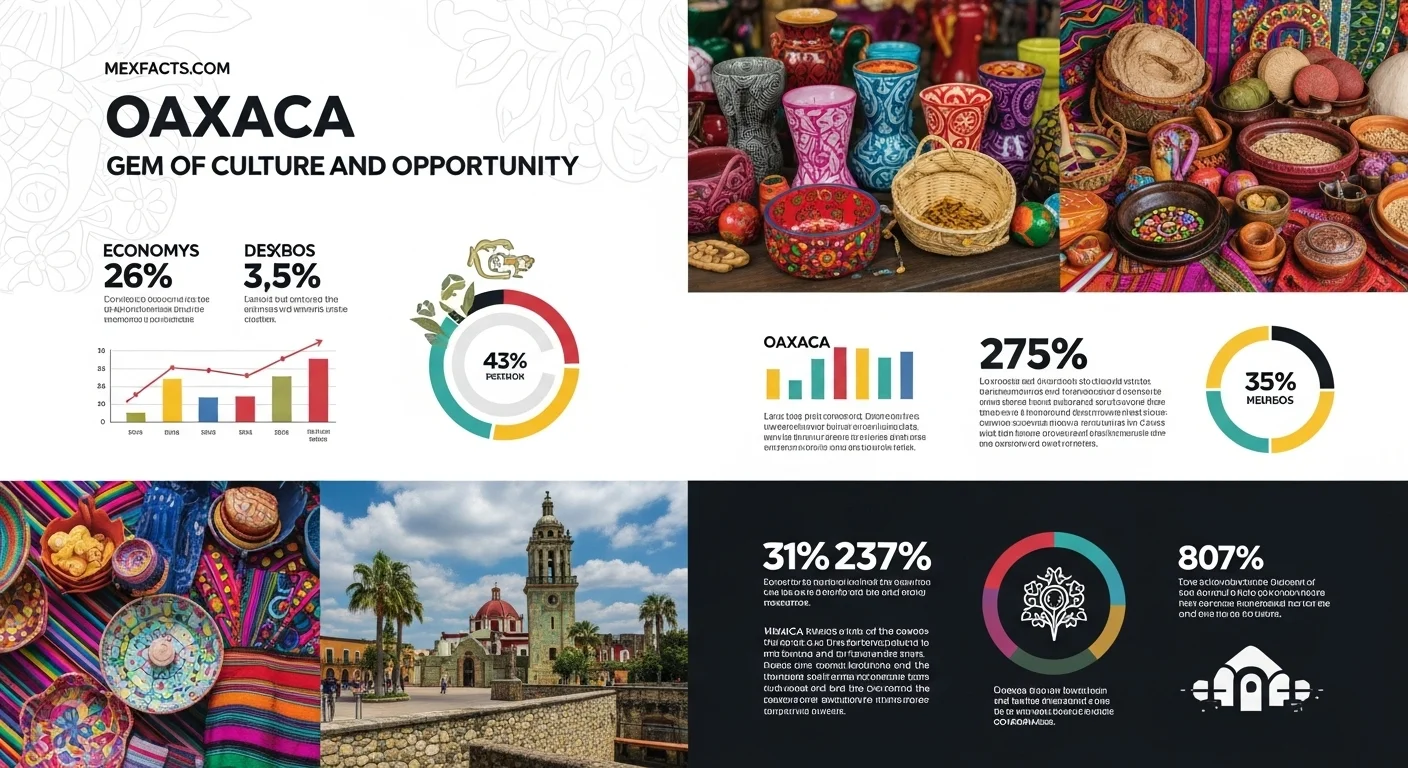
Demographics, Regional Diversity & Economic Base
Beyond its cultural acclaim, Oaxaca represents a complex, developing regional economy navigating modern industrialization while supporting traditional agrarian livelihoods.
Demographics and Municipal Structure
According to the official 2020 Population and Housing Census conducted by the National Institute of Statistics and Geography (INEGI), Oaxaca registered 4,132,148 inhabitants. The state comprises 570 municipalities—accounting for almost a quarter of all municipalities in Mexico—illustrating significant administrative and geographical fragmentation.
Of these 570 municipalities, 417 operate under Sistemas Normativos Internos (indigenous customary legal frameworks, formerly known as usos y costumbres), recognized by state and federal constitutions. Under this system, municipal authorities are selected through communal civic assemblies rather than political party ballots, emphasizing rotating civil service (cargos), communal solidarity, and obligatory communal labor known as tequio.
Key Economic Sectors and Productive Activities
Historically reliant on agriculture and commerce, Oaxaca's workforce balances traditional cultivation with modern manufacturing and international trade:
- Agriculture: The primary sector employs a significant portion of rural families, producing staple crops (maize, beans) alongside commercially valuable crops including shade-grown specialty coffee (cultivated in Pluma Hidalgo, the Mixteca, and the Sierra Juárez), mangoes, limes, papayas, and avocados.
- Manufacturing and Energy: Food and beverage manufacturing (led by mezcal, dairy products, and baked goods) forms a core industrial pillar, complemented by renewable energy generation in the Isthmus of Tehuantepec, home to one of Latin America's highest concentrations of wind energy farms.
- Foreign Trade: In 2024, the state recorded over US$300 million in international exports, led by artisanal and commercial mezcal, fresh agricultural produce, and specialized machinery.
Tourism Dynamics, Guelaguetza & Cultural Seasons
Tourism serves as the foundational driver of Oaxaca's services sector, generating employment across hospitality, culinary arts, transportation, and artisan cooperatives.
The Guelaguetza Festival
Celebrated annually during the two Mondays following July 16 (known as Los Lunes del Cerro), the Guelaguetza is Oaxaca's premier cultural gathering. Held at the open-air Auditorio Guelaguetza on Cerro del Fortín, delegations from the state's eight regions converge to present traditional dances, indigenous music, and agricultural offerings to spectators. The celebration generates peak economic impact across the state, with city hotel occupancy typically exceeding 85% to 90% and drawing hundreds of thousands of domestic and international visitors.
Seasonal Travel Patterns
Visitor demand experiences marked peaks throughout the annual calendar:
- Day of the Dead (Día de los Muertos, late October to November 2): A major cultural celebration marked by neighborhood comparsas (brass-band costumed processions), elaborate home and street altars (ofrendas), marigold markets, and cemetery vigils in San Felipe del Agua, Santa Cruz Xoxocotlán, and Atzompa.
- Winter Holiday Season (mid-December to early January): Characterized by mild winter weather, cultural concerts, and the traditional Noche de Rábanos (Night of the Radishes) on December 23, where artisans carve elaborate nativity scenes and historical dioramas from giant radishes in the central Zócalo.
- Holy Week (Semana Santa, March/April): Draws regional pilgrims and cultural travelers observing religious processions, sacred music concerts, and the Friday of Sorrows (Viernes de Dolores) floral displays.
The Mezcal Economy: Agave Cultivation & Global Trade
Mezcal represents Oaxaca's most iconic agricultural and industrial export, transforming from a domestic spirit into an internationally celebrated category within premium spirits.
Denomination of Origin and Production Volumes
Mezcal is protected by a strict Denomination of Origin (DOM) established in 1994. According to regulatory data from the Mezcal Regulatory Council (Consejo Regulador del Mezcal, CRM), the state of Oaxaca produces between 85% and 90% of all certified mezcal in Mexico. In recent years, national certified production has surpassed 12 million liters annually, with over 75% destined for export to primary markets including the United States, Canada, the European Union, and Japan.
Artisanal and Ancestral Standards
The vast majority of Oaxacan mezcal—exceeding 90% of certified volume—is categorized as Mezcal Artesanal under official standard NOM-070-SCFI-2016:
- Cooking: Agave hearts (piñas) are roasted for several days in conical underground earthen pits lined with river stones, oak, and mesquite, imparting characteristic smoky profiles.
- Crushing: Cooked agaves are crushed using heavy circular stone millstones (tahonas) pulled by horses or mules, or occasionally by mechanical shredders.
- Fermentation: Crushed agave fibers ferment naturally with airborne yeasts in open-top pine or oak vats (tinas), without chemical accelerants.
- Distillation: The fermented liquid and bagasse are double-distilled in traditional copper alembics. An even rarer subcategory, Mezcal Ancestral, mandates hand-mashing with wooden mallets in stone or wooden troughs and distillation in clay pots (ollas de barro) with reed condensers.
Agave Varieties and Geographic Clusters
While cultivated Agave espadín (Agave angustifolia) constitutes roughly 85% to 90% of production due to its reliable 7- to 8-year maturation cycle, Oaxaca's reputation for complexity derives from semi-cultivated and wild agave species. These include Tobalá (Agave potatorum, growing at high elevations in shade), Tepeztate (Agave marmorata, requiring up to 25–35 years to mature on limestone cliffs), Arroqueño (Agave americana), Cuishe and Madrecuixe (Agave karwinskii). Major distillation epicenters include Santiago Matatlán (“the World Capital of Mezcal”), San Dionisio Ocotepec, Tlacolula de Matamoros, Ejutla de Crespo, and Sola de Vega.
Transport Infrastructure: The Coastal Highway & Airport
For decades, Oaxaca's mountainous topography presented a formidable logistical bottleneck, separating the economic core of the Central Valleys from the Pacific coast. Groundbreaking public infrastructure projects have recently restructured this connectivity.
The Barranca Larga–Ventanilla Toll Highway (Autopista 175D)
Inaugurated in February 2024 by federal and state authorities, the Autopista Barranca Larga–Ventanilla (Federal Highway 175D) represents the most significant highway project completed in southern Mexico in recent decades. Spanning 104.3 kilometers, the modern two-lane toll road features 10 bridges, 3 viaducts, 3 tunnels, and 15 junctions.
Crucially, the highway slashes driving time between Oaxaca City and the Pacific coastline from 6.5 to 7 hours down to approximately 2.5 to 3 hours. Terminating at Ventanilla near Puerto Escondido on coastal Federal Highway 200, the highway enables rapid freight, bus, and passenger vehicular transit. Travelers can now combine mountain cultural exploration in Oaxaca City with coastal excursions to the sustainable coastal haven of Huatulco or the laid-back Pacific beaches of Zipolite in a single weekend itinerary.
Oaxaca International Airport Modernization
Operated by airport group ASUR (Grupo Aeroportuario del Sureste), Oaxaca International Airport (OAX) has undergone substantial modernization and physical expansion. Upgrades have quadrupled terminal floor space, modernized baggage and security checkpoints, expanded boarding gates, and added international processing capacity to accommodate rising passenger traffic from domestic hubs and direct international routes from the United States (including Houston, Dallas/Fort Worth, and Los Angeles).
Social Realities, Community Governance & Sustainability
While economic indicators and visitor numbers show notable momentum, Oaxaca continues to face profound socioeconomic challenges. The state historically registers some of Mexico's highest rates of multidimensional poverty and informal employment, particularly across isolated mountain communities where rugged geography complicates access to public utilities, healthcare infrastructure, and secondary education.
Bridging this divide requires development initiatives that work within existing indigenous communal frameworks rather than superseding them. Models of community-managed ecotourism, such as the Pueblos Mancomunados in the Sierra Norte, demonstrate that conservation, cultural preservation, and fair economic returns can coexist when local assemblies retain ownership of tourism assets and forest management.
Strategic Economic Growth & The Interoceanic Corridor (CIIT)
Oaxaca's economic landscape is undergoing an unprecedented structural transition driven by large-scale federal infrastructure programs designed to establish a global commercial bridge across the Isthmus of Tehuantepec.
The Corredor Interoceánico del Istmo de Tehuantepec (CIIT)
The Interoceanic Corridor of the Isthmus of Tehuantepec (CIIT) modernizes the narrowest land corridor between the Pacific and Atlantic oceans in Mexico, establishing a multimodal freight route designed to complement international maritime traffic moving through the Panama Canal. The core transit backbone is the modernized 308-kilometer Line Z of the Ferrocarril del Istmo de Tehuantepec, linking the Gulf of Mexico port of Coatzacoalcos, Veracruz, with the Pacific deep-water port located in the strategic port city of Salina Cruz in Oaxaca.
Line Z operates scheduled cargo and passenger rail services, bolstered by major maritime investments including a massive deep-water breakwater at Salina Cruz capable of receiving post-Panamax commercial container vessels.
Development Poles for Well-Being (PODEBI)
Along the modernized rail corridor, federal authorities designated specialized industrial zones termed Development Poles for Well-Being (Polos de Desarrollo para el Bienestar, PODEBI). Oaxaca hosts six strategic industrial poles, including Salina Cruz, San Blas Atempa, Santa María Mixtequilla, Asunción Ixtaltepec, Matías Romero Avendaño, and Ciudad Ixtepec.
To attract private capital and nearshoring manufacturing operations, the Mexican government established comprehensive tax incentive packages for participating enterprises, including:
- Substantial federal income tax (ISR) reductions during initial operating years (up to 100% relief across early operational phases, transitioning to 50% subject to local job creation metrics).
- Accelerated depreciation allowances for fixed capital equipment and machinery.
- Value-added tax (IVA) exemptions and credits for transactions conducted within the development polygons.
Priority industrial sectors targeted for these poles include semiconductors, automotive components, medical device manufacturing, clean energy equipment, agro-industrial processing, and information technologies. For detailed analysis on industrial nearshoring, review our overview of nearshoring and industrial logistics in Mexico, or consult official frameworks through the Secretariat of Economy (Secretaría de Economía).
Living in Oaxaca: Expat Realities, Costs, Healthcare & Safety
Oaxaca has emerged as an attractive hub for international retirees, remote professionals, cultural researchers, and entrepreneurs seeking a slower, community-oriented lifestyle steeped in artistic traditions.
Climate and Daily Life in the Central Valleys
Situated at an altitude of approximately 1,550 meters (5,085 feet) above sea level, Oaxaca de Juárez enjoys a temperate subtropical highland climate. Days are predominantly warm and sunny year-round, while evenings are refreshingly cool:
- Dry Season (November to April): Characterized by clear skies, minimal precipitation, daytime highs around 27°C to 30°C (80°F–86°F), and nighttime lows dropping to 9°C to 12°C (48°F–54°F).
- Rainy Season (May to October): Brings green valley landscapes and afternoon showers, with peak precipitation occurring between June and September.
Comparative Cost of Living
The cost of living in Oaxaca remains significantly lower than in major North American urban centers, though rental real estate in core neighborhoods has experienced price appreciation in recent years due to heightened demand. Essential expenses breakdown realistically as follows:
- Housing: Long-term one- to two-bedroom furnished apartments in central districts like Jalatlaco, Centro, or Xochimilco range between 14,000 and 28,000 MXN per month (roughly $750–$1,500 USD). Residential neighborhoods such as Colonia Reforma, San Felipe del Agua, or San Agustín Yatareni offer larger homes and townhouses at comparable or slightly lower price points.
- Groceries and Dining: Sourcing fresh fruits, vegetables, beans, and poultry from municipal markets like Mercado de Abastos or neighborhood tianguis is exceptionally economical. Casual street food and traditional fondas cost 50 to 120 MXN per meal ($3–$7 USD), while upscale dining at signature contemporary restaurants averages 500 to 1,200 MXN per person ($27–$65 USD).
- Utilities and Connectivity: Basic utilities (electricity, municipal water, cooking gas) typically total 600 to 1,500 MXN monthly, with electricity costs rising if air conditioning is used in warmer months. High-speed fiber-optic internet (Telmex Infinitum, Totalplay) offering speeds from 100 to 500 Mbps is widely available in central colonias for 400 to 800 MXN per month ($22–$45 USD), supporting digital nomad workflows.
Healthcare Facilities and Medical Care
Oaxaca de Juárez possesses dependable private medical infrastructure capable of handling routine healthcare, diagnostics, and elective surgeries. Prominent private medical centers include Hospital Reforma, Clínica Hospital del Carmen, and Hospital San Antonio. Consultation fees with board-certified medical specialists typically range between 600 and 1,200 MXN ($32–$65 USD), and major pharmacies (Farmacias del Ahorro, Farmacias Similares, Farmacias Guadalajara) provide accessible prescription and generic medications. For specialized tertiary surgical interventions, patients occasionally travel to Puebla or Mexico City.
Safety, Civic Realities, and Travel Advice
Oaxaca de Juárez is generally recognized as a secure destination for international travelers and foreign residents, maintaining violent crime indices well below those of northern border states or major port hubs. Common safety realities include:
- Petty Theft and Opportunistic Crime: Pickpocketing and bag snatching occur primarily in crowded markets (especially Central de Abastos) or late at night in unlit peripheral streets. Travelers should carry minimal cash, avoid displaying expensive electronics, and use radio or app-based taxis (DiDi) after dark.
- Civic Protests and Demonstrations: As the historical center of teachers' union activism (Section 22 of the SNTE) and indigenous community advocacy, Oaxaca frequently experiences political marches, plantones (encampments) around the central Zócalo, and periodic highway toll-booth blockades. These demonstrations are almost universally peaceful toward international visitors but can cause logistical transit delays.
- Natural Hazards: Oaxaca is situated within an active seismic zone; buildings follow seismic construction norms, and mobile seismic alarm systems operate throughout the capital. During the summer rainy season, travelers driving into the Sierra Madre should monitor local road advisories for localized landslides.
Sustainable Development & Responsible Travel Practices
Preserving Oaxaca's singular heritage requires deliberate, respectful engagement from both short-term visitors and prospective residents.
Water Scarcity and Environmental Stewardship
Water availability is one of the Central Valleys' most critical challenges. Prolonged dry spells and urban population growth place substantial pressure on regional aquifers. Sustainable residents and travelers prioritize water conservation, choose hotels and rentals with water-recycling and rainwater-harvesting systems, avoid single-use plastics, and minimize waste footprint throughout their stay.
Fair Economic Engagement with Artisan Communities
When purchasing world-class crafts—from Teotitlán textiles to Arrazola alebrijes—buying directly from artisan workshops and registered community cooperatives ensures that revenue directly supports creator families rather than commercial intermediaries. Haggling aggressively over artisanal works diminishes livelihoods; paying fair, advertised prices honors the weeks or months of specialized manual skill required to produce each piece.
Conclusion: Oaxaca's Enduring Horizon
Oaxaca presents an extraordinary convergence of pre-Columbian tradition, living Indigenous culture, world-class gastronomy, and bold economic transformation. Whether wandering cobblestone colonial avenues beneath the shadow of Templo de Santo Domingo, tracing trade routes along the modernized Interoceanic Corridor, or traveling the coastal highway to the Pacific, visitors and prospective residents encounter a region that honors its ancestral past while purposefully charting its economic future.
Expert Reviews
Eleanor Vance, Traveler ⭐⭐⭐⭐⭐
This guide was my bible for planning a trip to Oaxaca! The way the author describes the culture and food made me feel like I was already there. It went beyond a simple travel guide and helped me understand the soul of the place. The tips on getting from Mexico City were spot on. A truly beautiful and insightful read.
Marcus Chen, Investor ⭐⭐⭐⭐⭐
As an investor looking at opportunities in Mexico, this article was invaluable. It perfectly balanced the cultural context with hard data on the economic transformation happening in Oaxaca, especially regarding the Interoceanic Corridor. It's rare to find content that is both inspiring and provides the practical statistics I need. Highly recommended.
Sofia Rossi, Chef & Food Blogger ⭐⭐⭐⭐⭐
I’ve been obsessed with Oaxacan cuisine for years, and this article captured its magic perfectly. The descriptions of the moles and the mezcal-making process were so vivid. It inspired me to book a culinary tour! It’s clear the author has a deep, personal connection to the food culture of Oaxaca. Wonderful!