
Isla Mujeres, Mexico: Complete Travel Guide, Attractions & Investment Profile

Isla Mujeres, located just across the Bahía de Mujeres from Cancún, offers an intimate Caribbean island setting shaped by over a thousand years of history. Once a sacred Mayan sanctuary dedicated to Ixchel, the goddess of fertility and medicine, the island has grown into one of Quintana Roo's most distinctive destinations. From the tranquil, turquoise waters of Playa Norte to the dramatic cliffs of Punta Sur and the underwater sculptures of MUSA, Isla Mujeres combines world-class marine recreation with a relaxed, golf-cart-paced atmosphere. Beyond leisure travel, the island sustains a strong local economy powered by year-round tourism, high hospitality occupancy, and a specialized coastal real estate market governed by the Mexican bank trust (fideicomiso). This comprehensive guide examines the cultural identity, essential attractions, economic metrics, and sustainable growth opportunities that define Isla Mujeres for international visitors and investors alike.
What is Isla Mujeres and Why is It So Special?
Tucked into the clear turquoise waters of the Mexican Caribbean, roughly 13 kilometers (8 miles) northeast of Cancún across the Bahía de Mujeres, lies Isla Mujeres—the "Island of Women." Measuring approximately 7 kilometers (4.3 miles) long and rarely more than 650 meters wide, this compact barrier island offers a striking contrast to the high-density hotel towers of the mainland. Its historical footprint reaches back more than 1,500 years to the classic and post-classic Maya civilization, when the island served as a sacred sanctuary dedicated to Ixchel, the goddess of fertility, healing, weaving, and the moon.
According to colonial chronicles, Maya women and pilgrims traveled by seafaring canoes from the mainland across the bay to leave ceramic offerings and figurines at Ixchel's coastal shrine. When Spanish navigator Francisco Hernández de Córdoba made landfall in March 1517, his expedition discovered hundreds of these terracotta female figures along the southern cliffs, prompting the name Isla Mujeres. Today, visitors can walk the windswept promontory at Punta Sur, the southern tip of the island and one of the island's highest viewpoints. In addition to preserving the archaeological foundations of Ixchel's temple, Punta Sur features an outdoor sculpture park, steep limestone cliffs battered by Caribbean swells, and memorable Caribbean sunrise views.
While Punta Sur captures the island's dramatic, rocky topography, the northern end anchors its leisure identity. Playa Norte is routinely recognized by international travel organizations as one of the finest beaches in the Caribbean basin. Its broad expanse of soft, crushed-coral white sand shelves gently into waist-deep, translucent water that remains calm across wide expanses, shielded from heavy open-ocean swells. Just steps from the beach, the island's primary urban core, known locally as El Centro, features pedestrian promenades such as Avenida Hidalgo, where open-air seafood restaurants, local taquerías serving regional Maya dishes like tikinxic (achiote-marinated fish baked in banana leaves), artisan jewelry shops, and boutique hotels create a lively yet walkable town center.
Because passenger vehicles are restricted by space and ferry logistics, golf carts, scooters, and bicycles serve as the primary modes of transport across the island's two main coastal roads. Beyond the shoreline, Isla Mujeres sits adjacent to the Mesoamerican Barrier Reef, the second-largest barrier reef system in the world. Key underwater attractions include the Manchones reef shelf and the Museo Subacuático de Arte (MUSA), an innovative conservation project co-founded by Jaime González Cano, Roberto Díaz Abraham, and Jason deCaires Taylor featuring more than 500 submerged life-size sculptures. These installations divert dive and snorkel traffic from fragile natural coral formations while providing artificial substrate for marine colonization. From June through September, the open waters off the island's northern perimeter host significant seasonal aggregations of whale sharks, strictly monitored by Mexico's National Commission of Protected Natural Areas (CONANP) to ensure responsible eco-tours. Through this combination of cultural heritage and protected marine habitats, Isla Mujeres operates as a diverse island resort destination with a distinct community identity.
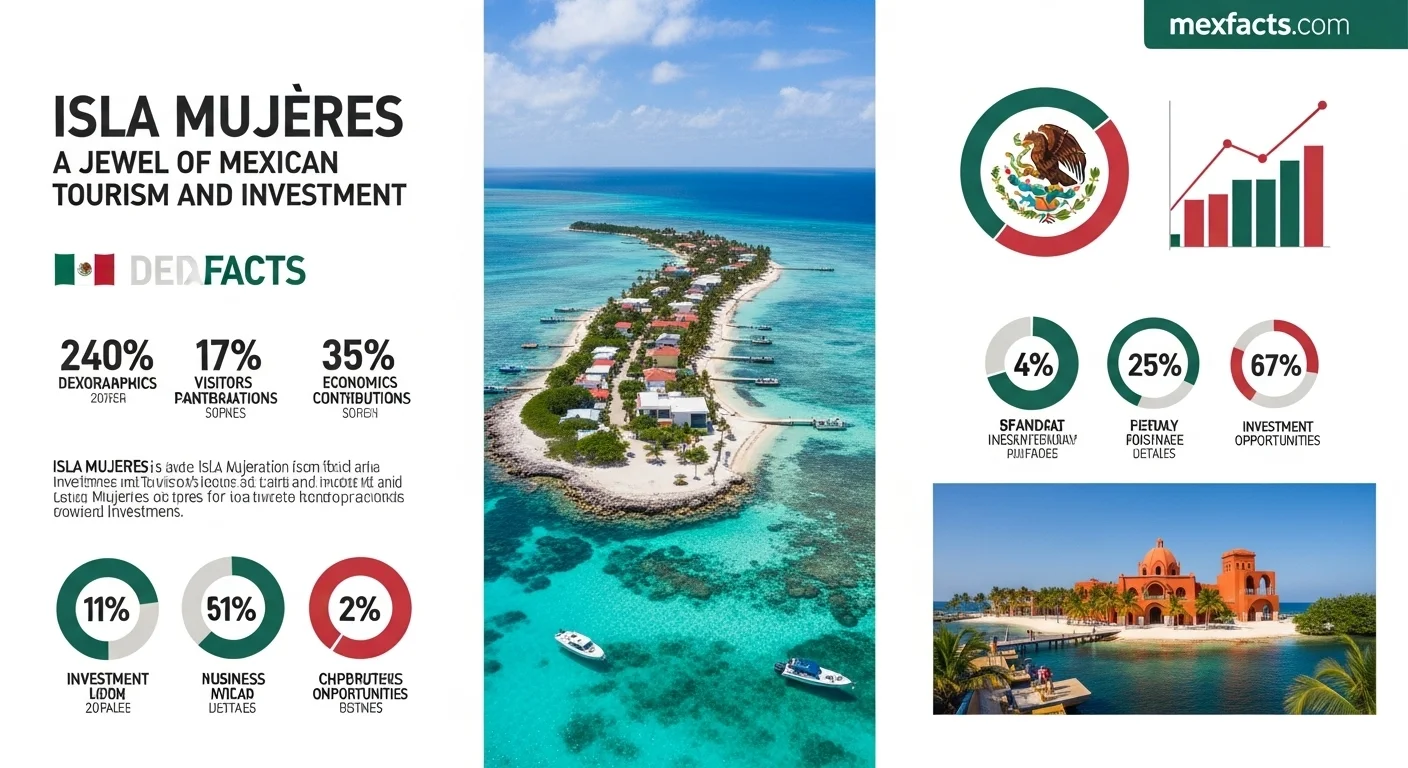
A Look at the Numbers: Tourism, Economy, and Real Estate
Understanding the economic vitality of Isla Mujeres, Mexico requires reviewing its performance within Quintana Roo's broader tourism ecosystem. While mainland centers such as Cancún and Playa del Carmen process massive passenger volumes through high-density resort strips, Isla Mujeres commands consistent lodging demand across all four seasons. Quintana Roo's SITURQ tourism statistics report 65.6% hotel occupancy in Isla Mujeres for 2025 and 72.57% for January–July 2026. Because these values cover different periods, they should not be compared as annual averages. Vacation rental occupancy is a separate metric and should not be assumed to match hotel occupancy.
The island's international visitor profile is led by North American travelers, with visitors from the United States representing the largest demographic share, followed closely by Canadian travelers, domestic Mexican vacationers, and expanding European traveler segments. Commercial high-speed catamarans operated by companies such as Ultramar and Jetway depart throughout the day from mainland terminals including Puerto Juárez, Playa Caracol, and Playa Tortugas, transporting day-trippers and overnight guests on crossings that take roughly 20 to 30 minutes. In addition, vehicle roll-on/roll-off ferries departing from Punta Sam supply the island with fuel, commercial goods, building materials, and food staples, forming the critical logistics chain for the municipality.
For global buyers, the real estate landscape on Isla Mujeres presents a constrained-supply market characterized by land scarcity, premium waterfront positioning, and steady capital appreciation. Because the island is located within the Mexican Restricted Zone (within 50 kilometers of the coast), foreign nationals acquire residential real estate through a 50-year renewable bank trust known as a fideicomiso, established through an authorized Mexican financial institution. The bank trustee holds legal title, while the foreign beneficiary has rights to use and benefit from the property under the trust agreement and applicable Mexican law.
Property inventory on the island divides into three distinct sub-markets: El Centro and Playa Norte, characterized by condominium developments and high-turnover short-term vacation rentals; Sac Bajo, a sheltered peninsula facing the Laguna Macax known for luxury residences, private yacht slips, and upscale boutique developments; and the Mid-Island to Punta Sur zone, featuring quiet residential enclaves, cliff-top ocean-view villas, and private Caribbean retreats. Prices vary substantially by location, property type, title status, condition, and timing; buyers should consult dated listings and independent valuations rather than rely on unsourced price ranges. Before projecting rental returns, investors should account for seasonal occupancy, taxes, management fees, maintenance, and regulatory requirements. For additional property-specific context, Isla Mujeres real estate investments maintain a defensive profile against oversupply cycles that occasionally impact larger mainland developments.
Economic viability on the island is inextricably tied to conservation management. Isla Mujeres forms a core component of the Parque Nacional Costa Occidental de Isla Mujeres, Punta Cancún y Punta Nizuc, a federal marine park established to safeguard fragile reef ecosystems. Visitors and operators should follow the current federal and local rules protecting reefs, wildlife, and turtle nesting areas; exact restrictions vary by site and season. These environmental policies protect the natural resources that generate local employment in artisanal fishing, maritime transportation, dive operations, and hospitality services.
The Future of Isla Mujeres: Sustainable Growth and Opportunities
The forward trajectory of Isla Mujeres depends upon preserving its walkable, small-island character while modernizing municipal infrastructure to support managed visitor flows. As travelers increasingly seek wellness retreats, regenerative tourism models, and deeper local cultural connections, the island is positioned to capture high-value, lower-impact segments that prioritize quality of experience over sheer volume.
A notable shift in traveler behavior is the transition from brief mainland day-excursions to multi-night stays focused on culinary arts, marine biology, and relaxation. Entrepreneurs and developers are responding with specialized hospitality formats: eco-conscious boutique properties utilizing localized limestone architecture, sustainable solar arrays, and high-efficiency greywater systems; farm-to-table and sea-to-table dining concepts highlighting traditional Quintana Roo recipes; and wellness centers capitalizing on Punta Sur's coastal tranquility. With internet availability and speeds varying by neighborhood and accommodation, Isla Mujeres has also emerged as a viable destination for seasonal digital professionals seeking stable connectivity paired with Caribbean lifestyle amenities.
Regional connectivity upgrades across the Yucatán Peninsula also influence the island's accessibility. The ongoing integration of regional transit corridors, including expanded flight networks at Cancún International Airport (CUN), regional road and transit connections to mainland ferry terminals, and the broader rail connections linked through the Tren Maya network on the mainland, lower logistical friction for travelers arriving from North America and Europe. While primary mass-transit rail infrastructure operates strictly on the mainland, it facilitates smoother multi-destination itineraries that combine inland colonial or archaeological visits with extended island stays, enriching broader Isla Mujeres vacation itineraries.
Managing long-term island growth requires addressing environmental and logistical realities common to small barrier islands. Municipal priorities include safeguarding freshwater supplies routed via sub-sea aqueducts from mainland aquifers, upgrading wastewater collection, enforcing appropriate development and land-use controls, and mitigating seasonal Caribbean sargassum seaweed arrivals along windward eastern beaches through maritime barrier deployment and beach cleanup initiatives. These operational demands present commercial opportunities for environmental engineering, waste-management innovation, and green building consulting.
For prospective visitors comparing destinations such as Isla Mujeres versus Playa Mujeres, strategic timing is essential. Travelers should evaluate seasonal variations: December through April offers dry, mild weather ideal for beach activities, while June through September provides calm seas for whale shark encounters alongside higher humidity and seasonal rainfall. Prospective property purchasers should conduct thorough due diligence, including property title verification (escritura pública), registry status at the Registro Público de la Propiedad, condominium regime compliance, and zoning verifications through licensed Mexican legal counsel. By balancing environmental stewardship with thoughtful development, Isla Mujeres remains a resilient cultural symbol and a cornerstone of sustainable tourism in Mexico's Caribbean basin.
Expert Reviews
Jessica Miller, Traveler ⭐⭐⭐⭐⭐
After years of hearing about Isla, my family finally visited. This article is spot on. We rented a golf cart (a must-do!) and explored every corner. The feeling at Punta Sur, where the Mayans honored Ixchel and where Mexico's sun first rises, was truly spiritual. And Playa Norte... believe the hype. The water is impossibly blue and calm. This place has a soul.
Marco Bianchi, Entrepreneur ⭐⭐⭐⭐⭐
I moved to Isla Mujeres two years ago to open a small dive shop. This piece perfectly explains why I chose this place over others in the Riviera Maya. It's not just about the numbers, which are strong, but about the community and the commitment to protecting the reef. The mention of MUSA and the shark conservation projects highlights the forward-thinking attitude here. It's a special place to live and do business.