
Traveling to Mexico in 2025? Here's the Truth About the Health Form

If you're getting ready for a trip to Mexico, one of the first things you'll do is check the entry requirements. You might have heard whispers about a mandatory health form. Let's clear that up. During the pandemic, Mexico did have a health questionnaire called the 'Vuela Seguro' form. I remember it well; it was a required step where you had to declare your health status before flying. But here’s the good news for all of us who love to travel: this requirement is officially a thing of the past. As of early 2022, the 'Mexico arrival health form' was completely discontinued. The government realized it was slowing things down at the airport without adding much real value in stopping the virus. So today, you don't need to worry about any 'Mexico health form'. While that simplifies things, you still need to know about standard procedures like the Forma Migratoria Múltiple (FMM). This article will walk you through the story of the health form and, more importantly, what travel to our beautiful Mexico looks like now.
Table of Contents
- What Was the 'Vuela Seguro' Health Form?
- Why Was This Form So Important for a While?
- The Reality of Using the Form: A Traveler's Headache
- Why Mexico Scrapped the Health Form for Good
What Was the 'Vuela Seguro' Health Form?
When people talk about the 'Mexico Health Form,' they're almost always referring to the 'Vuela Seguro' questionnaire. This was a digital form that everyone flying to, from, or even within Mexico had to fill out during the COVID-19 pandemic. It was Mexico's way of responding to a global health crisis. Looking back, it’s easy to see this as a temporary, but significant, chapter in our travel history. It was a time when countries everywhere were trying to figure out how to keep people safe, and for Mexico, the entry health form was a key part of that strategy to manage the flow of international visitors without completely shutting our doors, something that would have been devastating for so many communities that depend on tourism.
Why Was This Form So Important for a While?
In 2020, as the world locked down, Mexico chose a different path. Our economy, especially in beloved places like the Riviera Maya or Los Cabos, is deeply intertwined with tourism. Instead of closing borders, the government, through the Federal Civil Aviation Agency (AFAC), introduced the 'Vuela Seguro' system, which translates to 'Fly Safe'. It was a mandatory online form where you’d enter your contact info, flight details, recent travel history, and answer questions about COVID-19 symptoms. After submitting, you’d get a QR code. That little code was your ticket through airport health checks. I saw it countless times: travelers fumbling with their phones to show that QR code before boarding and upon landing. For international travelers, it became as essential as a passport.
Internationally, this form served two purposes. First, it was a tool for public health. The idea was to track potential virus exposure among travelers. Second, and just as important, it was a message to the world. It showed that Mexico was taking safety seriously. While other destinations were completely closed or had expensive quarantine rules, Mexico became one of the most visited countries during the pandemic; our requirements were seen as reasonable, a small hurdle for the reward of enjoying our sun, culture, and hospitality.
The Reality of Using the Form: A Traveler's Headache
While the idea was sound, the execution was often a mess. I can't tell you how many travelers I spoke with who were frustrated by the 'Vuela Seguro' website. It was infamous for crashing, being slow, or giving errors right when you needed it most. The QR code sometimes expired within hours, adding a layer of stress as you tried to time it perfectly with your flight. This led to huge lines and delays at airports. I’ve seen airport staff in Cancún and Mexico City handing out paper forms to frantic passengers whose online attempts had failed, which kind of defeated the whole purpose of a speedy digital system. Eventually, even top health officials like Hugo López-Gatell admitted the form was causing more logistical problems than it was solving.
Why Mexico Scrapped the Health Form for Good
Looking back, the form was a product of its time. It was an emergency measure. As the pandemic evolved, with more people vaccinated and a better understanding of the virus, its utility faded. The system relied on travelers being honest about their symptoms, which is always a gamble. The bottlenecks and stress it created for travelers and airport staff became a bigger issue than the limited health data it provided. So, when the announcement came that the form was being discontinued, there was a collective sigh of relief across the tourism industry. It was a clear signal that Mexico was fully reopening, removing the last piece of pandemic-era bureaucracy. This decision was crucial. It streamlined arrivals, cut down wait times, and removed a source of anxiety, reinforcing Mexico's identity as a welcoming and accessible place. For everyone from the big hotel chains to the local artisan selling their crafts in a small market, it meant we could get back to what we do best: sharing the incredible richness of our country with the world without any asterisks or complicated rules.
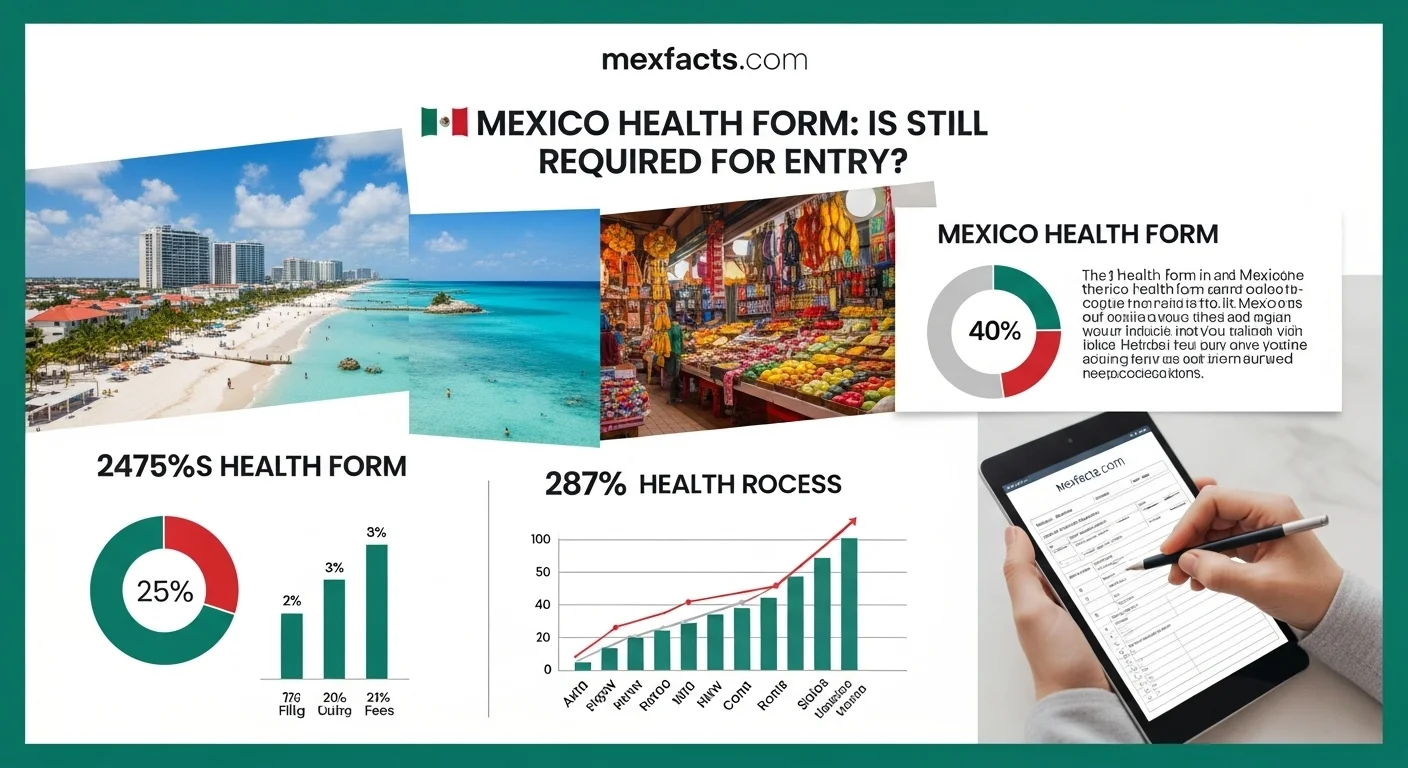
What the Numbers Say: Mexico's Tourism After the Health Form
While the Health Form for entering Mexico is now just a memory, looking at the data from that time tells a fascinating story of resilience. We can't track 'current' stats for a form that was eliminated on January 1, 2022, but we can see the incredible boom that followed its removal. This tells you everything you need to know about Mexico's strength as a top travel destination.
The 'Vuela Seguro' Era in Numbers
Think about this: during its run from mid-2020 to the end of 2021, millions upon millions of travelers filled out the Mexico arrival health form. In 2021 alone, Mexico welcomed nearly 32 million international visitors. Every single person who arrived by plane had to generate that little QR code. We're talking about a massive data collection effort happening every day at every airport, from the mega-terminals in Mexico City and Cancún to smaller hubs. The goal was to track health risks, but in reality, the main effect was often long lines and congestion, a fact that airport authorities themselves pointed out as a reason for its removal.
The Incredible Tourism Boom After the Form
The moment the form was discontinued, it felt like the floodgates opened. The correlation is undeniable; removing that last administrative hurdle helped fuel a recovery that has been nothing short of spectacular. Let's talk numbers. In 2019, before the world changed, we had 45 million international visitors. By 2024, we officially surpassed that pre-pandemic peak. It wasn't just about the number of people; the money they spent here reached a record-breaking $32.96 billion in 2024. This isn't just a statistic; it's the lifeblood of our economy. Tourism is a huge part of our national GDP, and this powerful recovery shows the world that Mexico's appeal is stronger than ever.
Who is Visiting and How?
The data shows our friends from the north lead the way. The United States is by far our biggest market, making up about 60% of all international visitors, with Canada coming in second. It's a familiar and welcome sight to see so many Americans and Canadians enjoying our beaches, ruins, and cities. Air travel is king, accounting for nearly 90% of all tourism income. This is why getting rid of the health form for entering Mexico was so impactful—it directly improved the experience for the vast majority of our visitors. Destinations like the Mexican Caribbean have seen unbelievable growth. Even back in 2021, the region's economy was rebounding at a staggering rate, a trend that has only accelerated since.
Today's Simple and Easy Entry Process
So, what is it like to enter Mexico now? It's back to basics, wonderfully simple. You need your valid passport. Depending on your nationality, you might need a visa, but for most tourists (including from the US, Canada, UK, and EU), you don't. Upon arrival, you'll receive a Forma Migratoria Múltiple (FMM), or tourist card, which you just need to keep safe and show when you leave. There are absolutely no COVID-19 testing, vaccination proof, or quarantine requirements. The national public health emergency was officially declared over in May 2023. Of course, I always tell my friends and family visiting from abroad: get good travel insurance. It’s just common sense for any international trip. The data tells a clear story: Mexico navigated the pandemic with a unique strategy that paid off. We are not just recovered; we are thriving. For anyone planning a trip, the message is simple: come on down, the process is easy, and a world of incredible experiences awaits you.
The Future After the Health Form: What's Next for Travel in Mexico?
The end of the Mexico Health Form was more than just removing a rule; it marked a shift towards the future. We're now focused on smarter travel, sustainable growth, and using the lessons we learned to build an even better experience for visitors. The 'Vuela Seguro' form is gone, but the conversation it started about technology and resilience is shaping incredible opportunities for tourism, business, and anyone looking to invest in Mexico's vibrant future.
Smarter Borders and Future Preparedness
The pandemic forced the world to experiment with digital health passes, and Mexico was part of that. While our first attempt, the Mexico entry health form, had its flaws, it taught us valuable lessons. Now, the goal is to be ready for any future crisis with systems that are actually smart and user-friendly. Imagine a future where health verification, if ever needed again, is seamlessly integrated into a digital travel pass—no more crashing websites or last-minute panic. This is a huge opportunity for tech companies that specialize in secure digital identity. Having seen the chaos the old form caused, I know Mexico's government would be very interested in solutions that prioritize efficiency. The idea is to build 'smart border' capabilities that make any future health form for entering Mexico a smooth, secure part of the journey, not a roadblock.
The Rise of Wellness and Health Tourism
One of the most positive shifts since the pandemic is how much people value their well-being. This has created a boom in wellness travel, and Mexico is perfectly positioned to lead this movement. We offer so much more than just beautiful beaches. I've had profound experiences in traditional temazcal ceremonies, which are ancient sweat lodges used for purification, and have seen friends find peace at yoga retreats in places like Tulum or Sayulita. The focus has changed from worrying about a health form to actively seeking destinations that promote health. This is a golden opportunity to invest in wellness resorts, train our amazing hospitality staff in new skills, and market Mexico as the world's premier destination for rejuvenating the body, mind, and spirit. Our easy entry process is now a major competitive advantage for attracting wellness seekers.
Growing a Stronger, More Diverse Tourism and Business Scene
With tourism numbers breaking records, the foundation is strong. Now, our challenge is to make this growth sustainable and spread the benefits across the country. It's about encouraging visitors to discover the charm of our 'Pueblos Mágicos' (Magical Towns), to explore the incredible ecotourism in states like Chiapas and Oaxaca, and to experience the depth of our culture at our 35 UNESCO World Heritage sites. This boom also creates amazing opportunities for international businesses. There's a huge demand for hospitality tech, modern transportation, and green energy solutions for our resorts. Furthermore, the removal of the Mexico arrival health form sent a powerful message: Mexico is open for business. This matters for more than just tourism. With the 'nearshoring' trend, where companies are moving manufacturing closer to the US, Mexico is becoming a global logistics powerhouse. A hassle-free travel environment for executives and investors is a small but vital part of what makes our country so attractive for these massive investments. For anyone wanting deep dives into this, resources like Mexico Business News offer fantastic insights.
Conclusion: A Future Built on Welcome and Innovation
The story of the Mexico Health Form is one of resilience. It was a tool for a crisis, and we made the right call to leave it behind. Today, Mexico’s future is incredibly bright. We've proven our ability to adapt and have emerged as an even more appealing destination. The real opportunities now lie in using technology to make travel even safer and more seamless, cultivating our growing wellness scene, and building a sustainable business climate. The future isn't about bringing back old forms; it's about innovating to ensure every visit to Mexico is safe, easy, and unforgettable. Our doors are wide open, and our spirit of welcome is stronger than ever.
Expert Reviews
Sarah K., Frequent Traveler ⭐⭐⭐⭐⭐
What a relief to read this! I traveled to Cancún back in 2021 and the Vuela Seguro form was such a nightmare. The website crashed on me three times. This article clearly explains why it's gone and made me feel so much more relaxed about booking my upcoming trip to Oaxaca. Thank you for the straightforward info!
Brian T., First-Time Visitor ⭐⭐⭐⭐⭐
My family and I are planning our first ever trip to Mexico, and we were getting confused by some outdated travel blogs mentioning a health form. This article was a lifesaver. It answered our question directly and gave us confidence that the entry process will be smooth. Feeling very excited for our visit to the Riviera Maya now!
Jacobo Torres, Business Consultant ⭐⭐⭐⭐
Excellent and concise summary. I needed to confirm the current entry protocols for a client traveling to Monterrey for business. This article provided a clear 'yes' or 'no' answer and then gave valuable context on the economic and tourism recovery. Very professional and helpful.